This page focuses on the optional use of topical products marketed as exosomes or extracellular-vesicle support immediately around microneedling procedures. It does not treat injected exosome therapy, topical cosmetics, human-cell-derived biologic products, and plant-derived extracellular-vesicle-like products as interchangeable categories. That distinction matters clinically and regulatorily.
Fountain of Youth SWFL currently offers SkinPen microneedling with an exosome enhancement as one option on its Fort Myers treatment menu. The purpose of this article is to explain what human studies actually show, what remains uncertain, and what patients should ask before choosing the adjunct.
What Changed in the Evidence by 2026?
A 2026 systematic review specifically examining microneedling combined with exosome-based therapies identified eight studies suitable for its final narrative synthesis. Study sizes ranged from only three to 60 participants, and the authors concluded that more evidence is needed before the long-term efficacy and safety profile can be established.
A separate 2026 systematic review of human skin-rejuvenation studies found encouraging short-term signals involving hydration, elasticity, wrinkles, pores, pigmentation, and overall appearance. Most included studies were not randomized, methods varied substantially, and long-term follow-up remained limited. That is a stronger evidence base than existed when this page was first published, but it still does not support guaranteed results or one standardized protocol.
Microneedling remains the core procedure
Microneedling creates controlled micro-injuries that trigger a wound-healing response and collagen remodeling. Exosome-based topicals are being studied as adjuncts, not replacements for the device procedure. The available literature does not establish that every product marketed as an exosome adds a clinically meaningful benefit to every microneedling session.
The word “exosome” does not identify one standardized product
Research products have been derived from human adipose stem cells, other mesenchymal-cell sources, platelets, plants, and other systems. Some commercial products are better described as extracellular-vesicle or exosome-like formulations. Their cargo, particle characterization, manufacturing, stability, and biological activity can differ substantially. Evidence from one product cannot automatically be transferred to another.
How Exosome-Based Adjuncts May Work
Extracellular vesicles and signaling
Exosomes are nanosized extracellular vesicles released by cells. They can carry proteins, lipids, RNA, and other signaling molecules. Laboratory and clinical research suggests that certain extracellular-vesicle preparations may influence inflammatory signaling, keratinocyte behavior, extracellular-matrix activity, and wound-healing pathways. A plausible mechanism, however, is not the same as proof that a particular commercial topical will improve a patient’s result.
The post-microneedling delivery window
Microneedling temporarily disrupts the skin barrier and can increase penetration of topically applied material. Several studies apply exosome-based products immediately after needling or energy-based resurfacing, which is one reason this timing is common in research protocols. No consensus establishes a single ideal application window, concentration, volume, or formulation.
Human-derived and non-human products should not be collapsed into one category
Human-cell-derived exosome products raise distinct biologic-product and regulatory questions. Plant-derived or other non-human extracellular-vesicle-like products are chemically and biologically different and should not be assumed equivalent to the human-derived products studied in many published trials. Non-human origin by itself does not prove that a product is FDA-approved, legally marketed for a specific claim, or clinically effective.
Evidence Snapshot: What the Human Studies Actually Show
| Study |
Design |
Signal |
What It Cannot Prove |
| 2025 acne study |
22-patient case series using needle RF plus topical exosome product |
Mean IGA acne score decreased by 2.5 points with high patient satisfaction |
There was no control arm, so the exosome contribution cannot be separated from RF treatment |
| 2025 pore/texture study |
Three-patient microneedling case series |
Blinded evaluators reported visible pore and texture improvement |
Three patients cannot establish predictable effectiveness or a standard treatment schedule |
| 2025 long-follow-up report |
Single patient receiving superficial microneedling plus topical exosome product |
Reported improvements in pores, erythema, and pigmentation persisted through 21 months |
A single case cannot establish durability, maintenance intervals, or expected outcomes for other patients |
| 2020 randomized split-face study |
25 patients; fractional CO2 laser plus human adipose-derived exosome gel versus control gel |
Acne-scar scores improved 32.5% on the exosome-treated side versus 19.9% on control |
This was fractional CO2 laser, not RF microneedling, and it used a human-derived research product |
Acne activity and IGA changes
The 2025 needle-RF study involved 22 patients with moderate to severe acne who received a combined treatment. All participants improved, with a mean 2.5-point decrease in Investigator’s Global Assessment score. The study had no RF-only or exosome-only control group, so it cannot tell us how much of the improvement came from the topical adjunct.
Pores and texture
A 2025 case series followed three patients who received microneedling with topical exosome application. The outcomes were encouraging, but the sample was extremely small and there was no control arm.
Long-term case data
A separate 2025 report followed one woman after two superficial microneedling sessions with a topical exosome product. Imaging documented reductions in pore size, erythema, and melanin measures, with much of the change persisting at 21 months. That is interesting durability data for one patient, not evidence for a six- or twelve-month maintenance schedule.
The 32.5% versus 19.9% acne-scar result needs the right context
The often-cited randomized split-face study involved 25 patients receiving fractional CO2 laser, followed by human adipose-tissue stem-cell-derived exosome gel on one side and control gel on the other. The exosome-treated side showed a greater reduction in acne-scar scores. This study was conducted by researchers affiliated with institutions in Korea and Guam; it was not an RF microneedling trial and should not be described as a Johns Hopkins-run study.
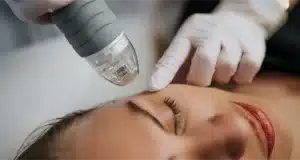
Exosome-Boosted RF Microneedling: Evidence and Safety
Protocols Are Not Yet Standardized
Timing after microneedling
Many published protocols apply the study product immediately after needling or resurfacing. That does not establish that every commercial formulation should be refrigerated, frozen, reconstituted, or applied within the same number of minutes. Product-specific handling instructions should control preparation and storage.
Number of sessions and spacing
Published protocols vary widely. Some studies use two or three sessions, while the uncontrolled acne case series used six to ten combined treatments. Those study schedules should not be converted into a universal exosome protocol. Fountain of Youth’s current microneedling program commonly plans a series of three treatments about one month apart, with the exact option selected according to skin goals and provider review.
Expected timelines
Texture, redness, pore appearance, and scar measurements can change gradually over weeks or months after microneedling. The evidence does not support promising that an exosome adjunct will shorten every recovery period, produce a specific percentage improvement, or eliminate the need for additional treatments.
Safety, Sourcing, and U.S. Regulation
FDA has not approved an exosome product
FDA continues to state that there are no FDA-approved exosome products. Its public safety notification followed serious adverse events involving unapproved products marketed as containing exosomes, and FDA warning letters continued to address exosome products in 2025 and 2026.
That statement should not be converted into the opposite claim that every topical product using the word “exosome” is automatically an illegal biologic. U.S. classification depends on the product itself, its intended use, composition, route, and claims. FDA explains that a topical marketed only to beautify or alter appearance may fall within cosmetic regulation, while claims to treat disease or affect the structure or function of skin can cause a product to be regulated as a drug.
“Non-human” does not mean “FDA-approved”
A plant-derived or other non-human extracellular-vesicle-like product may avoid some issues specific to human-cell-derived biologics, but origin alone does not establish regulatory compliance, sterility, efficacy, or safety. Patients should ask for the exact product name, manufacturer, intended-use labeling, ingredient or source description, and the provider’s explanation of why that product is appropriate for topical use.
MISEV is a scientific framework, not a regulatory certificate
The International Society for Extracellular Vesicles publishes MISEV recommendations for characterizing extracellular vesicles in research. Marker analysis, particle sizing, contamination controls, and other characterization can improve scientific quality, but “MISEV-aligned” does not mean FDA-approved, FDA-cleared, or legally compliant for a particular clinical claim.
Product-quality questions still matter
Depending on the formulation, useful questions can include lot number, expiration date, storage requirements, manufacturer documentation, contamination controls, and whether the product is intended for topical cosmetic use or another regulated purpose. A certificate of analysis can provide useful batch information, but it is not proof of clinical effectiveness.
What a Microneedling Visit at Fountain of Youth Looks Like
At Fountain of Youth SWFL in Fort Myers, microneedling is performed by a licensed nurse aesthetician. The visit begins with medical history and consent review, followed by skin preparation and topical numbing. The team reviews whether standard SkinPen, platelet-derived growth factor, exosome enhancement, ProGen, or plated serum best matches the patient’s goals.
Most microneedling visits take about 45 to 60 minutes. Temporary redness, warmth, and sensitivity can last roughly 24 to 72 hours, and patients receive aftercare instructions before leaving. Exosomes are an optional enhancement rather than a mandatory part of the procedure.
Current published price: SkinPen with exosomes is listed at $850 per session or $2,400 for a package of three. Pricing and package availability should be confirmed when scheduling.
Fountain of Youth currently states that it does not use human-derived exosome products. Because formulations and suppliers can change, patients can ask the team for the current product identity, source, intended-use information, and handling details during consultation.
Patient Selection and Expectations
Active acne needs its own assessment
The 22-patient case series studied moderate to severe acne, but that does not make every active-acne patient an automatic candidate for microneedling. Fountain of Youth’s current service guidance asks patients with active acne to check with the provider before scheduling. Nodules, cysts, infection, barrier disruption, recent isotretinoin use, or other medical factors may change the plan.
Skin type and pigmentation risk
Higher Fitzpatrick skin types can have a greater risk of post-inflammatory hyperpigmentation after inflammatory procedures. Device settings, sun exposure, recent treatments, barrier condition, and aftercare matter. The exosome adjunct should not be presented as a guarantee against PIH.
When another treatment may make more sense
Persistent acne, melasma, vascular redness, deep scars, volume loss, or active inflammatory skin disease may require treatments other than—or in addition to—microneedling. A useful consultation defines the main problem before selecting an enhancement.
Cost and Value: What Is the Adjunct Actually Adding?
RF or SkinPen microneedling provides the core controlled-injury treatment. The exosome option adds cost and should therefore be discussed in terms of incremental evidence, not marketing language. Patients can reasonably ask what result the provider expects the adjunct to improve, what evidence supports that specific product, whether standard microneedling would still be appropriate, and how the added cost changes the overall plan.
Practical Questions to Ask Before Treatment
- What exact product is being used? Ask for the product name, manufacturer, source, and how the clinic describes its intended use.
- Is the evidence product-specific? A study using a human adipose-derived research product cannot automatically validate a plant-derived or other commercial formulation.
- What does the adjunct add over microneedling alone? Ask for a realistic explanation rather than a guaranteed percentage improvement.
- How is the product stored and tracked? Product-specific handling, lot, and expiration information should be available when relevant.
- What happens if I skip the adjunct? Standard microneedling remains a separate treatment option and may be sufficient for some goals.
Frequently Asked Questions
Are exosome products FDA-approved?
FDA states that there are currently no FDA-approved exosome products. A topical cosmetic or extracellular-vesicle-like product may fall under a different regulatory framework depending on its composition, intended use, and claims, but it should not be described as “FDA-approved exosomes” unless there is an actual FDA approval for that specific product.
Do exosomes improve acne after RF microneedling?
A 22-patient case series reported meaningful acne improvement after combined needle RF and topical exosome treatment. The absence of a control group means the study cannot determine how much improvement came from RF, the topical product, natural change, or the combination.
Do exosomes reduce downtime?
Some small studies and the 2020 fractional-laser split-face trial reported less erythema or shorter downtime on the exosome-treated side. The evidence is not strong enough to promise faster recovery for every microneedling patient or every commercial formulation.
Does Fountain of Youth use human-derived exosome products?
Fountain of Youth SWFL currently states that it does not use human-derived exosome products. Patients can ask for the current product identity and sourcing information because formulations and suppliers can change over time.
How many sessions are needed?
There is no validated universal exosome-enhanced microneedling schedule. Published studies use different devices, products, intervals, and treatment counts. Fountain of Youth commonly plans microneedling as a three-treatment series about one month apart, then adjusts according to skin goals, response, and provider guidance.
How This Fits Into Fountain of Youth’s Microneedling Service
The clinic’s current microneedling menu includes standard SkinPen, SkinPen with platelet-derived growth factor, SkinPen with exosomes, ProGen microneedling, and microneedling with plated INTENSE Serum. A consultation should compare those options rather than assume the most expensive enhancement is automatically the best choice.
Patients complete history and consent forms, receive topical numbing, undergo the selected microneedling treatment, and leave with aftercare guidance. Fountain of Youth is located at 13720 Cypress Terrace Circle, Suite 303, Fort Myers, with free parking and ground-floor access. Call 239-355-3294 to review the current treatment menu and pricing.
Key Evidence and Regulatory Sources
Questions? We’re here to help. Call us at 239-355-3294 to schedule a consultation or ask about microneedling enhancement options.
Medical review: Reviewed by Dr. Keith Lafferty MD, Fort Myers on October 14, 2025. Fact-checked against government and academic sources; see in-text citations. This page follows our Medical Review & Sourcing Policy.
