Where Newer Protocols Fit (and Where They Don’t) in 2025–2026
Rosacea affects skin in ways that are visible, uncomfortable, and unpredictable. Redness can linger long after a trigger fades. Flushing may arrive without warning. Burning or stinging can make even gentle skincare feel irritating. Because of this complexity, procedures that rely on heat or injury demand extra caution. RF microneedling has entered rosacea conversations more frequently in recent years, yet confusion remains about what it can realistically help, when it should be avoided, and how newer protocols attempt to reduce risk. Current evidence from 2024–2026 offers clearer boundaries than marketing language ever has.
Understanding rosacea-prone skin before considering procedures
Rosacea is not a single condition with a single solution. Background redness behaves differently from visible vessels, and inflammatory bumps follow a different biology than flushing or stinging. Skin barrier weakness often overlaps with all of these features, which explains why treatments that look promising on paper sometimes worsen symptoms in practice.
Many patients considering RF microneedling arrive after trying topical medications, trigger avoidance, or light-based treatments with mixed results. Some describe redness that never fully clears, even on calm days. Others tolerate medications well but still feel constant warmth or sensitivity. These distinctions matter, because RF microneedling does not act uniformly across rosacea features. Evidence consistently shows that outcomes depend more on which rosacea manifestations dominate than on the device brand itself.
What RF microneedling actually does
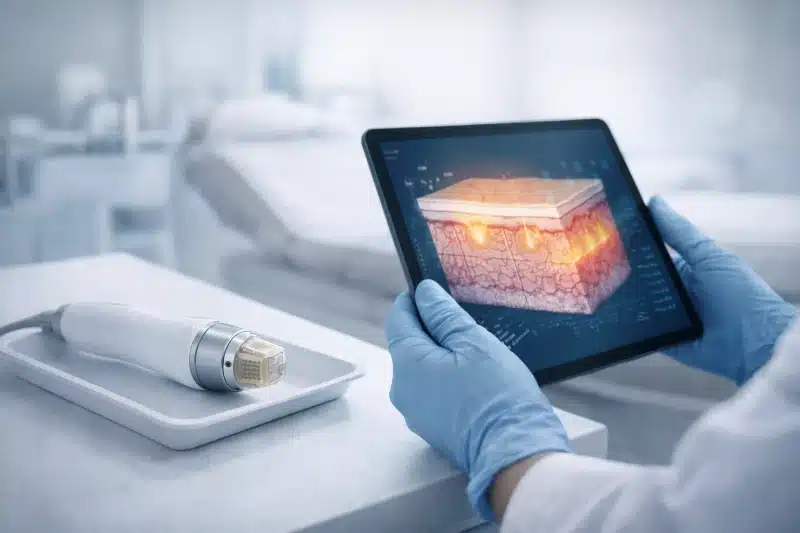
RF microneedling combines two controlled injuries. Very fine needles create micro-channels in the skin, while radiofrequency energy delivers heat at a specific depth. In theory, this heat can trigger collagen remodeling and alter superficial vascular behavior. Standard microneedling relies only on mechanical stimulation, while RF microneedling adds thermal energy that penetrates below the epidermis.
From a rosacea perspective, the heat component is both the potential benefit and the primary concern. Heat can sometimes calm diffuse redness over time, yet heat is also a known rosacea trigger. That tension explains why protocols for rosacea differ from those used for acne scars or skin tightening. The FDA’s consumer overview of microneedling devices underscores that these are medical devices used for specific indications and require attention to safety risks when skin is penetrated and deeper tissue is affected.
Where RF microneedling appears to fit in rosacea care
Current clinical evidence suggests RF microneedling may help a subset of rosacea patients, particularly those with persistent background redness, frequent flushing, and sensory symptoms such as burning or stinging. A prospective observational study of non-insulated fractional microneedle RF in difficult-to-treat rosacea reported improvements in flushing severity, fixed erythema, and patient-reported quality of life after a series of treatments. Pain scores were low, topical anesthetic was not required, and short-term side effects were generally mild and transient when conservative endpoints were used.
These findings matter because they align with what many patients seek: not flawless skin, but less redness, fewer flares, and improved daily comfort. Improvement was assessed over time rather than immediately after treatment, reinforcing that RF microneedling in rosacea is a gradual strategy rather than a rapid fix. Evidence for fractional RF approaches in rosacea also appears in the biomedical literature indexed by the National Library of Medicine, including a clinical study available via PubMed’s record on fractional microneedling radiofrequency in rosacea, which can support carefully worded statements about measured erythema-related outcomes in select patients.
RF-based energy, even when not delivered through microneedles, has also been studied in erythematotelangiectatic rosacea. A recent comparative study evaluating pulsed dye laser, intense pulsed light, and RF therapy found that RF could reduce clinician-rated erythema and improve quality-of-life scores over short follow-up periods. Authors described RF as relatively comfortable and associated with minimal downtime, though they emphasized that vascular lasers remain more precise for visible vessels.
Where RF microneedling does not reliably help
Evidence is consistent on one limitation: RF microneedling does not reliably eliminate visible telangiectasia. In the rosacea-specific microneedle RF study, telangiectases did not show significant change, even when background redness and symptoms improved. Patients whose primary concern is broken capillaries often feel disappointed if expectations are not clarified in advance.
Active inflammatory rosacea also falls outside RF microneedling’s comfort zone. Papules and pustules represent ongoing inflammation, and introducing heat and injury during an active flare can worsen redness or prolong recovery. Studies and reviews stress stabilization first, using medical management and barrier repair, before any procedural intervention is considered.
Another mismatch occurs when patients expect dramatic, rapid clearing of redness. RF microneedling outcomes tend to be incremental. Improvements may be subtle session to session, becoming meaningful only after cumulative remodeling. Anyone seeking a single-session transformation is likely to be dissatisfied.
Not all procedural options for rosacea have the same strengths or limitations. The table below compares common approaches by the rosacea features they tend to address, highlighting where RF microneedling commonly fits and where other modalities often have stronger evidence.
| Approach |
Rosacea feature it most directly targets |
What people often hope it will do |
What the evidence most reliably supports |
Common limitation to understand before choosing |
| RF microneedling (conservative rosacea protocols) |
Diffuse background redness, flushing, burning/stinging in select patients |
Calmer skin tone and fewer flare sensations |
Gradual improvement in erythema-related measures and symptoms in selected cohorts reported in clinical studies |
Visible telangiectasia may persist even when redness and discomfort improve |
| Vascular laser and light-based therapy |
Visible vessels and persistent redness patterns |
Clearer broken capillaries and more even-looking tone |
Stronger published support for telangiectasia-focused improvement compared with newer RF strategies |
The approach targets vascular features more than inflammatory bumps |
| “Stabilize-first” medical management |
Inflammation control and flare reduction |
Fewer papules/pustules and less reactive skin |
Foundational step emphasized in clinical reviews before escalating to devices in reactive patients |
Ongoing management often matters even when procedures are added later |
| Combination planning (phenotype-guided) |
Mixed patterns, such as diffuse redness plus visible vessels |
A plan that addresses more than one problem without worsening sensitivity |
Modern reviews emphasize matching tools to features rather than expecting one device to solve everything |
Progress may look uneven if one feature responds faster than another |
| Procedures during an active flare |
Active inflammation and unstable redness |
Fast improvement despite ongoing flare activity |
Clinical discussions generally caution against heat and irritation during unstable phases |
Higher likelihood of prolonged redness and poor tolerance |
How newer protocols try to reduce risk
The most important shift in 2025–2026 is not a new device, but a new philosophy. Rosacea protocols increasingly focus on conservative endpoints rather than aggressive visual change. Treatment is stopped at mild erythema or subtle swelling, rather than pushing toward intense redness or pinpoint bleeding. Energy levels are adjusted to tolerance, and sessions are spaced further apart, often two months or longer.
Published rosacea protocols describe full-face treatment over the “red zone” rather than targeting isolated points. Needle depth, pulse duration, and overlap are selected to distribute energy evenly and avoid hotspots. These choices reflect a recognition that uneven heat delivery can provoke flares in reactive skin.
Combination thinking also shapes newer protocols. RF microneedling is positioned as an adjunct after baseline rosacea control, not a replacement for medical therapy or vascular-targeted devices. Reviews that discuss the procedural landscape for rosacea, including an evidence-focused overview available through PubMed Central’s rosacea management review, can support careful comparisons about where vascular lasers and IPL have stronger evidence and where newer approaches remain emerging.
Safety realities that matter in 2025–2026
In October 2025, the U.S. Food and Drug Administration issued a safety communication warning that radiofrequency microneedling devices may cause serious injuries when misused. Reported risks included burns, scarring, pigment changes, infection, nerve damage, and unintended fat loss. The seriousness of these potential harms is described in the FDA safety communication on RF microneedling, which reinforces that heat-based microneedling requires qualified use and clear risk counseling.
For rosacea-prone skin, these warnings carry extra weight. Risk factors include frequent flushing, impaired barrier function, history of pigment changes after inflammation, and very thin facial skin. Conservative protocols reduce risk but do not eliminate it. Patients benefit from understanding that “low downtime” does not mean “no risk,” especially with heat-based devices.
Preparing rosacea-prone skin for a better outcome
Preparation often determines whether RF microneedling helps or harms. Simplifying skincare in the weeks before treatment supports barrier recovery and reduces background irritation. Many patients discover that their daily routine contributes more to baseline redness than they realized, especially when multiple actives are layered.
Trigger planning also matters. Heat exposure, alcohol, spicy foods, intense exercise, and emotional stress can all amplify post-procedure redness. Managing these factors around treatment windows often makes the difference between a smooth recovery and a prolonged flare. Timing sessions away from high-sun periods and major social events further reduces frustration.
During treatment, patients should feel empowered to speak up if sensations become uncomfortably hot. Pain tolerance should never be the guiding metric. After treatment, redness and swelling should gradually settle over days, not intensify. Persistent tenderness, worsening discoloration, or delayed swelling warrant prompt evaluation.
Measuring success without misleading yourself
Rosacea symptoms fluctuate, which makes progress hard to judge without structure. Photos taken under consistent lighting and conditions help distinguish real change from day-to-day variation. Comparing a calm day to a flare day can falsely suggest failure or success.
Symptom tracking often proves more meaningful than photographs alone. Fewer flushing episodes, reduced burning, and improved tolerance of skincare or makeup represent tangible quality-of-life gains. If each session leads to longer recovery or stronger flares, reassessment is appropriate rather than pushing forward.
3 Practical Tips
- Choose stability over speed. Heat-based procedures reward patience, and rushing sessions increases flare risk.
- Reduce variables instead of adding soothing products. A minimal routine you already tolerate often outperforms complex post-procedure regimens.
- Ask for clarity about goals. Understanding whether redness, symptoms, or texture is being targeted prevents disappointment later.
FAQ
Can RF microneedling make rosacea worse?
Yes, it can, particularly when performed during active flares or with aggressive settings. Heat is a known rosacea trigger, and excessive energy can prolong redness or provoke inflammation. Conservative protocols and careful patient selection reduce risk but do not eliminate it.
Does RF microneedling remove broken capillaries?
Current evidence does not support reliable removal of visible telangiectasia with RF microneedling alone. Studies show improvement in diffuse redness and symptoms without significant vessel clearance. Patients focused on broken capillaries usually require different vascular-targeted approaches.
How many sessions are typically used for rosacea-prone skin?
Published rosacea protocols often use a small series rather than a single treatment, with sessions spaced widely apart. The exact number depends on response and tolerance, and plans are frequently adjusted after the first session based on recovery and symptom change.
What should I do if redness lasts longer than expected after treatment?
Persistent or worsening redness should prompt contact with the treating clinician rather than waiting it out. Early assessment helps rule out heat injury, infection, or inflammatory flare and allows timely intervention if needed.
Clinical teams at Fountain of Youth in Fort Myers stay current with evolving evidence and safety guidance related to advanced skin procedures, including those involving radiofrequency technologies.
Questions? We are here to help! Call 239-355-3294.
Medical review: Reviewed by Dr. Keith Lafferty MD, Medical Director at Fountain of Youth SWFL on February 5, 2026. Fact-checked against government and academic sources; see in-text citations. This page follows our Medical Review & Sourcing Policy and undergoes updates at least every six months. Last updated February 5, 2026.