
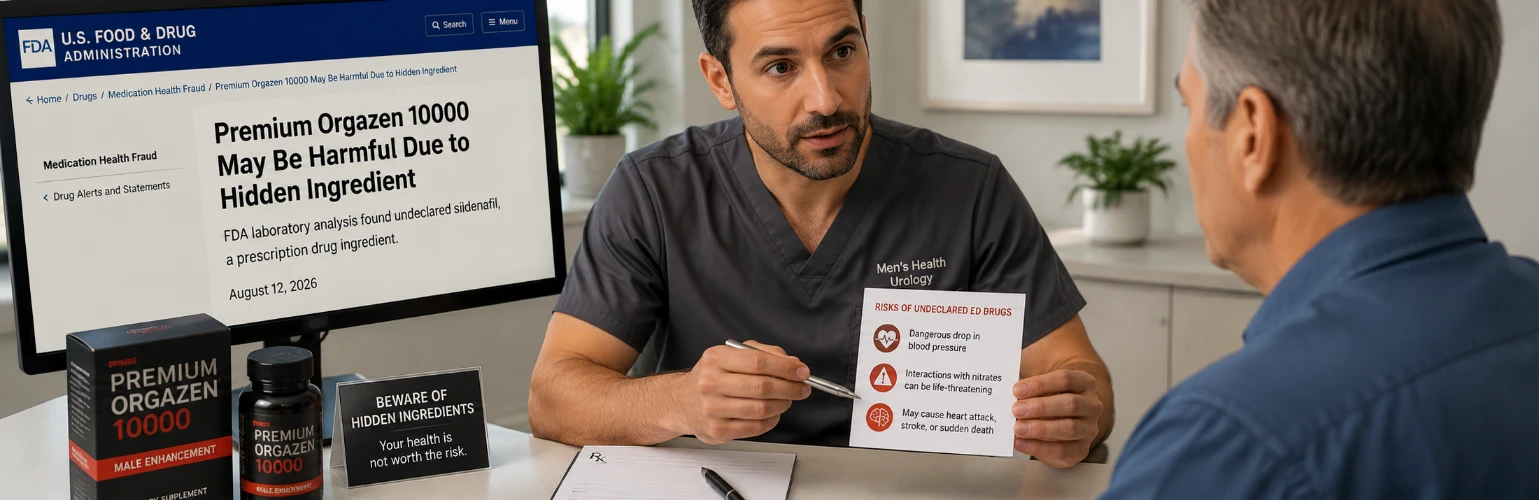
A sexual-enhancement product can look like a supplement, chocolate, honey, capsule, or other over-the-counter item and still contain a prescription drug that is missing from the label. Men in Fort Myers may see these products online, in convenience-oriented retail settings, or through social media and assume that “natural” means gentler or safer. Recent FDA testing shows why that assumption can be risky. The concern is not only whether a product works, but also whether a person knows what he is actually taking.
For men in Lee County dealing with erectile dysfunction, that distinction matters because legitimate ED medicines can be appropriate for many patients when they are prescribed with a review of medical history and current medications. An undeclared drug bypasses that review. It also makes it harder to know the dose, anticipate interactions, or explain a reaction to a clinician. The safer question is not whether a package looks natural, discreet, or easy to buy. It is whether the active ingredients are known and medically appropriate for you.
Three Questions Matter More Than a “Natural” Label
- Do you know exactly which active ingredients and doses the product contains?
- Could an undeclared ED drug interact with nitrates, heart medicines, or other prescriptions?
- Has the underlying reason for a persistent change in erections been medically reviewed?
Replace Ingredient Guesswork With a Known Treatment Plan
If erectile problems are persistent or you have been relying on unverified sexual-enhancement products, an erectile dysfunction evaluation can address medication safety, relevant health history, and appropriate treatment options before another product is used.
Physician-reviewed content • Evidence-aware care • Personalized treatment planning
Understand the Prescription Options Behind the Headlines
Known prescription ingredients allow clinicians to review contraindications and dosing rather than work around an undisclosed substance. Learn more about medically supervised sildenafil treatment and tadalafil treatment.
What FDA Found in 2026
On August 12, 2026, FDA warned consumers not to purchase or use Premium OrgaZEN 10000 after FDA laboratory analysis found sildenafil that was not listed on the product label. Sildenafil is an active ingredient used in an FDA-approved prescription medicine for erectile dysfunction. FDA specifically warned that the hidden ingredient may interact with nitrates, including nitroglycerin, and lower blood pressure to dangerous levels.
The August alert was not an isolated example. On February 11, 2026, FDA warned about ilum Male Sexual Enhancement Chocolate after testing found undeclared tadalafil, another prescription ingredient used for erectile dysfunction. FDA’s current sexual-enhancement notification list also includes numerous other 2026 products in forms such as honey, chocolate, liquids, and capsules. Some were found with sildenafil, tadalafil, or more than one undeclared ingredient. FDA also cautions that its list covers only a fraction of potentially contaminated products on the market, so absence from a warning list does not establish that a product is safe.
Why “Natural” Does Not Remove Prescription-Drug Risk
Words such as “natural,” “herbal,” or “supplement” describe marketing or product positioning; they do not tell you whether independent testing has found a hidden prescription ingredient. FDA says products promoted for sexual enhancement are sometimes represented as all natural even when laboratory testing later identifies undeclared drugs. That creates a basic safety problem: a person may take a pharmacologically active ingredient without knowing it is present. A label cannot guide safe use when the label is incomplete.
Imagine a man who avoids prescription ED medication because he takes heart medicine and believes a “natural” honey packet is a separate category. He uses the packet before sex without mentioning it to his clinician. If the product secretly contains sildenafil or tadalafil, he may have taken the same type of drug he was trying to avoid, but without a confirmed dose or interaction review. A friend’s good experience would not rule out that risk. Familiar packaging would not rule it out either. FDA warnings have involved products sold both online and in retail stores.
This is also why reviews, packaging, and claims of quick results are poor substitutes for knowing the actual ingredients. A product can look polished and still create uncertainty about what entered your body. That uncertainty matters more when you use prescription medicines, have cardiovascular disease, or have conditions that already affect blood pressure. The practical goal is to remove guesswork before treatment, not after a problem occurs.
Why Hidden ED Ingredients Can Be Dangerous With Nitrates
Sildenafil and tadalafil belong to a class of medicines that can lower blood pressure. Nitrates, which include medicines such as nitroglycerin used for chest pain, also lower blood pressure. Taking the two together can cause a dangerous drop in blood pressure, which is why medication review is a central safety step before ED treatment. A hidden ingredient defeats that safeguard because neither the patient nor the clinician may know that an ED drug has been taken. The risk is especially relevant for someone who keeps nitroglycerin for angina or uses another nitrate-containing prescription.
This does not mean FDA-approved ED medicines are inherently unsafe. It means they need to be used in the right patient with attention to contraindications, current prescriptions, and health history. MedlinePlus instructs patients taking sildenafil to tell their doctor or pharmacist about nitrates and other prescription and nonprescription medicines. That is possible with a known prescription, but much harder with an undeclared drug in a product marketed as something else.
ED itself also deserves context rather than a one-size-fits-all pill. Blood vessel disease, high blood pressure, diabetes, hormone problems, nerve disorders, certain medicines, and emotional factors can contribute to erectile problems. A clinician may ask about sexual symptoms, medications, supplements, medical conditions, and emotional health before deciding what evaluation makes sense. That conversation provides information a product label cannot. It helps separate medication safety from the underlying reason erections have changed. In some men, erectile dysfunction can be a cardiovascular risk marker.
ED Can Be a Reason to Review More Than Sexual Symptoms
When erection changes occur alongside cardiovascular risk factors, medication use, metabolic concerns, or other men’s health issues, a broader men’s health evaluation can help determine which factors deserve attention before treatment is selected.
What to Do if You Have Already Used a Questionable Product
Stop using a product that FDA has specifically warned consumers not to purchase or use. Keep the package, wrapper, receipt, or a clear photo of the label if you still have it, because those details can help identify what you took. Write down when you used it, how much you used, and any symptoms that followed. Tell your clinician about prescription drugs, over-the-counter medicines, vitamins, and supplements you take rather than trying to decide on your own which ones matter.
Seek prompt medical attention for serious symptoms such as chest pain, fainting, severe dizziness, sudden vision loss, sudden hearing changes, significant shortness of breath, or a painful erection or one lasting longer than four hours. These symptoms can require urgent evaluation. If emergency care is needed, tell the treating team that you used a sexual-enhancement product and when you took it.
A person who feels fine after using a questionable product may still benefit from a medication review before taking it again or switching ED options. Feeling no immediate side effect does not reveal the hidden dose or prove that the product fits safely with your prescriptions. Bring the product name or photo when possible. Mention nitrate use directly, including nitroglycerin or medicines for chest pain. A complete list helps the clinician decide whether a prescription ED medicine is reasonable and whether the erectile problem warrants more evaluation.
What to Bring Up at an ED Visit
Taking a few details with you can make a medication-safety conversation more useful. The goal is to show what you used, what else you take, and what happened afterward.
| Information to share | Why it helps |
|---|---|
| Product name, package, or photo | Helps identify the exact item and compare it with current safety notices. |
| When and how much you took | Gives the clinician a clearer timeline for symptoms and medication exposure. |
| All prescription medicines | Allows a review for important interactions, including nitrate use. |
| Over-the-counter products and supplements | Creates a more complete medication list instead of focusing only on prescriptions. |
| Symptoms after taking the product | Helps connect timing with effects such as dizziness, chest symptoms, or other changes. |
| Your usual erection concerns | Keeps the visit focused on the underlying ED problem as well as product safety. |
Why Erectile Dysfunction Deserves a Medical Review
Erectile dysfunction is not a single-diagnosis problem with one universal cause. NIDDK explains that an ED evaluation may use medical, sexual, and mental health history, a physical exam, and selected tests. The history often includes prescription medicines, over-the-counter products, vitamins, and supplements. That review helps identify factors that may be contributing before treatment is chosen.
For one man, the main issue may be a medication side effect; for another, diabetes, vascular health, hormones, stress, or another condition may be involved. Some men notice occasional difficulty, while others have a persistent change in erection firmness or duration. A clinician can ask when the problem began, whether desire has changed, and whether there are symptoms during physical activity or sex. Testing is not identical for every patient. The evaluation should match the person rather than assume every case has the same cause.
Cardiovascular context matters because erectile dysfunction can be associated with heart and blood vessel disease. American College of Cardiology commentary on the Princeton IV consensus describes ED as a cardiovascular risk marker and emphasizes review of cardiovascular conditions, exercise tolerance, and current medications, especially nitrates. That does not mean every man with ED has heart disease. It means a new or persistent erection problem can be a useful reason to review broader health risks instead of treating the symptom in isolation.
Choosing a Safer Path for ED Treatment
A safer path starts with known ingredients and an honest medication list. Prescription sildenafil or tadalafil may be options for some men, but suitability depends on health history, other medicines, and contraindications. The same ingredient that can be used appropriately under medical supervision can create avoidable risk when it appears secretly in an unlabeled amount. Knowing what you are taking changes the entire safety conversation.
Bring up nitrate medicines even if you use them only occasionally or keep them for chest pain. Tell the clinician about prescriptions, nonprescription medicines, supplements, and any recent sexual-enhancement product you tried. Ask what side effects should prompt a call and what symptoms require urgent care. Ask whether your symptoms suggest checking cardiovascular, metabolic, hormonal, or other contributors based on your history. A useful ED visit should address both treatment and why the problem may be happening.
At Fountain of Youth in Fort Myers, Florida, staff stays current on FDA alerts and other developments that may affect men considering ED care. That kind of medication-safety awareness is especially important when a product is marketed as natural but may contain an undeclared prescription ingredient. Patients should still provide a complete health and medication history so treatment decisions can be individualized. The goal is a known treatment plan rather than an unknown ingredient list.
When a Clinician-Led Next Step Makes Sense
An ED consultation may be particularly useful when there is uncertainty about what you have taken, whether a prescription option is appropriate, or whether another health factor should be evaluated.
- You have used a honey, chocolate, capsule, or supplement marketed for sexual enhancement and cannot verify its active ingredients.
- You take cardiovascular, blood-pressure, diabetes, or other prescription medication and want an interaction review before using an ED treatment.
- Erection firmness, duration, or reliability has changed persistently and you want to evaluate possible vascular, metabolic, hormonal, medication-related, or other contributors.
Bring a current medication list and, when available, the packaging or a photo of any sexual-enhancement product you have recently used.
For medication review, treatment planning, or appropriate follow-up that does not require an in-person procedure, ask whether a TeleHealth consultation fits your situation.
Frequently Asked Questions
Are all “natural” sexual-enhancement products unsafe?
No single label word can tell you that every product is safe or unsafe. The FDA concern is that some products marketed for sexual enhancement have contained undeclared drug ingredients, and FDA says its notification list does not cover every potentially contaminated product. A product that is not named in an alert has not automatically been proven safe. Discussing a product with a clinician or pharmacist before use is especially important when you take prescription medicines or have cardiovascular conditions.
Why are nitrates such an important issue with ED drugs?
Nitrates and medicines such as sildenafil or tadalafil can both lower blood pressure. Using them together can produce a dangerous blood-pressure drop, so nitrate use is a key contraindication to review before ED medication is prescribed. Hidden ED ingredients are concerning because a person may unknowingly combine the two.
If an online product worked for me, does that mean it was safe?
No. A noticeable effect does not identify the ingredient, verify the dose, or rule out interactions. Some FDA-tested sexual-enhancement products have contained prescription drug ingredients that were not disclosed on the label. A good experience on one occasion also cannot confirm what will happen with another dose or another product.
What should I ask about before starting prescription ED medication?
Share your health history, current medicines, supplements, and any chest-pain or nitrate medication before treatment. Ask whether your symptoms call for evaluation of cardiovascular, metabolic, hormonal, medication-related, or emotional factors based on your history. Review expected effects, common side effects, major interactions, and what to do if urgent symptoms occur. A known prescription with a documented medication review is fundamentally different from taking a product with an undeclared active ingredient.
Continue With Information That Supports a Safer Decision
If you are deciding what to do after an unverified product or persistent erection changes, review how lifestyle factors affect ED and why cardiovascular health matters when sexual symptoms are evaluated.
Questions? We are here to help! Call 239-355-3294.
Medical review: Reviewed by Dr. Keith Lafferty MD, Fort Myers on September 14, 2026. Fact-checked against government and academic sources; see in-text citations. This page follows our Medical Review & Sourcing Policy .
