
What “medical-grade skincare” should mean before a facial
Clinic-sold products can support a more controlled plan, but the label itself does not replace evidence, formulation quality, or skin assessment. Because Fort Myers sun exposure can affect peel timing and aftercare, the safest decision starts with your current routine, tolerance, outdoor schedule, and the specific result you want from treatment.
- Claims matter: A product’s legal category depends on intended use and promotional language, not on whether it appears in a spa, clinic, or online shop.
- Formulation matters: Vitamin C, acids, antioxidants, and retinoids can behave very differently depending on concentration, delivery system, pH, and stability.
- Timing matters: A facial plan should account for retinoids, exfoliants, prescriptions, recent procedures, and expected sun exposure before stronger actives are layered.
Bring the label back to your skin plan
A consultation can help sort product claims, peel strength, and routine timing before you choose medical-grade skincare or a facial protocol for dullness, sensitivity, discoloration, or texture.
Physician-reviewed content • Evidence-aware care • Personalized treatment planning
When a facial should stay conservative
Skin that already feels tight, reactive, or over-exfoliated may need a gentler path through a customized facial or a session focused on skin barrier health before stronger actives make sense.
Why the term creates confusion
“Medical-grade skincare” sounds like a regulated product class, but U.S. rules do not recognize it as a formal category. Skin products are regulated as cosmetics, drugs, or both, based on intended use and the claims made—not on where they are sold or who recommends them. Guidance from the U.S. Food and Drug Administration in “Is It a Cosmetic, a Drug, or Both? (Or Is It Soap?)” lays out this boundary in plain language.
That gap between label and law drives common misunderstandings. People may expect a one-visit “clinical reset,” assume stronger stinging equals better results, or treat any clinic-sold product as automatically safer. A clearer definition focuses on what can actually change in a facial setting: how claims are phrased, what evidence supports them, how formulas behave on skin, and how professional protocols control risk.
How U.S. regulation shapes “medical-grade” claims
Intended use and the cosmetic-versus-drug line
The way a product is described often matters more than the setting where it is used. FDA explains that drugs are defined in part by intended use, including products intended to treat or prevent disease or to affect the structure or function of the body, and notes that intended use can be established through statements on labeling, advertising, and other promotional materials in its overview “Is It a Cosmetic, a Drug, or Both? (Or Is It Soap?)”. The same document clarifies that some products can be both a cosmetic and a drug when they make both types of claims, and it states that the law does not recognize a separate “cosmeceutical” category even though that term appears frequently in marketing.
In skincare terms, “improves the look of dryness” fits cosmetic framing, while “treats acne” or “reduces eczema symptoms” moves into drug-type territory. A patient-facing takeaway follows: clinical-sounding labels or phrases such as “medical-grade” do not change the legal framework; the claims and intended use do. That perspective helps people interpret “medical-grade” language they see in facial menus and online shops without assuming it creates a new regulatory category.
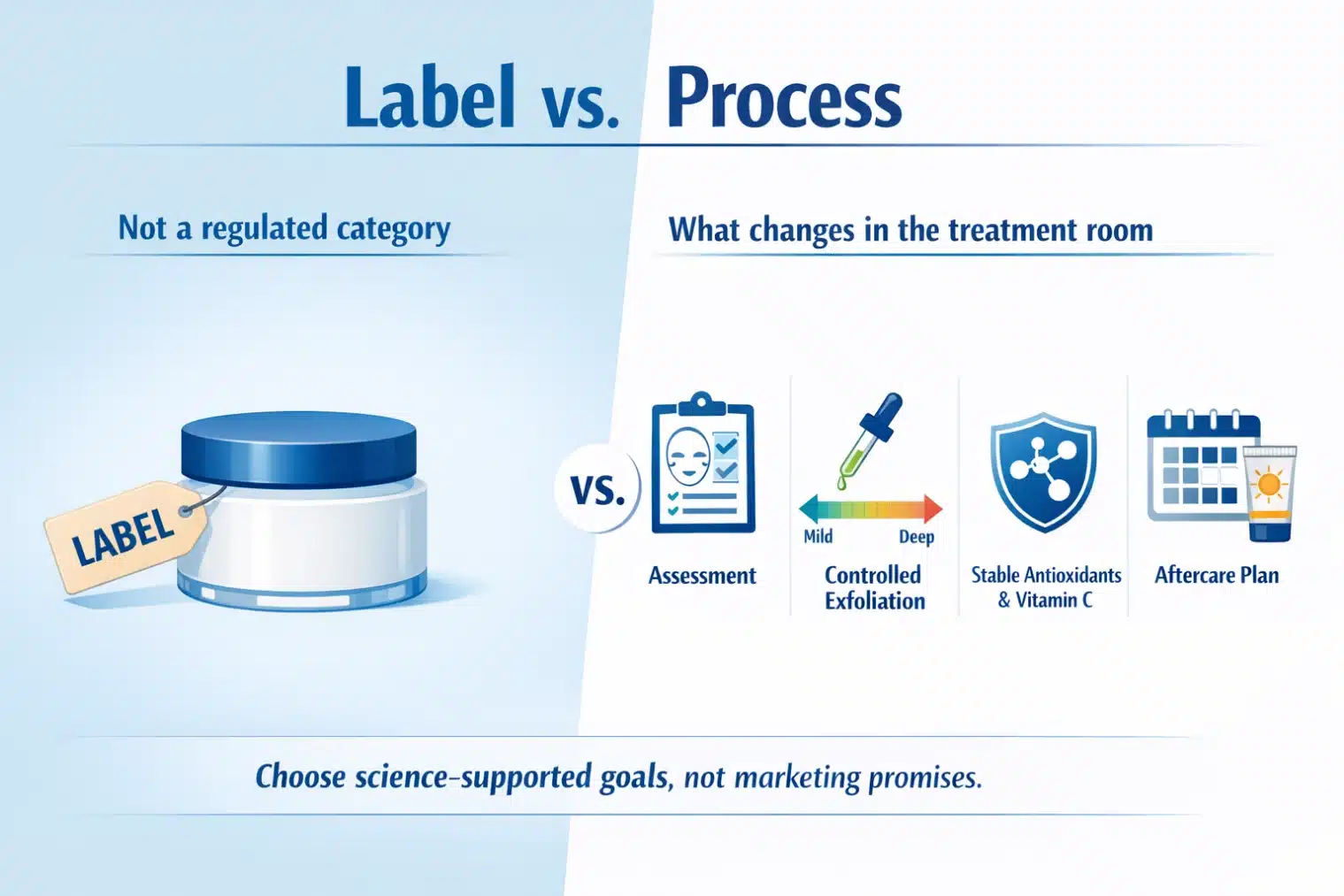
This image contrasts the marketing label “medical-grade skincare” with what truly matters in practice: evidence-guided assessment, controlled treatment depth, and structured aftercare that shape safe, realistic results.
What “proof” should look like when benefits are promised
Advertising standards complement FDA’s product categories. The Federal Trade Commission explains in its Health Products Compliance Guidance that health-related product claims must be truthful, not misleading, and supported by “competent and reliable scientific evidence,” which it describes as well-controlled human clinical studies or other appropriate scientific data, depending on the claim.
Patients can use that logic as a filter when reading product pages and listening to consults. Strong promises require strong evidence, and careful language grounded in data rather than hype is usually a good sign. Providers who describe what is known, what is uncertain, and what depends on tolerance help people make decisions without relying on a label alone.
Match the product claim to the facial choice
When a product promises visible change, the session should account for routine history, active ingredients, and downtime; a customized facial can keep that decision grounded in what your skin can tolerate that day.
What can change during a facial appointment
Assessment and tailoring that reduces trial-and-error
The most meaningful “medical” element in many facial experiences is the process: a structured assessment that avoids stacking steps that conflict. A protocol can account for recent exfoliants, retinoids, sensitivity history, and downtime tolerance, then prioritize one main goal rather than layering multiple aggressive steps in a single visit. That kind of planning often changes results more than simply switching to products marketed as stronger.
A common scenario shows the difference. A person alternates an at-home exfoliating acid with a retinoid, then books a facial hoping to “reset” skin before travel or a big event. A screening step can identify irritation risk and shift the session toward barrier-friendly choices and realistic appearance goals, rather than adding more exfoliation onto an already stressed routine.
Chemical exfoliation as a defined technique, not a vague “stronger peel”
Professional exfoliation works best when it is treated as a controlled technique instead of a generic upgrade. Florida cosmetology rules define chemical exfoliation as using products that contain chemicals to loosen or dissolve dead cell buildup and name alpha hydroxy acids as examples in the state’s rule text on skin care services. That definition signals that chemical exfoliation is a recognized practice with boundaries rather than an informal “extra step.”
For stronger agents, risk management becomes central. The U.S. Food and Drug Administration warns consumers in a 2024 communication titled “FDA warns against purchasing or using chemical peel skin products without professional supervision” that some high-concentration chemical peel products sold online can cause serious injuries such as chemical burns, swelling, infection, skin color changes, and scarring, and emphasizes that depth and injury risk depend on concentration, number of applications, and contact time. Supervision allows those variables to be chosen deliberately and adjusted in real time.
Aftercare that protects the outcome
Aftercare guidance can be just as important as the in-session steps. FDA’s guidance to industry on alpha hydroxy acids explains that studies reviewed by the agency and expert panels found that cosmetics containing AHAs can increase skin sensitivity to UV radiation and sunburn, and recommends a specific “Sunburn Alert” statement alongside advice to use sunscreen, wear protective clothing, and limit sun exposure while using an AHA product and for a week afterward, as described in its document “Guidance for Industry: Labeling for Cosmetics Containing Alpha Hydroxy Acids”. Those recommendations apply whether AHAs appear in daily skincare, in-facial steps, or both, so timing and product layering deserve attention.
Patients often experience those recommendations as practical rules: schedule exfoliating facials with sun exposure in mind, use broad-spectrum sunscreen as directed, and treat shade and hats as part of the plan rather than optional add-ons. That approach protects both comfort and long-term pigment balance. Clear written aftercare instructions and reminders lower the chance that these steps are forgotten once visible redness fades.
What can change inside the product itself
Vitamin C: stability and delivery can limit consistency
Some popular ingredients have practical formulation constraints that affect real-world results, and vitamin C is a classic example. A topical delivery study archived in PubMed Central describes L-ascorbic acid, the pure form of vitamin C, as highly vulnerable to oxidation in aqueous systems and identifies this instability as a major challenge for formulators seeking reliable skin delivery, in the context of spanlastic systems designed to improve targeting and stability (Topical delivery of L-ascorbic acid spanlastics for stability and skin targeting). That instability helps explain why packaging, pH, and delivery systems often matter more than label language alone when people compare vitamin C products.
Another peer-reviewed review on ascorbic-acid-derivative delivery systems discusses why derivatives are designed to improve stability and performance in skin applications, which helps explain why products with similar “vitamin C” labeling can behave differently in practice. Patients often experience that science as inconsistency: one bottle oxidizes quickly or irritates, another seems inert, and routine switching becomes the default. A facial setting can help by reducing routine churn and selecting steps that match tolerance, since stability challenges can make “more products” a less reliable strategy.
Antioxidant systems: supportive ingredients can change performance
Formulation choices sometimes have direct evidence. A Journal of Investigative Dermatology study indexed in PubMed found that adding ferulic acid to a low pH solution containing vitamins C and E improved the chemical stability of the antioxidant combination and significantly increased protection against solar-simulated irradiation compared with vitamins C and E alone, supporting the idea that synergistic antioxidant systems can outperform single-actives in isolation (Ferulic acid stabilizes a solution of vitamins C and E and doubles its photoprotection of skin). This kind of testing does not usually appear on a label, yet it shapes how dependable a formula can be over time.
That kind of data shows why two products with similar ingredient lists can behave differently. The exact form of each active, its concentration, pH, and supporting ingredients all shape stability and tolerability, which matters more in cumulative routines than any single heroic step. In practice, it often makes sense to build a steady routine around a few well-designed antioxidant combinations instead of frequent product hopping driven by marketing.
Evidence-backed ingredients people often associate with “medical-grade” routines
Tretinoin as a reference point for prescription-level evidence
Many “medical-grade” conversations borrow credibility from prescription dermatology, so it helps to separate prescription therapy from cosmetic skincare. A systematic review of randomized controlled trials published in 2022 and archived in PubMed Central concluded that topical tretinoin improved multiple clinical signs of photoaging, including wrinkling and mottled hyperpigmentation, and described benefits as early as one month that were sustained with continued use in longer follow-up periods (Topical tretinoin for treating photoaging: A systematic review of randomized controlled trials). Those findings help explain why dermatology practices still treat tretinoin as a reference standard when discussing photoaging therapies.
A facial appointment can complement a prescription routine by supporting hydration, barrier comfort, and sun-protection behaviors, but substitution is the wrong expectation. Coordination is the useful role: choosing steps that respect irritation risk and aftercare needs, then avoiding messaging that frames a facial as a replacement for prescription therapy. Framing facials as support for, rather than substitutes for, medical treatment keeps roles clear for patients and providers.
Chemical peels and depth: outcomes depend on more than “strength”
Chemical peels sit at the center of many “medical-grade” discussions because they look like a direct “stronger is better” dial. A practical clinical review in the dermatology literature describes the goal of a chemical peel as creating a predictable, uniform thickness of controlled skin injury and explains that peel depth—and therefore both results and complication risk—is shaped by factors such as agent concentration, exposure time, and number of applications (A Practical Approach to Chemical Peels: A Review of Fundamentals and Clinical Practice). Understanding that goal helps patients view peel strength in terms of controlled injury rather than pure intensity or discomfort.
Patients can use those fundamentals to ask better questions. A safer plan focuses on depth, downtime, and complication avoidance rather than chasing the highest percentage on a label. Providers who explain how they control exposure and who set clear post-care expectations usually deliver a more predictable experience than “maximum-strength” marketing.
Safety boundaries patients should take seriously
High-concentration peel products sold for home use
FDA’s 2024 warning on certain chemical peel products highlights the risk of serious injury from chemical burns and lists potential outcomes such as pain, swelling, infection, skin color changes, and scarring, while urging consumers to use chemical peels only under the supervision of a dermatologist or other licensed and trained practitioner (FDA warns against purchasing or using chemical peel skin products without professional supervision). The agency’s message aligns poorly with unsupervised high-strength kits that invite people to self-treat at home. Positioning strong peel agents inside supervised treatment plans keeps exposure closer to what the warning describes as safer.
Patients who see “professional strength” or “clinic-level” labels on at-home peel kits can use that warning as a strong signal to pause. A supervised plan can account for cumulative exposure and observe early warning signs, while unsupervised layering increases the chance that a cosmetic goal becomes an injury and recovery project instead. Asking who will monitor healing and what to do if pain or darkening appears turns vague marketing language into a practical safety check.
Licensure and the setting where services should be performed
Florida’s cosmetology statute states that skin care services must be performed by a licensed cosmetologist or facial specialist within a licensed cosmetology or specialty salon and defines skin care services in relation to applying or removing chemical preparations and similar substances on the face and body (Fla. Stat. §477.013 Definitions). The same framework covers many exfoliating and resurfacing steps that meaningfully alter how the skin barrier behaves. Licensure therefore represents minimum training and oversight expectations, not just administrative paperwork.
That framework supports a patient-facing point: licensure and setting create baseline accountability when services involve skin-altering steps. Fountain of Youth in Fort Myers keeps staff current on regulatory updates and clinical evidence relevant to skincare protocols, including FDA safety communications and the peer-reviewed findings discussed here. Patients can also ask to see current licenses and inquire about continuing education to confirm that a setting lives up to those expectations.
How to decide whether “medical-grade” matters for you
The label alone rarely answers the question patients actually have: “Will this be worth it for my skin?” A better approach is to evaluate whether the plan matches skin tolerance, timeline, and goal clarity, and whether the provider communicates within the boundaries that FDA and FTC frameworks imply, such as those outlined in the FDA’s cosmetic-versus-drug guidance and the FTC’s health products compliance document. Clarifying whether your main aim is comfort, prevention, texture change, or discoloration control makes that evaluation more concrete.
The checklist below helps you prepare for a “medical-grade” facial consultation by organizing key details your provider needs. Sharing this information clearly supports safer decisions about products, strengths, and in-office treatments. Bringing a printed or digital version of the checklist to the appointment keeps important points from being forgotten once the conversation starts.
| Information to prepare | Why it matters in a medical-grade context | What to listen for from your provider |
|---|---|---|
| Full list of skincare products you use, including how often you use each one | Prevents unintentional layering of strong actives, such as exfoliating acids or retinoids, on top of in-clinic treatments that may also stress the skin barrier. | Clear guidance about which products to pause or continue before and after the facial, with specific time frames instead of vague phrases. |
| Prescription creams, gels, or oral medications that affect the skin | Some prescriptions increase sensitivity, alter healing, or change how skin responds to exfoliation and other procedures, so treatment intensity may need adjustment. | Questions about dosing, timing, and application sites, along with a plan that respects any instructions from your prescribing clinician. |
| Past reactions, allergies, or products that caused burning, rash, or prolonged redness | History of irritation guides avoidance of certain ingredients, fragrances, or vehicles, and supports a more conservative introduction of new formulas. | Specific follow-up questions about what happened, how long symptoms lasted, and which areas reacted, not just a quick note that you have “sensitive skin.” |
| Recent procedures such as peels, microneedling, lasers, or injectables, with approximate dates | Skin recovering from recent procedures may need extra healing time or gentler in-office steps to avoid compounding inflammation, dryness, or pigment changes. | A timeline review that considers intervals between treatments and adjusts today’s plan instead of running standard protocols for every visitor. |
| Typical sun exposure and any upcoming outdoor events or travel | Sun exposure after exfoliating or resurfacing steps can raise the risk of irritation and pigment changes, so scheduling and aftercare require extra attention. | Discussion about timing your facial relative to events, along with clear sun protection and shade-seeking strategies for the days that follow. |
| Daily habits that stress the skin, such as frequent pool use, hot yoga, or harsh scrubs | Heat, chlorine, and mechanical friction can weaken the barrier and change how skin tolerates stronger in-clinic actives or peels. | Practical suggestions to modify these habits around treatment days instead of ignoring them, such as spacing out pool sessions or skipping abrasive tools. |
| Comfort level with downtime, flaking, and visible redness in the days after treatment | Tolerance for visible side effects guides whether your plan leans toward low-downtime maintenance or more intensive protocols with staged recovery. | An honest explanation of expected appearance changes over the first week and options to adjust intensity to match work, social, or family obligations. |
Three practical signals help separate substance from marketing. The first signal is precise language about appearance goals instead of sweeping treatment promises, since FDA ties classification to intended use and types of claims in its cosmetic-versus-drug guidance. The second signal is a clear safety plan for exfoliation and sun protection, since FDA’s documents on alpha hydroxy acids and its chemical peel warning describe predictable risks when exposure is mismanaged. The third signal is willingness to reference evidence and uncertainty, since the FTC guidance emphasizes science-supported health product claims rather than vague assurances.
When this kind of facial planning makes sense
The best fit is usually someone who wants clearer guidance, not a harsher treatment by default. The appointment should narrow choices, reduce routine conflicts, and keep skin comfort in view while still addressing visible concerns.
- You use retinoids, acids, vitamin C, or prescription creams and want cleaner timing around treatment.
- You want brighter or smoother-looking skin, but need guidance about downtime, sun exposure, and barrier comfort.
- You feel confused by “clinic strength” claims and want a plan based on ingredients, evidence, and tolerance.
For stronger resurfacing questions, a comparison with chemical peel options may help clarify risk, depth, and expected recovery.
“Medical-grade” becomes meaningful when it points to disciplined protocols, realistic claims, and formulation choices that behave consistently. The highest-value outcome for many patients is a routine that stays stable over time and a plan that respects the skin barrier and sun sensitivity instead of chasing intensity. Over the long term, that steadiness often matters more than any single high-intensity treatment advertised as a quick fix.
Related skin-care decisions to review next
If product claims are only one part of the decision, the next step may involve a closer look at medical-grade skincare or a broader advanced facial technology plan that fits your skin history and comfort level.
Medical review: Reviewed by Dr. Keith Lafferty MD, Fort Myers on March 2, 2026. Fact-checked against government and academic sources; see in-text citations. This page follows our Medical Review & Sourcing Policy and undergoes updates at least every six months.