Irradiance, Wavelength, Pulsing, and the Biphasic Dose Response
Why PBM dosing matters more than most patients expect
Photobiomodulation, often shortened to PBM, can look simple on the surface: light goes on the body to support comfort, recovery, or function. Real-world results vary widely, and dosing usually explains that gap more than brand names or marketing claims.
Many people assume stronger light or longer sessions always help more. The research literature repeatedly describes a non-linear response, where benefits improve within a window and can drop outside that window.
A patient-facing way to think about “standards” in 2025–2026 is this: reputable protocols explain the key parameters, keep dosing inside known therapeutic ranges, and document enough detail to repeat results reliably. Clear reporting matters, because dose depends on more than session length.
What “dose” means in photobiomodulation
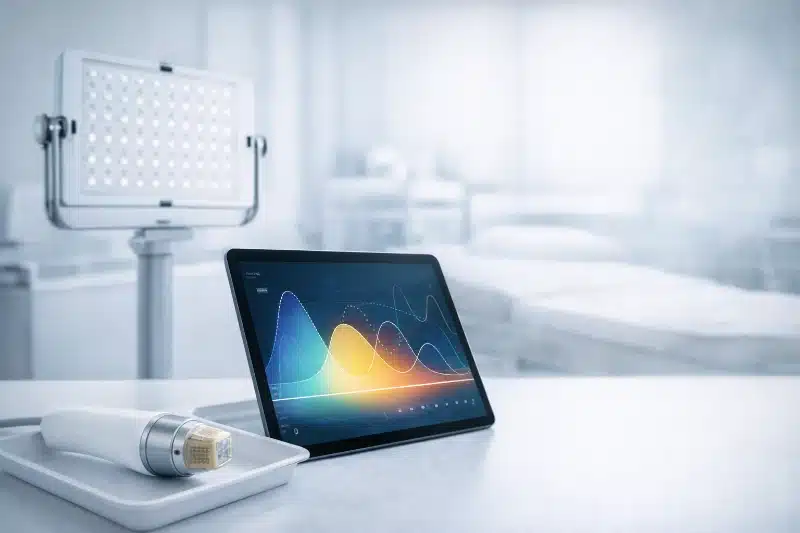
What “dose” means in photobiomodulation
PBM dose is not a single number
PBM dose combines several measurable factors that work together. Irradiance describes how intense the light is at the skin or scalp, and fluence describes how much total energy reaches a defined area over time.
Time, spot size, and the number of sessions shape how that energy adds up biologically. Two people can sit under light for the same minutes and still receive different doses, because beam area and application technique change energy density.
Many protocols also specify whether light runs continuously or in pulses, because pulse settings change average energy delivery and surface heating.
Why delivered dose can differ from advertised output
Device specifications typically describe output at the source, not what reaches deeper targets. Tissue layers absorb and scatter photons, so delivered energy drops with depth and differs across body sites.
Those differences matter most when the intended target lies below the surface, such as transcranial PBM, where skin and skull sit between the light source and brain tissue. Protocols that treat dosing as a simple “minutes on” instruction often fail to explain this reality.
Wavelength selection and tissue targets
Red and near-infrared wavelengths serve different goals
PBM commonly uses red to near-infrared light, and wavelength selection aims to match tissue depth and biological targets. Brain-focused PBM reviews describe PBM therapy as using red to near-infrared wavelengths while studying parameters like fluence, power density, repetition, treatment duration, and continuous versus pulsed delivery in preclinical and clinical contexts.
For background on brain PBM parameter considerations, you can cite brain photobiomodulation therapy parameter considerations in the University of Johannesburg repository.
Why deeper penetration is not automatically better
Deeper penetration can help when the target sits deeper, yet deeper is not always the right answer. Skin-focused goals often require attention to superficial delivery rather than chasing maximal penetration.
Wavelength also interacts with individual factors that influence absorption and scattering. A protocol that explains wavelength choice in plain language usually reflects more careful dosing than one that treats wavelength as a cosmetic preference.
Different PBM goals rely on different combinations of wavelength, intensity, and timing, and patients often benefit from seeing those variables laid out side-by-side. The chart below summarizes source-supported parameter ranges and reporting items that help patients compare protocols without reducing everything to “minutes per session.”
| What the parameter describes |
Why it changes outcomes |
Source-supported examples you may see reported |
What a patient can ask to hear in plain language |
| Wavelength |
Wavelength influences penetration depth and what tissue layers absorb light. |
Brain PBM reviews describe red to near-infrared use, and studies model examples like 670 nm, 810 nm, and 1064 nm in transcranial contexts. |
“Which wavelength are you using, and what target depth are you aiming for?” |
| Irradiance (power density) |
Intensity sets the delivery pace and can affect comfort and biological response. |
One 2025 review summarizes a “safe dose range” for brain PBM that includes 5–50 mW/cm², depending on protocol context. |
“What intensity reaches the skin or scalp, and how do you manage warmth?” |
| Fluence (energy density) |
Fluence combines intensity and time, and it often tracks the therapeutic window. |
A 2025 review summarizes brain PBM safe-dose context as 4–30 J/cm² and reports that neural cell work has shown effective ranges such as 0.1–15 J/cm² in some experimental settings. |
“How many joules per square centimeter are you targeting for my goal?” |
| Time per area and spot size |
The same time can deliver different energy densities if the beam area changes. |
Dose tables specify time ranges (for example, 20–300 seconds) and tie dosing to a defined treatment area rather than minutes alone. |
“How large is the treated spot, and how long is each spot exposed?” |
| Continuous vs pulsed delivery |
Pulsing changes average energy delivery and can change heating patterns. |
PBM reviews describe continuous or pulsed delivery, and published work reports pulse frequencies ranging from 1–3000 Hz in research contexts. |
“If pulsed, what frequency and duty cycle are you using, and why?” |
| Therapeutic window guidance |
Benefits can drop outside the optimal range, even when “more” seems logical. |
WALT states therapeutic dose windows typically range within ±50% of listed values, and it advises reducing dose after inflammation comes under control. |
“What is your plan for adjusting dose if symptoms improve or change?” |
Irradiance, fluence, and time: finding the therapeutic window
Irradiance sets the biological pace
Irradiance tells you how much power reaches a square centimeter at the surface. Patients often describe intensity as “how strong it feels,” yet the goal is not to feel heat or force a sensation.
Reviews of transcranial PBM summarize dosing ranges in terms of both fluence and irradiance, because intensity influences both comfort and cellular response patterns. A protocol that states only minutes without irradiance leaves out a core dosing variable.
Fluence reflects cumulative exposure
Fluence describes total energy delivered per square centimeter. Research summaries for brain PBM describe dose ranges in joules per square centimeter, reflecting how intensity and time combine to define exposure.
When a protocol reports fluence clearly, it becomes easier to compare across sessions and devices. Clarity also reduces the chance that well-meaning changes, such as doubling time, will overshoot the therapeutic window.
Time alone does not define dose
Patients often compare sessions by minutes, because time is the easiest variable to notice. The dose can still change when distance, spot size, or contact pressure changes, even if the timer stays fixed.
Professional dosing tables show why time has meaning only when tied to a defined area and power range. WALT tables specify time ranges and describe acceptable windows around recommended values rather than treating time as a stand-alone prescription.
Continuous versus pulsed delivery
What pulsing changes
PBM protocols can use continuous wave light or pulsed light. Pulsing introduces on-off cycles, and the resulting duty cycle affects average delivered energy even when peak output stays high.
Research summaries describe pulse frequency ranges used in studies, and recent work in near-infrared exposure describes biphasic responses where lower fluences can show protective effects while higher fluences can show detrimental effects in the measured outcome. PubMed indexing describes that pattern while noting an “optimal exposure duration” window reported between 60 seconds and 15 minutes for the studied context.
You can cite biphasic dose-response findings in near-infrared exposure when you explain why pulsing and exposure duration should not be treated as arbitrary.
The biphasic dose response in plain language
More light is not always better
PBM often follows a biphasic dose response, sometimes called an Arndt–Schulz curve. The core idea is that low levels of light can stimulate and support tissue repair, while higher levels can reduce those benefits or even inhibit the response.
A widely cited review in PubMed Central describes this phenomenon directly and emphasizes that low levels can have better effects than higher levels in many PBM contexts. You can inline cite that foundation by linking the term biphasic dose response where you define the “sweet spot” concept for patients.
How the biphasic effect shows up in real care
Patients sometimes report early improvement that later stalls, even when they keep sessions consistent. The dose may have drifted upward through longer exposure, higher intensity, or tighter spacing between sessions.
Clinicians often respond by reducing intensity or spacing sessions farther apart rather than escalating, because the biphasic model predicts diminishing returns when a patient overshoots the optimal window.
WALT provides a practical version of this concept through its stated “therapeutic dose window” guidance and its recommendation to reduce dose after inflammation comes under control, supporting the idea that dose should change as the clinical picture changes.
Scheduling, personalization, and real-world use
Session frequency changes the biological signal
Dose involves what happens during a session and what happens between sessions. The same fluence can behave differently when delivered daily versus weekly, because recovery time and symptom response influence how the body adapts.
Protocols that include reassessment checkpoints usually protect patients from both underdosing and overdosing. A rigid plan that never changes can clash with the biphasic response pattern.
Transcranial PBM requires extra care
Head applications add layers of complexity because the target lies deeper and the scalp can heat faster than other areas. Modern brain PBM reviews discuss dosing variables such as wavelength, fluence, power density, repetition, duration, and continuous versus pulsed delivery, reflecting how many knobs affect both safety and efficacy.
Support your brain-specific parameter discussion by linking brain PBM safety and parameter considerations where you discuss why “one setting fits all” does not apply to head protocols.
Home devices versus supervised care
Home PBM can work best when use stays consistent and documented. Distance drift, angle changes, and incomplete coverage can quietly change dose over time, even when the user keeps the same timer.
Supervised settings often improve consistency because staff can keep distance and coverage stable, monitor comfort, and adjust dose within a therapeutic window rather than escalating by default.
Safety, comfort, and transparency
PBM aims to influence biological signaling rather than generate heat. Sustained warmth or discomfort suggests dosing that may be too aggressive for the treated area or the patient’s current sensitivity.
Protocols aligned with modern reporting standards can explain wavelength, intensity, time per area, and mode in plain language. Transparent dosing helps patients compare plans and reduces the risk that vague instructions will lead to accidental overdosing.
Staff at Fountain of Youth in Fort Myers follows current PBM dosing developments so patients can discuss parameter choices in clear, practical terms.
3 Practical Tips
- Consistency often matters more than intensity for patient outcomes. Keeping the same distance, the same treated area, and the same timing helps you avoid accidental dose drift.
- Tracking two signals can help you and your provider spot problems early: comfort during treatment and symptom changes within the next one to two days. A pattern of rising heat, increased irritation, or fading benefit can suggest that the dose moved outside the therapeutic window.
- When progress stalls, dose reduction or spacing sessions farther apart can make more sense than increasing intensity. The biphasic dose response framework supports that decision, and research discussing biphasic effects in PBM contexts reinforces the idea that more exposure can become less helpful.
Frequently Asked Questions
What does irradiance mean, and why does it matter?
Irradiance describes how much power reaches each square centimeter at the surface. It matters because intensity shapes the biological response, and protocols that report only time do not fully describe dose.
Is near-infrared light always better than red light?
Near-infrared light can penetrate deeper, which can help when deeper tissue is the goal. Red light can make more sense for superficial targets, so wavelength choice depends on purpose rather than ranking.
Should PBM be pulsed or continuous?
Both modes appear in PBM research and clinical protocols. Pulse settings matter, because frequency and duty cycle change average energy delivery and can change heat and tissue response patterns.
How can I tell if my PBM dose is too high?
Heat, discomfort, and diminishing returns after early improvement can suggest excessive dosing for your situation. Adjusting dose downward or spacing sessions farther apart can align better with the biphasic response pattern described in PBM literature.
Questions? We are here to help! Call 239-355-3294.
Harvard ADS record for a 2024 PBM biphasic dose-response study
UMass ScholarWorks PBM biphasic dose-response update
Medical review: Reviewed by Dr. Keith Lafferty MD, Medical Director at Fountain of Youth SWFL on February 5, 2026. Fact-checked against government and academic sources; see in-text citations. This page follows our Medical Review & Sourcing Policy and undergoes updates at least every six months. Last updated February 5, 2026.
