Here’s what you’ll learn when you read this article:
-
Why MASH treatment is shifting from single drugs toward combination strategies targeting multiple disease drivers at once
-
What current evidence says about resmetirom plus FASN inhibition and the lanifibranor Phase 3 timeline heading into 2026
-
How patients can interpret trial milestones and prepare for evolving treatment options without overreacting to headlines
Why MASH treatment is changing
Metabolic dysfunction–associated steatohepatitis, or MASH, has moved beyond being described as “fatty liver with inflammation.” Regulatory agencies and trial designers now define success primarily by whether fibrosis slows, stabilizes, or improves, because scarring best predicts long-term outcomes such as cirrhosis and liver failure. The U.S. Food and Drug Administration has described histologic endpoints used in noncirrhotic steatohepatitis trials, including improvement in fibrosis without worsening of steatohepatitis, which explains why fibrosis language now dominates trial headlines and patient discussions (FDA guidance (histologic endpoints)).
That shift matters to patients who may feel physically well yet still face meaningful progression risk. Over the past several years, trials have shown that improving a single biological pathway often leaves parallel drivers active, which helps explain why some patients see partial benefit before hitting a plateau. A “better liver panel” can be reassuring, yet it does not automatically answer the fibrosis question that regulators and clinicians prioritize.
Researchers and regulators are responding by rethinking strategy. Instead of searching for a single drug to solve a complex disease, programs are testing therapies that deliberately combine mechanisms. The goal is not to overwhelm the body with more medication, but to address distinct drivers of damage at the same time. This transition sets the stage for why 2026 is being watched closely, with several major readouts and trial launches expected.
Why single-agent therapy often falls short
Many MASH therapies focus on a primary driver such as lipid metabolism or inflammation. That approach can reduce liver fat or improve laboratory markers, yet fibrosis may continue to progress. Patients often ask why a drug that lowers liver fat does not always improve biopsy results.
The reason is that activated fibrotic pathways can persist independently, with scar-producing cells remaining active even after metabolic stress and inflammation begin to improve. When fibrotic signaling stays active, the liver can remain on a scarring trajectory even as some “upstream” stressors begin to soften. That disconnect is a key reason clinicians talk about “fat reduction” and “fibrosis response” as related but not interchangeable outcomes.
Why MASH treatment is changing
Dose limits also play a role. Some patients cannot escalate a single agent to the level needed for deeper impact because of tolerability or safety boundaries. When that happens, physicians are left with limited options other than supportive care and lifestyle management. These gaps have pushed development teams to explore combinations that allow moderate doses of two agents to do more than a high dose of one.
What combination therapy means in real terms
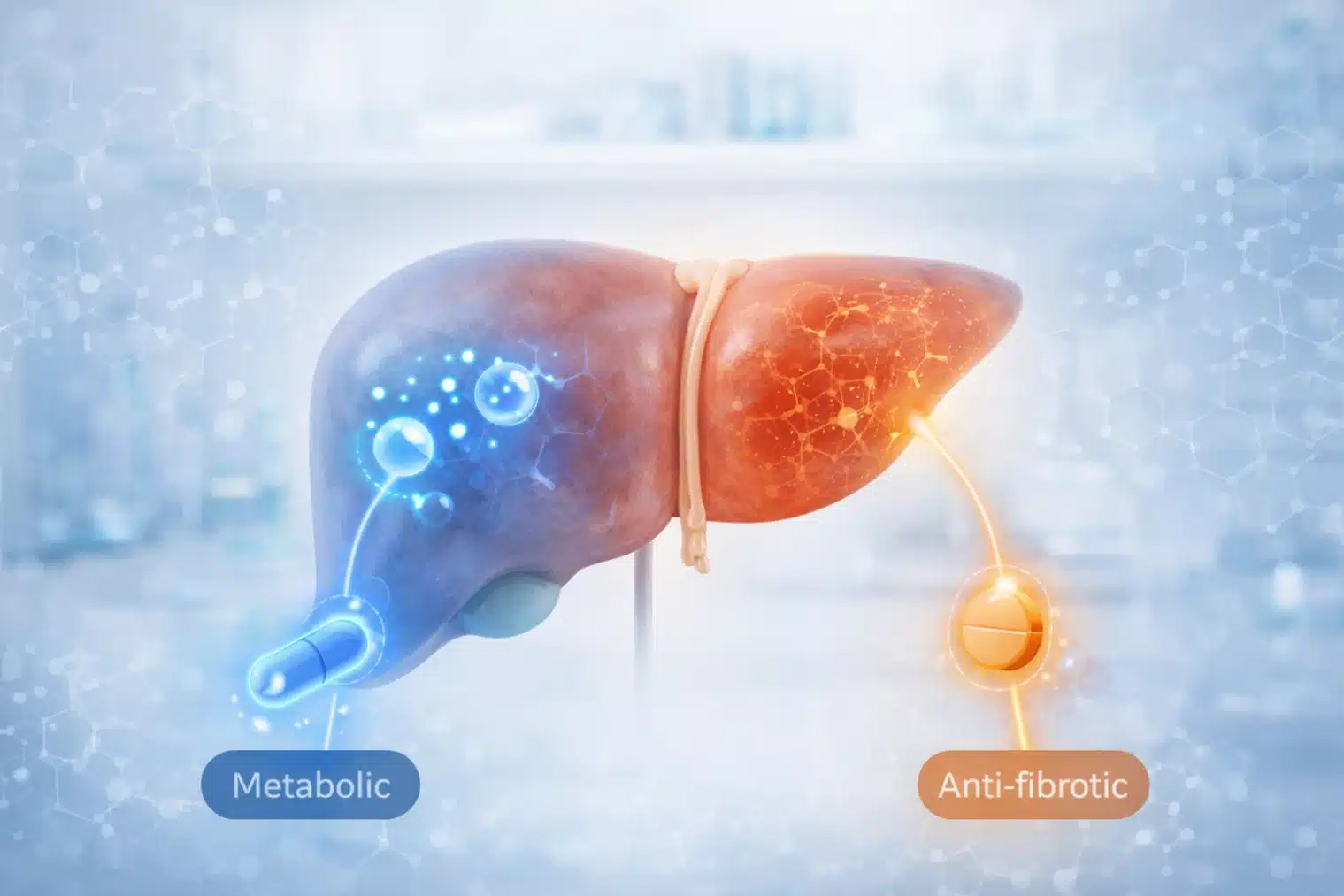
Combination therapy in MASH is not a random pairing of drugs. Programs are intentionally designed around complementary actions that address distinct aspects of disease biology without duplicating risk. One medication may target how the liver handles fats, while another reduces signaling that drives ongoing injury and fibrotic activation.
When mechanisms and safety profiles do not overlap excessively, developers can evaluate combinations with clearer attribution of benefit and risk. That clarity matters, because patients and clinicians need to understand what is driving benefit and what is driving side effects. Strong combination logic also makes it easier to interpret Phase 2 signals and decide which pairs deserve larger, longer trials.
Before combinations ever reach patients in larger trials, early studies focus on safety and drug–drug interactions. These studies answer a simple but critical question: can the drugs be taken together without changing how each behaves in the body. Only after that hurdle is cleared do developers move into trials that examine liver outcomes.
Resmetirom as a foundation therapy
Resmetirom is a thyroid hormone receptor-beta agonist designed to improve how the liver processes fats. Its development established a new reference point in MASH treatment by demonstrating that targeting metabolism directly could translate into histologic benefit for some patients. The FDA approved Rezdiffra (resmetirom) for adults with noncirrhotic steatohepatitis with moderate to advanced fibrosis, used along with diet and exercise, which is why many discussions now treat resmetirom as a “base layer” rather than a complete answer (FDA approval announcement).
Patients taking resmetirom may notice improvements in cholesterol profiles and reductions in liver fat over time. Fibrosis outcomes, however, vary across patients and disease stages, reflecting the fact that metabolic correction alone may not fully suppress fibrotic signaling. This gap has driven interest in pairing resmetirom with agents that act on complementary pathways. As a result, resmetirom is increasingly positioned as a foundation within combination strategies rather than a final therapeutic endpoint.
Why FASN inhibition is being paired with resmetirom
The rationale behind the pairing
Fatty acid synthase, or FASN, plays a role in creating new fat within the liver. Inhibiting this enzyme aims to reduce the internal production of fat that fuels inflammation and fibrotic signaling. When paired with a metabolic regulator like resmetirom, the strategy targets both incoming and newly synthesized lipid stress.
Denifanstat is the FASN inhibitor being studied alongside resmetirom. The rationale behind this pairing is grounded in complementary biology rather than redundancy. Resmetirom alters metabolic signaling, while FASN inhibition reduces the substrate that perpetuates injury. Together, they may offer broader coverage of disease drivers than either alone.
Where the resmetirom plus denifanstat program stands
What early combination studies can confirm
Early clinical work evaluating denifanstat and resmetirom together has focused on pharmacokinetics and safety. Those studies assessed whether taking the drugs together altered absorption or exposure in a clinically meaningful way. Results reported so far support moving forward, clearing a key prerequisite for combination development. Patients who want to see the “type” of work being done at this stage can compare it with the structure of a drug–drug interaction trial listing, where the focus is safety and how drugs behave together rather than fibrosis outcomes (clinical trial listing example).
What comes next in 2026
The next planned step is a Phase 2 proof-of-concept trial expected to begin in the second half of 2026. This study is designed to explore whether the combination can deliver measurable benefits in patients with more advanced disease, including those with significant fibrosis or cirrhosis. Patients following this space should understand that Phase 2 trials test signals rather than definitive outcomes, but they often shape which combinations advance further. Trial design details also matter, because endpoints and inclusion criteria determine whether results apply to a specific fibrosis stage in real-world care.
Lanifibranor and a different approach to broad coverage
Why the Phase 3 program matters
Lanifibranor represents another strategy aimed at addressing multiple aspects of MASH biology through a single molecule. As a pan-PPAR agonist, it interacts with receptors involved in lipid metabolism, inflammation, and fibrotic pathways. This broad activity is why its development program has emphasized fibrosis endpoints.
The pivotal Phase 3 NATiV3 trial enrolled a large population of patients with advanced fibrosis. Unlike early-stage studies, this trial is designed to provide data robust enough to inform regulatory decisions. Patients should recognize that Phase 3 trials demand longer follow-up and more stringent analysis, which is why timelines extend into late 2026. The company’s trial information pages have described topline results as expected in the second half of 2026, which is why “H2 2026” appears so often in coverage (Inventiva clinical trials timeline).
Understanding the Phase 3 readout window
What “H2 2026” usually signals
A “second half of 2026” readout window means that primary analyses are expected once all participants complete follow-up and data are reviewed. Initial announcements typically focus on whether the trial met its primary endpoints and whether safety findings align with expectations. Detailed subgroup analyses and secondary outcomes often follow later.
It also helps to remember what a “topline” update usually contains. Topline communications tend to prioritize the primary endpoint results and broad safety statements, not the full set of secondary endpoints and subgroup nuances. That is why a first headline can feel abrupt even when the underlying dataset is large and complex.
How to interpret headlines when results arrive
Headlines around Phase 3 results can be confusing. Terms such as “met endpoint” or “mixed results” have precise regulatory meanings that often omit nuance about subgroup response, durability, or secondary outcomes. Patients benefit from waiting for full context rather than reacting to early summaries alone. For those working with care teams that stay current on emerging data, including staff at Fountain of Youth in Fort Myers, these updates support informed discussions without rushing decisions.
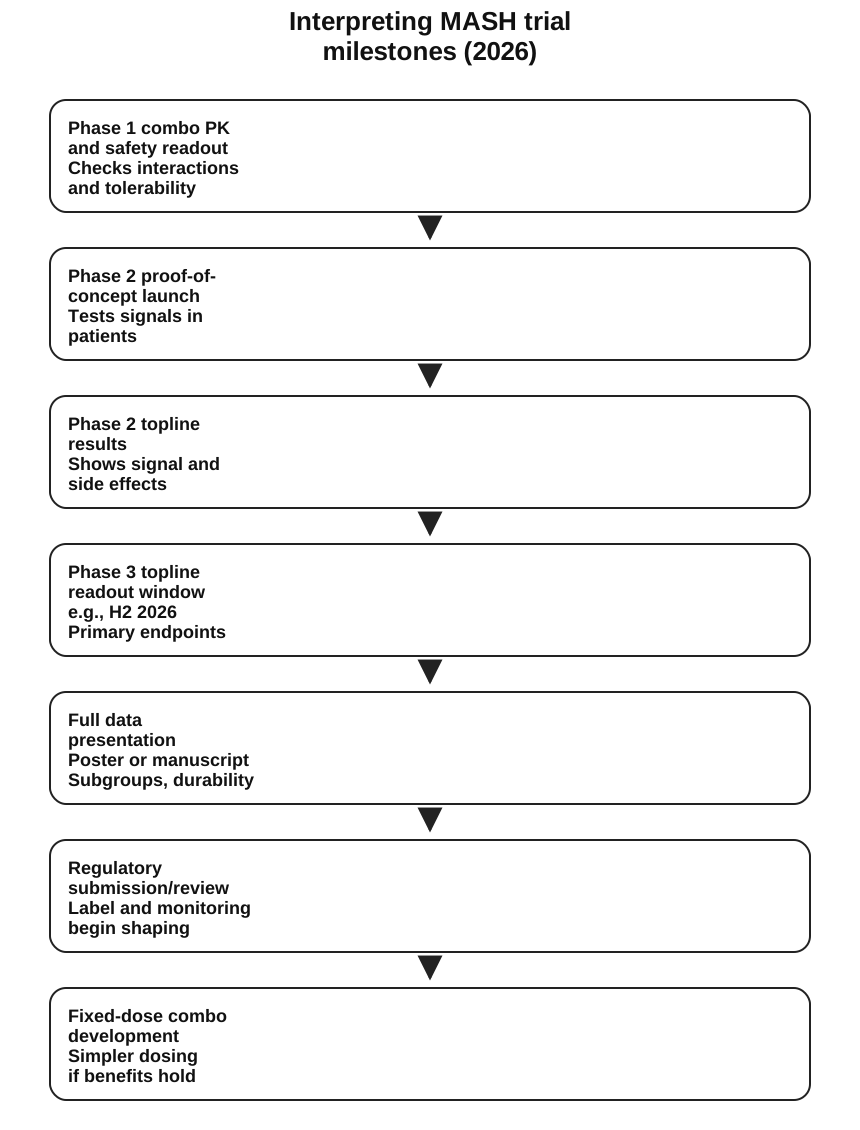
Trial news can sound definitive when it is actually a specific step in a longer pathway. This table helps you quickly understand what each common milestone usually means and what questions to ask next.
| Milestone you may see in 2026 news | What it typically tells patients | What it does not prove by itself | Practical next-step question to ask your clinician |
|---|---|---|---|
| Phase 1 combination PK / safety readout | Whether two drugs can be taken together without major interaction signals and with acceptable short-term tolerability. | It does not show the combination improves fibrosis or long-term liver outcomes. | “If a Phase 2 trial opens, what endpoints will actually reflect scarring risk for someone at my fibrosis stage?” |
| Phase 2 proof-of-concept (PoC) launch announcement | Developers are testing whether the biology translates into measurable signals in patients (often with imaging, labs, and/or biopsy endpoints). | It does not mean the combination will become standard care or be available soon. | “Would my current monitoring plan capture the same metrics this trial is trying to improve?” |
| Phase 2 topline results | Whether the therapy shows a signal worth advancing, and what side effects appear in a larger patient group. | It does not guarantee Phase 3 success or reflect real-world long-term safety. | “Do the results apply to my fibrosis stage, or were they concentrated in a specific subgroup?” |
| Phase 3 topline readout window (e.g., “H2 2026”) | Whether a large pivotal study met its primary endpoint(s) and how safety looks at scale. | It does not include every nuance; details often arrive later (secondary endpoints, subgroups, durability). | “Which endpoints were primary, and what do they mean for my risk of progression?” |
| Full data presentation (poster, manuscript, medical meeting) | A clearer picture of who benefited most, what tradeoffs exist, and how consistent effects were across patients. | It still may not answer long-term outcomes like decompensation or survival unless studied directly. | “What side effects caused people to stop treatment, and how would we manage those risks?” |
| Regulatory submission / review updates | Developers are seeking authorization based on evidence, and labels/monitoring requirements begin taking shape. | It does not mean immediate access, broad insurance coverage, or suitability for all fibrosis stages. | “If approval happens, what baseline labs and follow-up schedule would be typical for me?” |
| Fixed-dose combination (FDC) development updates | A push toward simpler dosing that may help adherence if the combination proves beneficial. | It does not guarantee the best dose balance for every patient or replace individualized monitoring. | “Would an FDC limit dose flexibility compared with taking the components separately?” |
How these developments affect patient decision-making
Patients living with MASH often face uncertainty about when to start, switch, or add therapy. The movement toward combination regimens signals that treatment plans may evolve rather than remain static. A patient who begins therapy today may encounter new options within a few years, especially as combination trials mature.
Preparing for that reality involves more than tracking drug names. Patients benefit from consistent monitoring strategies that capture fibrosis risk, metabolic health, and tolerability. Conversations with clinicians should focus on goals, such as stabilization versus reversal, and how new data might change priorities over time. When a milestone headline appears, the most useful follow-up often centers on what changes in monitoring, candidacy, or risk management, rather than whether the news is “good” or “bad.”
3 Practical Tips
- Keeping a simple record of labs, imaging results, and symptoms helps patients recognize trends and communicate clearly with clinicians as therapies evolve.
- Asking how progress will be measured beyond liver enzymes sets expectations early.
- Reviewing all medications and supplements before starting new therapy reduces the risk of unexpected interactions.
Questions? We are here to help! Call 239-355-3294.
FAQ
Why are combination therapies becoming more common in MASH?
MASH involves multiple biological processes that contribute to liver injury and scarring. Targeting only one pathway often leaves others active. Combination strategies aim to address these parallel drivers together, which may improve overall disease control compared with single-agent therapy.
Does a positive early combination study mean the treatment works?
Early studies primarily assess safety and how drugs behave together in the body. Positive results mean the combination can move forward, not that it has proven clinical benefit. Efficacy requires larger trials designed to measure liver outcomes.
What should patients watch for when Phase 3 results are announced?
Patients should look for whether primary endpoints were met and whether safety findings were consistent. Context matters, since secondary analyses and detailed data often come later. Discussing results with a knowledgeable clinician helps translate headlines into practical meaning.
How soon could these combination approaches reach routine care?
Timelines depend on trial outcomes and regulatory review. Even with positive data, additional studies or approvals may be required. Patients should view 2026 as a period of important information rather than immediate availability.
Medical review: Reviewed by Dr. Keith Lafferty MD, Fort Myers on February 2, 2026. Fact-checked against government and academic sources; see in-text citations. This page follows our Medical Review & Sourcing Policy and undergoes updates at least every six months.