
Dried Blood Spot (DBS) Testosterone Monitoring: Accuracy, LC–MS/MS, and What 2025–2026 Validation Is Changing
Better Testosterone Monitoring Starts With the Right Test
- Dried blood spot testing may help follow trends, but it does not always replace standard serum testing.
- Topical testosterone, inconsistent timing, hematocrit effects, and poor sample collection can distort results.
- Lab values should be interpreted alongside symptoms, dosing method, collection timing, and treatment goals.
Match the Monitoring Method to the TRT Plan
Men comparing DBS, venous labs, injections, gels, or follow-up schedules can begin with a structured men’s TRT evaluation that reviews dosing method, symptom changes, lab timing, and safety markers before any adjustment is made.
Physician-reviewed content • Evidence-aware care • Personalized treatment planning
Put Lab Results Into a Broader Clinical Context
Monitoring decisions often connect with dosing stability, sleep quality, and lifestyle response; related guidance is available in FOY’s pages on TRT optimization and sleep and testosterone.
Dried blood spot testosterone testing promises something many patients want: fewer clinic visits, finger-prick collection at home, and simpler follow-up over time. Interest has grown alongside testosterone replacement therapy and broader hormone monitoring, but usefulness depends on how well DBS results reflect what is happening in the body. Recent validation work through 2024–2026 has clarified where DBS performs well, where it struggles, and how modern laboratory methods such as LC–MS/MS shape accuracy. Understanding those boundaries helps patients avoid false reassurance, unnecessary worry, or incorrect dose changes.
What DBS testosterone monitoring is designed to do
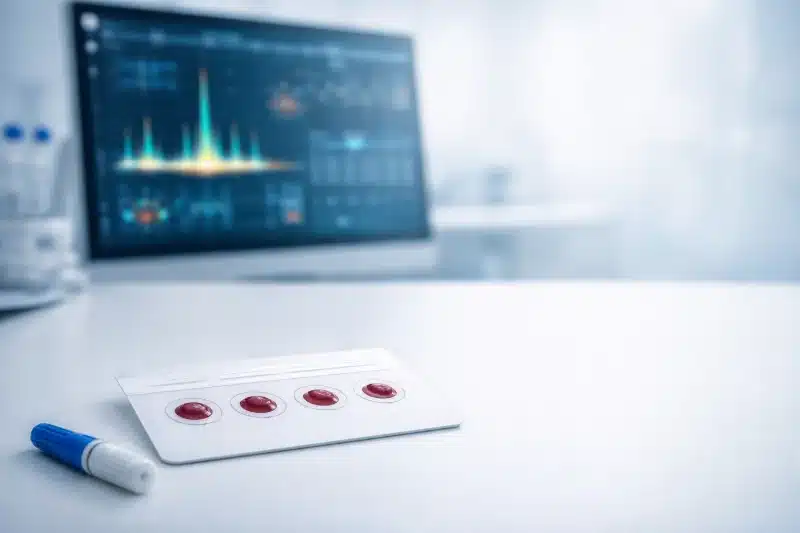
DBS testing uses capillary blood collected from a finger prick and dried on specialized filter paper. The goal is not convenience alone; it aims to make repeated measurements easier so trends can be followed without repeated venous draws. That distinction matters. Many people expect DBS to replace standard blood tests outright, but the strongest evidence supports its role as a longitudinal monitoring tool rather than a single stand-alone diagnostic measurement.
In practical terms, DBS can help answer questions such as whether testosterone levels are generally rising, falling, or staying stable after a treatment change. It performs best when the same person collects samples the same way at the same relative time point. Situations that require tight comparison to population reference ranges or strict treatment cutoffs still rely on venous serum or plasma testing.
How DBS differs from a standard blood draw
Capillary whole blood versus serum
Venous blood tests measure testosterone in serum or plasma after cells are removed. DBS captures whole capillary blood, which includes red blood cells, plasma, and intracellular components. Testosterone resides primarily in the plasma fraction, bound to proteins, but the presence of cells changes how much hormone ends up in a small punched disc of dried blood. That structural difference explains why DBS results do not always match serum values numerically, even when they track changes reliably.
Two meanings of “accuracy”
Accuracy in DBS testing has two layers. Analytical accuracy describes how precisely the laboratory method measures testosterone within a DBS sample. Clinical agreement describes how closely those DBS values correspond to venous serum measurements in real people. A method can perform excellently in the laboratory yet still show systematic differences when compared with serum. Recent studies emphasize separating these concepts so patients do not equate high analytical performance with perfect interchangeability.
Why LC–MS/MS matters for testosterone measurement
What DBS testosterone monitoring is designed to do
Liquid chromatography–tandem mass spectrometry has become the reference approach for testosterone because it identifies molecules by mass rather than antibody binding. Immunoassays, which remain common in routine labs, can suffer from cross-reactivity with similar steroids, especially at low concentrations. Mass spectrometry minimizes that risk.
Modern DBS testosterone validations use LC–MS/MS to establish linearity, precision, detection limits, and stability. One recent analytical validation demonstrated linear measurement across a wide concentration range with coefficients of variation generally under ten percent, as described in the validation of a dried blood spot testosterone assay using LC–MS/MS. That level of performance supports clinical use when results are interpreted within known constraints rather than treated as direct serum substitutes.
Laboratory method quality still varies across the broader testing landscape, which is why standardization efforts matter. The CDC maintains the Steroid Hormones Standardization Programs (HoSt) to improve comparability and accuracy for hormone measurements, including testosterone. Patients and clinicians who want higher confidence in assay performance can also review the CDC’s published list of methods in the CDC Certified Total Testosterone Assays document, which describes testosterone methods meeting CDC certification criteria.
What current evidence shows about DBS accuracy
Where DBS aligns well with venous testing
The most up-to-date clinical validation, published in early 2026, examined patient-performed finger-prick DBS alongside venipuncture in both healthy volunteers and men receiving testosterone therapy. Testosterone was measured by LC–MS/MS in both sample types. In healthy participants, DBS and serum values showed very strong correlation, indicating DBS reliably tracked circulating testosterone trends.
Men treated with intramuscular testosterone undecanoate also showed good agreement, though the relationship was not one-to-one. That finding matters for patients on injectable therapy who collect samples at consistent points in their dosing cycle. DBS can reflect whether levels are generally higher or lower over time, even if absolute numbers differ from serum.
When DBS diverges from serum values
The same 2026 study highlighted a major limitation: men using topical testosterone gels had extremely elevated DBS values compared with serum. The investigators attributed this to contamination rather than true systemic hormone levels. Similar patterns appeared in earlier research presented at professional meetings, where DBS testosterone measured ten- to hundred-fold higher than serum in topical users.
These findings show that DBS can fail dramatically in specific scenarios. The problem is not subtle variation but gross overestimation that makes results clinically misleading. Any patient using gels or creams must treat DBS results with caution unless contamination risk is clearly addressed.
Correlation does not mean interchangeability
High correlation means values rise and fall together, not that they match numerically. Several validations report regression slopes well below one, meaning DBS values are systematically lower or higher than serum depending on the method. That pattern reinforces why DBS excels for trend monitoring rather than single-point decision making. Changes over time carry more meaning than isolated numbers.
Broader comparisons of DBS and venous sampling across steroid hormones, including testosterone, also appear in the scientific literature. One example is the comparison of steroid hormone concentrations in dried blood spots and venous samples, which supports the general point that matrix and sampling differences can affect how DBS relates to venous results.
Do Not Adjust TRT From a Single Number Alone
When DBS and serum results differ, or when symptoms do not match the lab report, a supervised men’s hormone consultation can help determine whether the issue is timing, collection quality, dosing method, or true hormone response.
Major pitfalls that affect DBS reliability
Topical testosterone contamination
Topical formulations pose the most serious risk to DBS accuracy. Testosterone gel can transfer from skin to hands, surfaces, and collection cards even hours after application. A finger prick performed after incidental contact can contaminate the blood spot with external hormone, inflating results far beyond true circulating levels.
Recent clinical data show this effect clearly and consistently. The implication for patients is straightforward: DBS home sampling is unreliable for many topical users unless strict contamination controls exist. Washing hands thoroughly may not fully eliminate risk, which is why some experts advise against DBS monitoring in this group altogether.
Hematocrit and spot formation
Hematocrit, the proportion of blood made up of red cells, influences how blood spreads on filter paper. Some DBS workflows show minimal hematocrit effect, while others demonstrate differences approaching twenty percent depending on cell concentration and spot volume. The discrepancy reflects differences in cards, punch location, extraction methods, and calibration strategies.
Because no single DBS approach exists, patients should not assume all DBS testosterone tests behave the same way. Laboratory-specific validation determines whether hematocrit correction is necessary, optional, or irrelevant.
Timing and biological variability
Testosterone follows a daily rhythm, typically peaking in the morning. Injection regimens add another layer, with levels rising after dosing and declining before the next injection. DBS does not remove these biological factors; it simply makes sampling easier. Collecting at inconsistent times can create apparent changes unrelated to treatment response.
Shipping and sample handling
Stability studies show DBS testosterone remains stable for days under controlled conditions, including elevated temperatures. Problems arise when samples are not fully dried, are exposed to humidity, or are smeared during collection. Mailing a poor-quality spot can undermine even the best analytical method.
This chart helps you compare key aspects of sample types used in testosterone monitoring: finger-prick dried blood spot (DBS), traditional venous blood draws, and dried plasma spot approaches that aim to bridge DBS and serum testing. Understanding these differences at a glance can clarify why test performance varies across methods in practice.
| Feature | DBS Capillary Blood | Venous Serum/Plasma | Dried Plasma Spot |
|---|---|---|---|
| Sample Source | Capillary whole blood via finger prick | Venous blood processed to serum/plasma | Capillary blood with cells separated to plasma on card |
| Collection Setting | Home or clinic | Clinic or lab | Home or clinic (depends on device) |
| Comfort and Procedure | Finger prick; short collection time | Venipuncture; visit and phlebotomy | Finger prick plus device-based separation |
| Matrix Being Measured | Whole blood dried on paper | Serum or plasma | Plasma fraction dried on card |
| Common Laboratory Method | Often LC–MS/MS in validated workflows | LC–MS/MS or immunoassay, depending on lab | LC–MS/MS optimized for plasma matrix |
| How Results Compare to Serum | Usually strong trend tracking; absolute values may differ | Reference standard for most clinical cutoffs | Designed to better approximate venous plasma numerically |
| Topical Contamination Risk | High for gel/cream users | Lower, since venipuncture avoids card handling | Not eliminated, but the workflow targets fewer whole-blood artifacts |
| Hematocrit Sensitivity | Variable by method; can be meaningful in some workflows | Minimal compared with DBS | Lower than traditional DBS due to plasma separation design |
| Shipping and Stability Considerations | Generally stable when dried and protected from moisture | Requires handling protocols and timely processing | Shippable like DBS, with plasma-focused handling benefits |
What 2025–2026 validation work is changing
Earlier DBS research often involved trained staff collecting samples. Newer studies focus on true at-home collection by patients, acknowledging that real-world handling introduces variables absent in controlled settings. This shift provides more realistic performance data and highlights practical failure points, especially contamination and inconsistent technique.
Recent validations increasingly report total error relative to biological variation rather than laboratory statistics alone. That approach helps clinicians and patients understand whether observed differences matter for health decisions rather than merely satisfying analytical criteria.
Dried plasma spot microsampling has emerged as an alternative that separates plasma from cells at the point of collection. A 2025 validation showed strong correlation with venous plasma and robustness against hematocrit and spot volume. These devices aim to bridge the gap between convenience and closer serum equivalence, although availability and cost vary.
Who DBS monitoring may suit best
DBS testosterone monitoring may work well for people seeking convenient trend tracking who are not using topical formulations and can standardize collection timing. Men on injectable therapy often fall into this category when samples are taken at the same point in each dosing cycle.
DBS is less appropriate for individuals using gels or creams, those requiring precise comparison to diagnostic cutoffs, or anyone receiving results that conflict with symptoms or other laboratory findings. In such cases, confirmation with venous testing remains prudent.
Clinics that follow developments closely, including Fountain of Youth in Fort Myers, emphasize matching the testing method to the clinical question rather than assuming newer is always better.
Practical guidance for patients using DBS testing
Preparing for collection
Clean, dry hands reduce contamination risk. Warming the fingers improves blood flow, decreasing the temptation to squeeze excessively. Avoid lotions or topical products on the day of collection.
Creating a usable blood spot
A good DBS spot fills the printed circle evenly without layering or smearing. Touching the card to the finger repeatedly or adding drops after partial drying can distort results. When a spot looks uneven or incomplete, recollection provides more reliable information than mailing a questionable sample.
Mailing and follow-up
Allow full drying before packaging. Protect the card from moisture during transit. If results seem inconsistent with how you feel or differ markedly from previous trends, discuss whether repeat testing or venous confirmation makes sense.
Questions? We are here to help! Call 239-355-3294.
3 Practical Tips
- Consistency matters more than convenience. Collect DBS samples at the same time of day and the same point in your dosing cycle to make trends meaningful.
- Topical testosterone requires special caution. Consider alternative monitoring strategies if you use gels or creams, as DBS results may reflect contamination rather than hormone levels.
- Quality beats quantity. A single well-collected spot provides more value than multiple poorly formed samples that create confusion.
When a Monitoring Review Makes Sense
DBS can be useful, but the value depends on whether the sample method fits the clinical question and the treatment format.
- Your DBS result changed sharply without a matching change in energy, libido, sleep, or recovery.
- You use topical testosterone and want to avoid misleading contamination-driven results.
- You need a clearer schedule for labs, dosing-cycle timing, and symptom tracking.
The safest next step is to interpret the lab method, collection timing, and symptom pattern together.
For lab review, medication follow-up, and monitoring questions between visits, FOY’s TeleHealth visits can help keep TRT decisions organized.
FAQ
How accurate is DBS testosterone compared with a standard blood draw?
DBS testosterone testing measured by LC–MS/MS shows strong analytical performance and high correlation with serum in many populations. The numbers often do not match serum exactly, which limits direct interchangeability. DBS works best for tracking changes over time rather than making single diagnostic decisions.
Can DBS testing be used if I apply testosterone gel or cream?
Current evidence shows DBS results can be extremely inflated in people using topical testosterone due to contamination. This effect can occur even with careful handling. For many topical users, venous blood testing remains the more reliable option.
Do factors like hematocrit or hydration affect DBS results?
Some DBS methods show sensitivity to hematocrit and spot volume, while others report minimal impact. Differences depend on the specific laboratory workflow. Hydration affects blood flow but is less influential than spot quality and method validation.
When should a DBS result be confirmed with a venous test?
Confirmation makes sense when DBS results conflict with symptoms, change unexpectedly, or fall near important decision thresholds. Venous testing provides a reference point that helps interpret DBS trends accurately.
Related TRT Decisions to Review
Men comparing monitoring options may also want to review how nutrition and exercise and fertility planning can influence broader TRT decisions.
Medical review: Reviewed by Dr. Keith Lafferty MD, Medical Director at Fountain of Youth SWFL on February 5, 2026. Fact-checked against government and academic sources; see in-text citations. This page follows our Medical Review & Sourcing Policy and undergoes updates at least every six months. Last updated February 5, 2026.