
Muscle Definition and Physical Performance Deserve Separate Questions
- See what researchers measured through repetition counts and endurance tests in 38 healthy adults.
- Understand which differences remained four weeks after the final session—and where the findings were less consistent.
- Prepare questions about treatment goals, health screening, and the limits of comparisons with exercise.
Bring Your Conditioning Goals Into the Conversation
A clearer starting point is knowing whether you want visible definition, improved endurance, or both. Explore our Medical Aesthetics services before discussing your priorities with the team. Ask which options are available and what evidence supports each proposed approach.
Physician-reviewed content • Evidence-aware care • Personalized treatment planning
Know the Team and the Evidence Standards
A device study can help shape questions without determining your personal treatment plan. Learn about the practice before arranging a conversation about your goals. Review our sourcing policy for context on how medical information is presented.
Muscle-stimulation treatments are often discussed in terms of tone, firmness, or visible definition, but a new 2026 study asked a more practical question: can treatment change what people can actually do? For people in Fort Myers considering noninvasive muscle conditioning, that distinction matters because appearance and measurable physical performance are not the same outcome. The study tested strength- and endurance-related tasks rather than relying only on photographs, body measurements, or self-reported impressions. Its findings are encouraging, but they come from a small, short-term trial.
The study was published in Aesthetic Surgery Journal in August 2026 and highlighted by Sofwave on September 2, 2026. At Fountain of Youth in Fort Myers, Florida, staff stays current on developments in muscle-stimulation research so clients can discuss new findings in the context of realistic goals. The trial focused on healthy adults using Pure Impact VIP with PlyoPulse electromuscular stimulation. It was not a rehabilitation study for injury or disease. That makes the results most relevant to conversations about muscle conditioning within Medical Aesthetics and Rejuvenation and Healing services.
Why This Trial Is Different From a Body-Contouring Study
Many aesthetic muscle-stimulation studies have concentrated on changes in muscle thickness, tone, firmness, or body appearance. The new 2026 randomized trial instead made functional performance a central outcome. Researchers tested participants with tasks that required repeated muscle work or sustained effort.
This distinction is useful for someone whose main question is not simply, “Will my abdomen look more defined?” but, “Did the treated muscles perform differently on standardized tasks?” A person may value both goals, yet the evidence supporting each goal can differ. Functional testing gives the study an endpoint that can be counted or timed. It does not automatically prove better athletic performance, faster running, greater lifting capacity, or improved sports skills.
The study also sits within a larger and still developing evidence base. A 2023 systematic review of electrical stimulation in healthy adults found strength gains across included studies but noted substantial variation in protocols. That review did not find improvement in strength-related functional outcomes. The 2026 trial is notable because it directly measured several functional tasks after a specific multi-muscle stimulation protocol. One new study can add information without settling every question about electrical muscle stimulation as a category.
How the 2026 Study Was Designed
Researchers enrolled 38 healthy adults and assigned 19 to treatment and 19 to an untreated control group. The study was prospective and open-label, meaning participants knew whether they were receiving treatment. People in the treatment group completed six weekly sessions targeting the abdomen, quadriceps, hamstrings, and gluteal muscles. The control group followed the same assessment schedule without receiving stimulation.
Performance was measured at baseline, at week 5 before the final treatment, and again at week 9, four weeks after the last session. Evaluators who conducted the performance tests were blinded to group assignment, which reduces one potential source of measurement bias. Participants were asked to keep their activity levels stable during the study. Body weight remained stable. Those design choices help narrow the explanation for observed differences, although they cannot remove every source of bias.
The trial excluded people with several factors that could affect safety or interpretation, including pregnancy or lactation, unstable weight, certain significant medical conditions, implanted electronic or metallic devices, active infections or skin conditions in the treatment area, and a need for muscle rehabilitation. Those criteria describe the research population and are not a complete clinical screening checklist. The current FDA documentation classifies Pure Impact as a powered muscle stimulator for muscle conditioning. Its cleared use is directed at healthy muscles, and the labeling states that it is not intended to treat medical diseases or medical conditions.
What the Functional Tests Measured
The four tests looked at repeated contractions or endurance in muscle groups included in the treatment protocol. Each test answers a narrower question than a general claim of “better performance,” so the specific outcome matters.
| Functional test | Primary area assessed | How performance was recorded |
|---|---|---|
| Prone hip extension | Gluteal muscle performance | Number of repetitions |
| Paced curl-up | Abdominal performance | Number of repetitions |
| Seated quadriceps extension | Quadriceps performance | Number of repetitions against resistance |
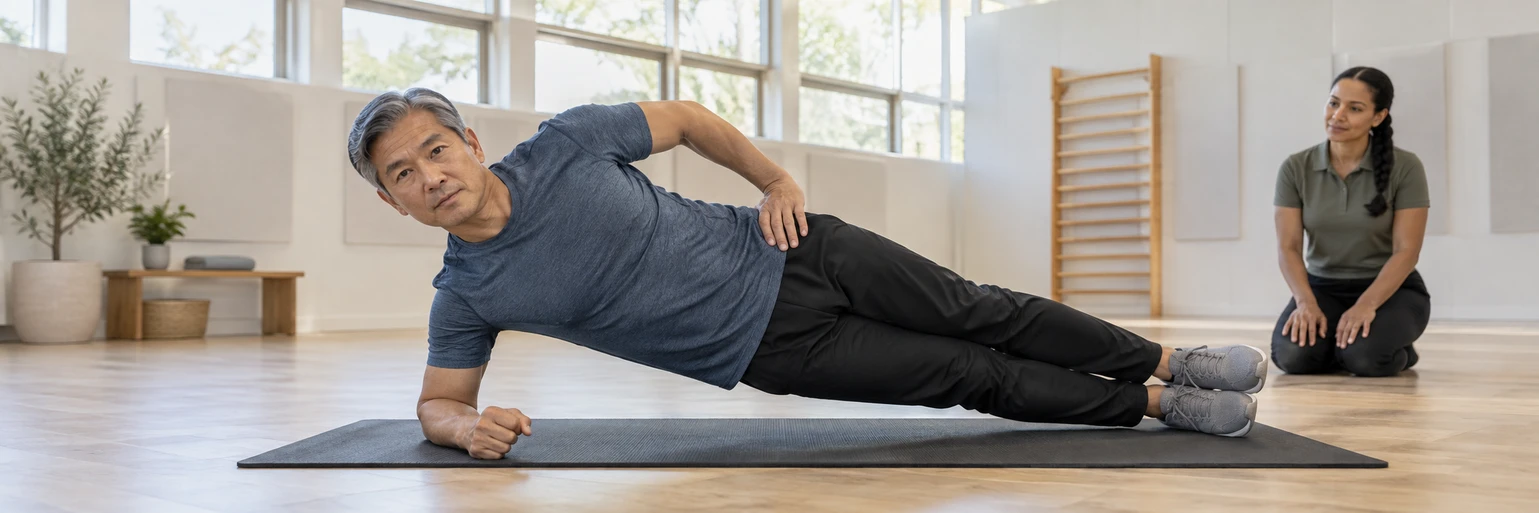
| Side plank | Lateral core endurance | Time held before breakdown |
| BODY-Q questionnaire | Body perception and related patient-reported outcomes | Validated questionnaire scores |
What Changed After the Treatment Series
At week 5, the treatment group improved from baseline on all four functional tests. Mean change was reported as 68% for prone hip extension repetitions, 42% for paced curl-ups, 53% for seated quadriceps extensions, and 73% for side-plank endurance. All four week-5 comparisons between treatment and control groups were statistically significant.
Those percentages sound large, but group averages do not predict an individual result. The study reported meaningful variation between participants, especially for the side-plank percentage change. A larger percentage can also reflect a lower starting value, so it should not be read as a universal increase in real-world strength. The untreated control group showed little change over the same period. The most defensible reading is that the treatment group performed better on the study’s selected tests at that time point.
The study also collected BODY-Q patient-reported outcomes. Treated participants reported improvement in several appearance and body-image domains, and 68% said their muscles felt stronger and firmer. Those responses are useful as secondary information, but they are different from the objective performance tests. Feeling stronger is not the same measurement as completing more repetitions or holding a position longer.
What “Four Weeks Later” Really Tells Us
The week-9 visit is useful because it tested whether the observed changes disappeared immediately after the treatment series. Four weeks after the last session, the treatment group still showed improvement from baseline in prone hip extension, paced curl-ups, and seated quadriceps extension. Between-group differences remained statistically significant for prone hip extension, seated quadriceps extension, and side-plank endurance. The paced curl-up comparison between groups was no longer statistically significant at that time point.
The side-plank result deserves a closer look because statistical comparisons answer different questions. At week 9, the difference between treatment and control groups remained statistically significant. The treatment group’s change from its own baseline, however, did not meet the study’s conventional significance threshold for that measure. That does not erase the finding. It shows why saying that “all gains lasted” would be too broad.
Four weeks is a short follow-up, and the trial does not tell us whether the measured changes persist for several months or whether maintenance sessions alter durability. It did not establish a permanent effect. Longer follow-up is needed before making claims about lasting performance benefits.
What the Study Can and Cannot Establish
The strongest conclusion is narrow: in this study, healthy adults who received six weekly sessions improved on selected repetition and endurance tests compared with an untreated control group. Several between-group differences were still present four weeks after treatment ended. That is more specific than saying the treatment “makes you fitter” or “improves athletic performance.” The tests involved muscles targeted by the protocol. The study did not evaluate aerobic fitness, balance, speed, agility, sport-specific skills, or injury prevention.
The trial also did not compare treatment with a structured resistance-training program. It therefore cannot establish that muscle stimulation is equivalent to exercise, superior to exercise, or a substitute for exercise. An untreated control group helps show whether changes differed from doing nothing during the study period. It does not answer how the protocol performs against squats, loaded resistance work, supervised strength training, or another active intervention.
Participant blinding was not possible, and there was no sham-stimulation group. The sample was small, with 19 people in each study arm. Follow-up extended only four weeks beyond the final session. The study was funded by Sofwave Medical. Two authors were company employees. The principal investigator disclosed a consulting relationship with the company.
Sofwave’s September announcement emphasized functional gains and short-term persistence after treatment. The journal authors also called for additional studies to confirm the effects, determine durability, and clarify the mechanisms involved. That is an appropriate boundary for the current evidence. The study supports further interest in functional outcomes, not a blanket promise of long-term physical-performance improvement.
How This Evidence May Fit Into a Client Conversation
For a healthy adult considering muscle stimulation, the most useful starting point is the goal. Someone focused on visible definition may care about aesthetic changes, while someone interested in functional conditioning may care more about repetitions, endurance, and whether any change lasts. The 2026 trial gives the second group more concrete information than an appearance-only study would. It also gives clinicians a clearer basis for explaining what has been measured and what remains uncertain.
Muscle stimulation may be discussed as a noninvasive conditioning option, but screening still matters. The research population was selected carefully, and the FDA-cleared indication is for stimulating healthy muscles rather than treating disease or replacing rehabilitation. Clients with medical conditions, implanted devices, recent procedures, pregnancy, or other health concerns should disclose that information before treatment. Suitability depends on health history, treatment goals, and appropriate screening. Aesthetic and rejuvenation goals should remain separate from medical treatment needs that belong in a different care pathway.
The practical takeaway is not that electrical stimulation has been proven to replace training. This specific 2026 protocol produced measurable short-term improvements on four targeted performance tests in a small randomized study. Several differences were still detectable four weeks later. The findings make functional performance a legitimate area for continued research rather than merely an extension of body-contouring language. Larger studies could test whether similar results appear in broader populations. Active exercise comparators, sham controls, and longer follow-up would also help define how meaningful and durable the changes are.
Which Questions Belong in Your Consultation?
Your reason for considering treatment should guide the discussion before choosing a procedure. The trial offers limited information about selected performance measures in healthy adults. These situations can help you identify the questions most relevant to your own decision.
- You want more visible definition: Ask which evidence concerns appearance and which findings concern counted repetitions or endurance.
- You want better performance during exercise: Ask whether the proposed approach has been tested against structured training and how progress would be measured.
- You have an implanted device, a recent procedure, or a rehabilitation need: Discuss that history before considering treatment, since the study’s selected population may not reflect your circumstances.
A useful next step is a discussion that connects your goals with appropriate screening and realistic expectations.
Frequently Asked Questions
Did the 2026 trial prove that muscle stimulation works like exercise?
No. The study compared treatment with an untreated control group, not with resistance training or another exercise program. It can show that the groups performed differently on the selected tests, but it cannot establish equivalence or superiority to exercise. A direct comparison with a structured exercise group would be needed to answer that question.
How long did the performance improvements last?
Researchers reassessed participants four weeks after the sixth and final treatment. Several improvements were still present, and three of the four between-group performance comparisons remained statistically significant at week 9. The study did not follow participants long enough to determine whether benefits persist for months or longer.
Were the results based only on how participants felt?
No. The main functional outcomes included counted repetitions and timed endurance tasks administered in a standardized way by evaluators who were blinded to group assignment. The study also included patient-reported BODY-Q measures, but those were separate from the objective performance tests. That separation helps distinguish perceived improvement from measured performance.
Who do these findings apply to most directly?
The findings apply most directly to healthy adults similar to those enrolled in the study. The research excluded people with several medical or treatment-related factors, and the FDA-cleared use is for conditioning healthy muscles rather than treating disease. Individual suitability still depends on health history, treatment goals, and appropriate screening.
Keep Your Broader Body Goals in View
Your interest in this research may sit alongside questions about activity or body contouring. Choose further reading that reflects the goal you actually want to discuss. Keep fat reduction, muscle appearance, and functional performance separate when comparing treatment claims.
Questions? We are here to help! Call 239-355-3294.
Medical review: Reviewed by Dr. Keith Lafferty MD, Fort Myers on October 25, 2026. Fact-checked against government and academic sources; see in-text citations. This page follows our Medical Review & Sourcing Policy.
