
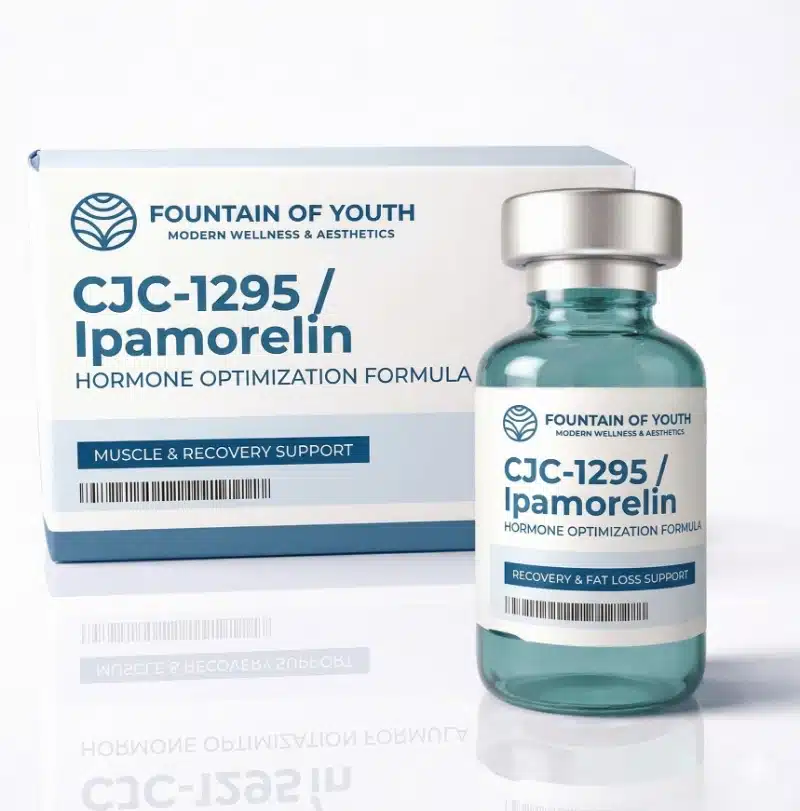
CJC-1295/Ipamorelin in Fort Myers: What GH Changes Actually Mean
Updated September 2026: Originally published in April 2026, this page has been substantially revised to reflect FDA’s compounding reviews of CJC-1295 and ipamorelin, the advisory-committee votes on both substances, current safety concerns, and the difference between changing growth-hormone markers and proving real-world wellness benefits.
The combination is easy to market. The evidence is harder.
CJC-1295 and ipamorelin are often sold together for sleep, recovery, lean muscle, fat loss, energy, and “anti-aging.” The pairing sounds logical because the two peptides act through different parts of the growth-hormone pathway. That does not mean those advertised outcomes have been proven in human trials.
- CJC-1295: a growth-hormone-releasing hormone analog. Human studies show that one long-acting DAC form can raise GH and IGF-1 in healthy adults.
- Ipamorelin: a ghrelin-receptor agonist that can trigger a pulse of GH release. Human pharmacology studies confirm that effect.
- The combination: widely marketed, but robust clinical trials have not established that the pairing reliably improves sleep, body composition, muscle growth, recovery, or healthy aging.
- FDA status: neither CJC-1295 nor ipamorelin is an FDA-approved drug, and FDA advisory committees voted against adding the evaluated forms to the 503A Bulks List.
For a patient, the useful question is not “Can these peptides raise growth hormone?” The better question is “What has actually been shown to happen in people after they do?”
Why Are CJC-1295 and Ipamorelin Paired?
The two compounds act at different receptors. CJC-1295 was designed to mimic growth hormone-releasing hormone, or GHRH, which signals the pituitary gland to release growth hormone. Ipamorelin acts as a growth hormone secretagogue through the ghrelin receptor.
That difference is the basis for the popular “two pathways” explanation used by peptide clinics. FDA’s CJC-1295 review even noted that wellness websites commonly market CJC-1295 with ipamorelin and claim synergistic growth-hormone release.
What is missing is the step that matters most clinically: high-quality human trials showing that the combination itself produces meaningful improvements in sleep, body fat, lean mass, strength, recovery, or quality of life. Mechanistic compatibility is not the same as proven synergy.
Is This the Same as Taking HGH?
No. This is one area where competitor explanations are useful. Recombinant human growth hormone, such as somatropin, supplies growth hormone directly. CJC-1295 and ipamorelin are intended to stimulate signaling involved in the body’s own GH release.
That difference matters, but it does not automatically make the peptide approach safer, more natural, or more effective. FDA-approved growth hormone products have approved indications, standardized manufacturing, labeled dosing, known contraindications, and established monitoring information. CJC-1295 and ipamorelin do not have that FDA-approved framework.
People with suspected true growth hormone deficiency need appropriate endocrine testing. A wellness peptide should not substitute for diagnosing a pituitary disorder.
What Human Research Exists for CJC-1295?
The best-known CJC-1295 study was published in 2006. Researchers gave healthy adults subcutaneous doses of a long-acting CJC-1295 formulation containing a drug-affinity complex, or DAC.
After a single injection, mean growth-hormone concentrations increased approximately two- to ten-fold for six days or longer. Mean IGF-1 concentrations increased approximately 1.5- to three-fold for nine to eleven days. After repeated doses, average IGF-1 remained above baseline for as long as 28 days.
Those findings establish a pharmacologic effect. They do not establish that CJC-1295 improves fat loss, muscle growth, sleep quality, athletic recovery, or “anti-aging.” FDA’s later review emphasized that the human studies involved healthy adults and did not measure endpoints such as lean mass, fat mass, or treatment of actual growth hormone deficiency.
The study also does not validate every product sold as “CJC-1295”
This is one of the most important details on the page. FDA evaluated five related substances: CJC-1295 free base, CJC-1295 acetate, CJC-1295 DAC free base, CJC-1295 DAC acetate, and CJC-1295 DAC trifluoroacetate.
FDA found inconsistent naming and characterization across the literature and marketplace. The agency concluded that the clinical studies appear to have involved a CJC-1295 DAC active moiety, but the exact salt form was often not identified.
That means evidence from a long-acting DAC formulation cannot simply be copied onto a product marketed as “CJC-1295 without DAC.” FDA specifically warned that the pharmacologic profile of CJC-1295 DAC cannot automatically be extrapolated to CJC-1295 without the DAC modification.
“With DAC” versus “without DAC” is not a minor label detail
The DAC modification was designed to extend exposure by allowing the peptide to bind to albumin. A product marketed without DAC may have a different duration and pharmacologic profile. FDA’s review found enough naming inconsistency that patients should not assume two products carrying the CJC-1295 name are interchangeable.
Before discussing dose or frequency, ask for the exact substance, whether DAC is present, the salt or counterion, the route, the pharmacy, and the evidence that applies to that particular form.
What Do Human Studies Show About Ipamorelin?
A human pharmacokinetic study evaluated ipamorelin in healthy male volunteers using intravenous infusions. The peptide produced a distinct growth-hormone pulse, with GH peaking within roughly an hour and declining afterward.
That shows ipamorelin can stimulate GH secretion. It does not establish that subcutaneous ipamorelin improves muscle gain, sleep, body composition, recovery, or age-related wellness.
FDA reviewed ipamorelin free base and ipamorelin acetate for growth hormone deficiency and postoperative ileus. The agency found no clinical evidence establishing effectiveness for growth hormone deficiency and no evidence supporting the proposed subcutaneous route for the conditions evaluated.
The one larger postoperative-ileus study used intravenous ipamorelin and failed to show significant improvement over placebo in its primary and secondary efficacy analyses. Development for that indication was reportedly discontinued after the disappointing results.
What Has Actually Been Proven—and What Has Not?
| Question | What Human Evidence Supports | What Remains Unproven |
|---|---|---|
| Can CJC-1295 raise GH/IGF-1? | Yes, a studied long-acting DAC formulation raised both markers in healthy adults. | That all CJC-1295 forms produce the same effect or clinical benefit. |
| Can ipamorelin trigger GH release? | Yes, human pharmacology studies demonstrated a GH pulse after administration. | That typical wellness dosing improves body composition, sleep, or recovery. |
| Does the combination build muscle? | No robust combination trial establishes this outcome. | Predictable lean-mass gains or better strength than training and nutrition alone. |
| Does it reduce body fat? | The CJC studies showed hormone-marker changes, not proven fat-loss outcomes. | Reliable weight loss or targeted fat reduction. |
| Does it improve sleep or recovery? | These are common marketing claims, not established outcomes from strong controlled trials of the combination. | A predictable improvement in sleep quality, injury recovery, or daily energy. |
FDA’s CJC-1295 Review Changed the Risk Conversation
FDA evaluated the five CJC-1295-related bulk drug substances for possible inclusion on the Section 503A Bulks List in the context of growth hormone deficiency.
The agency proposed that none of the five be included. FDA cited inconsistent naming and characterization, limited human safety information, lack of effectiveness data for actual growth hormone deficiency, unknown long-term safety, and nonclinical concerns involving certain DAC forms.
FDA’s current compounding safety page states that compounded CJC-1295 may pose immunogenicity risks for certain routes because of aggregation, peptide-related impurities, and API-characterization issues. FDA has identified serious adverse events associated with CJC-1295 including increased heart rate and systemic vasodilatory reactions, while available clinical data remain limited.
The December 2024 advisory committee voted against every evaluated CJC-1295 form
The Pharmacy Compounding Advisory Committee voted separately on the five substances. CJC-1295 free base received 0 yes and 13 no votes. CJC-1295 acetate received 1 yes and 12 no votes. The three evaluated DAC forms each received 0 yes and 13 no votes.
These were advisory votes about the 503A Bulks List. They were not FDA drug-approval votes and should not be described as a blanket ban. They do show that the committee was not persuaded by the available characterization, safety, and effectiveness evidence.
FDA Reached a Similar Conclusion on Ipamorelin
FDA separately evaluated ipamorelin free base and ipamorelin acetate in October 2024. The agency concluded that the balance of characterization, historical-use, effectiveness, and safety information weighed against adding either substance to the 503A Bulks List.
The advisory committee vote was similarly unfavorable. Ipamorelin free base received 0 yes, 12 no, and 1 abstention. Ipamorelin acetate received the same vote.
FDA also raises route-specific safety questions. Its current safety page notes potential immunogenicity from aggregation or peptide-related impurities and says ipamorelin acetate contains unnatural amino acids that add characterization complexity.
In the intravenous postoperative-ileus trial, reported events included hypokalemia, insomnia, hyperglycemia, nausea, vomiting, abdominal distention, and deaths. FDA explicitly states that it is unclear whether the two deaths were caused by ipamorelin. That study does not establish what would happen with a different dose or subcutaneous route, which is exactly why route-specific safety data matter.
What About the Popular Sleep, Muscle, Fat-Loss, and Recovery Claims?
These are the claims that matter most to people shopping for this combination, and they are where marketing usually outruns evidence.
Sleep
Growth hormone release is linked with normal sleep physiology, but that does not prove that raising GH with CJC-1295/ipamorelin treats insomnia or improves restorative sleep. Someone sleeping poorly should still consider sleep apnea, insomnia, alcohol, medications, stress, pain, restless legs, and other common causes.
Muscle and athletic recovery
Higher GH and IGF-1 levels are not the same as demonstrated strength or recovery gains. The CJC-1295 human trials FDA reviewed did not establish improvements in lean body mass, strength, exercise recovery, or injury healing.
Body fat
The combination is frequently marketed for body composition. Direct evidence proving predictable fat loss from the pairing is lacking. If body composition is the main concern, nutrition, resistance training, sleep, metabolic health, medications, and approved weight-management options may be more relevant depending on the patient.
“Anti-aging”
“Anti-aging” is not a measurable diagnosis. Feeling older can mean poor sleep, loss of conditioning, menopause or low testosterone, thyroid disease, iron deficiency, depression, chronic pain, medication effects, weight gain, or another health problem. A peptide should not replace identifying the cause.
What Should Be Evaluated Before a Growth-Hormone Peptide Discussion?
There is no FDA-approved screening or monitoring protocol for the CJC-1295/ipamorelin combination. That makes individualized medical review more important, not less.
A useful evaluation starts with the reason for treatment. Fatigue, poor recovery, body-composition changes, low exercise tolerance, and disrupted sleep can come from many conditions that require different care. Health history, current medications, metabolic health, sleep quality, endocrine symptoms, prior cancer history, swelling, headaches, glucose concerns, and other risk factors can change the discussion.
When growth-hormone signaling is being intentionally altered, a provider may decide that laboratory or other monitoring is appropriate. The exact testing should follow the patient’s clinical picture rather than a universal internet protocol.
How Fountain of Youth Approaches This Specific Peptide Question
The main Fountain of Youth peptide program contains the broader Fort Myers pricing, provider, lab, consultation, and visit information. This page has a different job: helping a patient understand what CJC-1295 and ipamorelin can actually be said to do before discussing a protocol.
For this combination, the consultation should clarify the goal, the exact CJC-1295 form being considered, whether DAC is present, the ipamorelin form, proposed route, current sourcing and pharmacy information, relevant labs, current regulatory status, and what established alternatives deserve comparison.
Current availability, formulation, treatment length, dosing, and price should be confirmed during the consultation rather than treated as permanent facts on an individual peptide page. Questions can be discussed by calling 239-355-3294.
Questions People Commonly Ask
Are CJC-1295 and ipamorelin FDA-approved?
No. Neither CJC-1295 nor ipamorelin is an FDA-approved drug in the United States for sleep, recovery, muscle gain, fat loss, healthy aging, growth hormone deficiency, or another indication.
Is CJC-1295/Ipamorelin the same as HGH?
No. HGH supplies growth hormone directly. CJC-1295 and ipamorelin act through signaling pathways intended to stimulate endogenous GH release. That mechanistic difference does not establish that the peptide combination is safer or more effective.
Does the combination increase IGF-1?
A long-acting CJC-1295 DAC formulation increased IGF-1 in healthy adults. That does not prove every CJC-1295 product has the same effect, and it does not prove that the combination produces meaningful changes in body composition, sleep, or recovery.
What is the difference between CJC-1295 with DAC and without DAC?
DAC is a drug-affinity modification designed to extend exposure by binding the peptide to albumin. FDA has emphasized that CJC-1295 naming is inconsistent and that evidence from DAC-containing forms cannot automatically be applied to products without DAC.
Does ipamorelin build muscle?
Human studies show that ipamorelin can stimulate a GH pulse. Strong clinical evidence has not established predictable muscle or strength gains from typical wellness use.
Does CJC-1295/Ipamorelin help sleep?
Sleep improvement is widely marketed, but robust trials of the combination have not established it as an insomnia or sleep-quality treatment. Persistent poor sleep deserves evaluation for common causes such as sleep apnea and insomnia.
Why did FDA advisory committees vote against these peptides for the 503A list?
The committees were not persuaded that the available characterization, safety, and effectiveness evidence supported inclusion of the evaluated forms. Those votes concerned compounding policy, not FDA approval of a finished drug.
What should I ask before considering the combination?
Ask which CJC-1295 form is being used, whether it contains DAC, which ipamorelin form is proposed, the route, pharmacy, sourcing, current regulatory status, human evidence for your goal, monitoring plan, total cost, and what established alternatives should be considered.
Key Sources
- FDA CJC-1295 evaluation – FDA’s detailed review of five CJC-1295-related bulk substances, including characterization, safety, human evidence, and its 503A recommendation.
- FDA CJC-1295 meeting minutes – Records the December 2024 advisory-committee votes on the five evaluated CJC-1295 forms.
- FDA ipamorelin evaluation – Detailed review of ipamorelin free base and acetate, including human evidence and safety concerns.
- FDA ipamorelin meeting minutes – Records the October 2024 advisory-committee votes.
- FDA peptide safety concerns – Current FDA summary of safety issues involving compounded CJC-1295 and ipamorelin acetate.
- CJC-1295 human study – Randomized studies demonstrating prolonged GH and IGF-1 elevation in healthy adults after a long-acting CJC-1295 formulation.
- Ipamorelin human study – Human pharmacokinetic and pharmacodynamic study demonstrating a GH pulse after ipamorelin administration.
The Useful Takeaway Is More Specific Than “It Raises Growth Hormone”
CJC-1295 and ipamorelin genuinely affect growth-hormone signaling. That part is not simply marketing. The gap appears when a measurable hormone change is turned into confident promises about sleep, fat loss, muscle growth, recovery, or anti-aging.
A better decision starts with the patient’s actual problem, the exact substances being considered, and the evidence for that use. It should also acknowledge the FDA compounding reviews, the unfavorable advisory votes, route-specific safety uncertainties, and the fact that the widely marketed CJC-1295/ipamorelin combination has not been validated for the broad wellness outcomes commonly attached to it.