
OCT and Confocal-Style Imaging in 2025–2026
When imaging adds clarity before a facial plan
Noninvasive skin imaging can help when a visible change, texture shift, or uneven area needs more context before elective treatment. OCT and confocal-style tools do not replace medical judgment, but they can support a more careful planning conversation when surface appearance alone leaves uncertainty.
- Useful when a specific area needs documentation before cosmetic treatment begins.
- Helpful for deciding whether to treat, monitor, adjust, or refer first.
- Most appropriate when imaging supports a defined question, not broad scanning without purpose.
Review the area before choosing a facial approach
A thoughtful visit can pair imaging-informed assessment with a tailored customized facial plan, especially when skin texture, redness, pigment, or visible change needs context before treatment in Fort Myers.
Physician-reviewed content • Evidence-aware care • Personalized treatment planning
Planning can include more than the scan
Imaging makes the most sense when it fits into a broader skin assessment. Related pages on AI skin analysis and advanced facial technology explain how visual tools can support careful aesthetic planning without overstating what technology can prove.
Why people seek imaging before deciding on treatment
Skin changes rarely arrive with a clear label. A spot looks different than it did last year, redness lingers despite careful skincare, or texture shifts without an obvious cause. Many people reach a point where a visual exam alone feels insufficient for making a confident decision about what to do next. Noninvasive skin imaging exists for that moment. These tools aim to reduce uncertainty before treatment planning by showing structural information that the naked eye cannot see, while avoiding needles or incisions.
In clinical practice, “treatment planning” does not mean choosing a device or facial protocol in isolation. Planning involves deciding whether an area needs medical evaluation first, whether it is safe to proceed, how aggressive a treatment should be, and how to monitor change over time. Imaging can influence each of those decisions when used appropriately and within evidence-supported boundaries.
The core technologies in plain language
Optical coherence tomography (OCT)
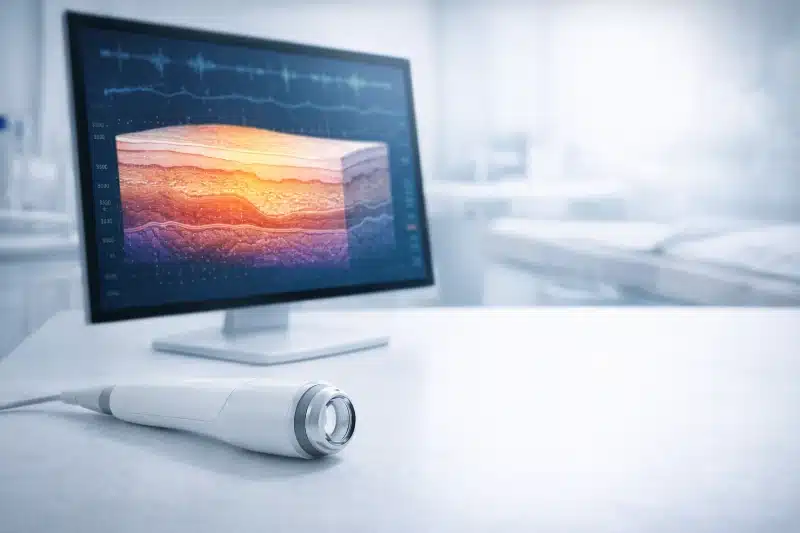
Optical Coherence Tomography
OCT uses light to create cross-sectional images of skin, producing views that resemble vertical slices through tissue. These images emphasize structure rather than surface appearance. Clinicians use OCT to visualize layers, estimate depth, and understand boundaries across a defined area. The technology scans quickly and covers a relatively broad field, which is why it has been studied for mapping and delineation tasks in dermatology, including using optical coherence tomography to optimize Mohs micrographic surgery.
For patients, the key takeaway is practical rather than technical. OCT shows what is happening below the surface without breaking the skin. That additional information can change whether an area is treated immediately, watched over time, or evaluated further.
Confocal-style imaging
Confocal-style imaging focuses on high-resolution views close to the skin surface. Instead of vertical slices, it often presents horizontal, en-face images that highlight fine patterns and cellular-level detail. Reflectance confocal microscopy is the best-known example, and it has been used to help evaluate suspicious features without immediately resorting to biopsy, as described in Introduction to reflectance confocal microscopy and its use in clinical practice.
From a patient perspective, confocal-style imaging addresses a different question than OCT. Rather than asking “how deep or how wide,” confocal approaches ask “what does this look like at a very fine scale.” Those answers can support decisions about monitoring, referral, or next steps when a visual exam leaves doubt.
Where LC-OCT fits
Line-field confocal OCT, often shortened to LC-OCT, has gained attention because it attempts to combine strengths from both approaches. It produces both vertical and horizontal high-resolution views, offering depth context alongside confocal-like detail. Current research evaluates LC-OCT as an adjunct tool rather than a replacement for established diagnostic pathways, including a systematic review and meta-analysis on LC-OCT diagnostic performance for skin tumors. That distinction matters, because the strongest evidence supports imaging as a decision-support aid, not as a standalone verdict.
The table below summarizes what each modality is designed to show and how the evidence base has been described in peer-reviewed literature. It is meant to help readers understand what questions each tool can support during planning conversations.
| Modality or evidence snapshot | What it is designed to show | How the literature describes use in planning | Notable published figures or outcomes |
|---|---|---|---|
| Optical coherence tomography (OCT) | Cross-sectional structural imaging of skin architecture | Studied for pre-procedure mapping and delineation in dermatology | Clinical study reports improved pre-surgical delineation outcomes when OCT mapping is used in Mohs planning contexts (study-level outcomes described in the Scientific Reports article) |
| Reflectance confocal microscopy (RCM) | High-detail, near-surface “confocal-style” imaging patterns | Used as a noninvasive adjunct in clinical evaluation workflows | Clinical-practice review describes how RCM supports decision-making and can reduce unnecessary biopsies in appropriate settings |
| LC-OCT (technology description from tumor meta-analysis) | Vertical and horizontal images; 3D structural representation from combined views | Positioned as a rapid, noninvasive diagnostic aid (adjunct), not a replacement for histology | Meta-analysis reports pooled sensitivity 86.9% and pooled specificity 91.1%, with AUC 0.914, while emphasizing limited study counts |
| LC-OCT case-based clinical use (PubMed/PMC article) | Noninvasive evaluation using RCM and LC-OCT views in a documented clinical scenario | Illustrates how multi-modality noninvasive imaging can support evaluation in practice | Published clinical report (with linked full text in PMC) documents application in a defined patient group |
| What remains definitive when uncertainty persists | Diagnosis confirmed by histopathology when clinically indicated | Imaging supports decisions, but clinicians still rely on biopsy when certainty is required | Meta-analysis and clinical practice literature consistently describe imaging as adjunctive rather than definitive |
What “treatment planning” actually means
Treatment planning is a sequence of decisions, not a single choice. A clinician starts by asking whether a visible change raises medical concern. Imaging may help clarify that risk and determine whether further evaluation is appropriate. If no immediate red flags appear, planning shifts toward how and when to treat, or whether to monitor instead.
Choose the next step with clearer context
When imaging helps define whether skin should be treated, watched, or evaluated further, the next conversation can connect those findings to a realistic luxury facial plan instead of relying only on surface appearance.
Imaging also supports conversations about boundaries and expectations. Structural information can guide how conservative or aggressive an approach should be. It can also define what should be tracked over time, so future changes are assessed against documented baselines rather than memory.
Where evidence is strongest today
The most robust, well-documented planning applications for OCT and confocal-style imaging come from medical dermatology. OCT has been studied for pre-procedure mapping, where understanding lesion boundaries and depth can influence surgical planning. Research in this area demonstrates that imaging can change operative decisions, reduce uncertainty, and improve efficiency in specific contexts.
LC-OCT has been evaluated across multiple studies for its diagnostic performance as an adjunct to clinical and dermoscopic assessment. Meta-analyses summarize sensitivity and specificity values that show meaningful accuracy when used by trained clinicians. Those numbers explain why interest continues to grow, while also underscoring why histology remains the definitive standard when certainty is required.
Confocal imaging shows strength in clarifying equivocal findings near the skin surface. Clinical practice literature describes how reflectance confocal microscopy can support evaluation and help reduce unnecessary biopsies in appropriate settings. That finding matters for access and consistency, particularly when local expertise is limited.
What imaging can help clarify for patients
One of the most valuable roles of imaging is helping clinicians decide whether something warrants further diagnostic workup before elective treatment. Imaging can increase confidence in that decision by adding structural or cellular context to a visual exam. That clarity protects patients from inadvertently treating an area that should be evaluated more carefully.
Some findings do not require immediate intervention. Imaging can support a “watch and document” approach by capturing baseline structure. Follow-up scans can then be compared to that baseline, helping clinicians distinguish stability from change.
Structural information can influence how aggressive a treatment should be and when it should occur. Planning may involve spacing sessions differently, choosing a gentler approach, or postponing treatment until uncertainty is resolved. Imaging does not dictate those choices on its own, but it informs them.
What imaging cannot promise
Imaging cannot replace pathology when a definitive diagnosis is required. It cannot guarantee that a finding is harmless, even when images appear reassuring. It also cannot predict cosmetic outcomes with precision, because results depend on biology, technique, healing response, and aftercare.
Clear boundaries matter for patient trust. Imaging adds information, but it does not remove uncertainty entirely. Ethical use involves explaining what the images support and what they cannot confirm.
A realistic imaging-assisted visit
A typical visit begins with history and a focused exam. The clinician identifies specific areas that raise questions and selects those targets for scanning. Imaging concentrates on decision-relevant zones rather than scanning everything indiscriminately.
Images are reviewed in context, sometimes immediately and sometimes with additional expert input. The discussion then turns to decisions. Proceeding with treatment, modifying the plan, monitoring, or referring for further evaluation all remain possible outcomes. The value lies in choosing among those options with more information than a visual exam alone provides.
What is emerging in 2025–2026
Several developments shape how patients experience imaging-assisted planning today. Research has quantified diagnostic performance for LC-OCT, providing concrete numbers rather than anecdotal claims. That shift supports evidence-based adoption rather than novelty-driven use.
Researchers continue to explore ways to streamline interpretation and reduce bottlenecks in clinical workflows, while published evidence still centers on clinician-interpreted imaging and documented diagnostic performance. Those efforts matter most when they improve consistency, access to qualified review, and clear decision-making for patients.
Standardization also matters. Researchers emphasize consistent image acquisition, training, and repeatability. Reliable follow-up depends on comparing like with like. That focus on standards reflects a maturing field moving beyond early experimentation.
Who tends to benefit most
People with new or changing spots often gain the most reassurance or clarity from imaging. Those with significant sun exposure or prior skin cancer history may also benefit from structured evaluation before elective treatment. Imaging appeals to patients who prefer objective documentation rather than subjective comparison, particularly when planning involves deferring or spacing interventions.
Comfort, safety, and limits
Imaging is surface-based and generally comfortable. The main limitation is scope. Scans answer specific questions about specific areas. Findings elsewhere on the skin still require clinical attention. Imaging should never delay timely medical evaluation when concerning symptoms appear.
Interpreting results without confusion
Patients benefit from simple framing. Asking what the scan rules in or out, what remains uncertain, and what would prompt reassessment keeps discussions grounded. Written plans help ensure that decisions do not rely on memory alone.
Clinics that use imaging responsibly stay aligned with evolving evidence and standards. Fountain of Youth stays current on developments in noninvasive skin imaging so planning decisions reflect validated use rather than marketing trends.
3 Practical Tips
- Bring a brief timeline describing what changed and when, including photos if available.
- Focus the scan on one to three areas where clarity matters most, rather than attempting to image everything.
- Request a clear next-step plan that explains whether to proceed, monitor, or evaluate further, along with timing for reassessment.
When imaging-assisted planning may fit
Noninvasive imaging is most useful when a specific skin concern could influence timing, treatment intensity, or referral decisions. It works best as part of a focused visit, not as a broad promise that every visible change can be fully explained by a scan.
- A visible area has changed and should be evaluated before elective facial treatment.
- Texture, redness, or pigment needs documentation before choosing a protocol.
- A conservative plan makes more sense until the area’s behavior becomes clearer.
For skin that needs both caution and comfort, imaging findings may help guide a gentler plan connected to skin barrier health.
Frequently asked questions
Can OCT or confocal imaging tell for sure if something is cancer? These tools can support decisions and reduce uncertainty, but they do not replace definitive diagnostic pathways when certainty is required.
If imaging looks reassuring, is it always safe to proceed with treatment?
Safety depends on context, the specific area scanned, and the presence or absence of red flags elsewhere.
Why is LC-OCT discussed more now than before?
Recent studies have quantified its performance and explored how it complements existing assessment methods, increasing confidence in appropriate use.
Can imaging track changes over time?
Baseline and follow-up scans can support monitoring, provided acquisition is consistent and interpretation remains clinically grounded.
Related planning options for careful skin decisions
Readers comparing imaging, visual analysis, and skin treatment options may also find helpful context in what medical-grade skincare means and how polynucleotides for skin repair fit into broader conversations about texture, recovery, and treatment planning.
Questions? We are here to help! Call 239-355-3294.
Medical review: Reviewed by Dr. Keith Lafferty MD, Medical Director at Fountain of Youth SWFL on February 5, 2026. Fact-checked against government and academic sources; see in-text citations. This page follows our Medical Review & Sourcing Policy and undergoes updates at least every six months. Last updated February 5, 2026.