
AI skin analysis has moved from novelty to practical clinical tool in facial care. In 2025–2026, its value comes from helping patients and providers see consistent patterns in tone, redness, pores, and texture over time, rather than relying on memory or subjective impressions. When used correctly, these systems support more thoughtful personalization while still requiring human judgment and realistic expectations.
A clearer baseline before choosing a facial
AI skin analysis can help make facial planning more specific by showing visible patterns in tone, redness, pore visibility, and texture. The scan does not replace a trained provider’s judgment, but it can give the visit a more consistent starting point. That matters when skin concerns overlap or change slowly over time.
- Useful for comparing current skin patterns with future visits under similar conditions.
- Helpful when redness, dullness, uneven tone, or texture concerns appear together.
- Best interpreted as a planning aid, not a diagnosis or guaranteed result forecast.
Your facial plan should start with visible patterns
A scan can help the provider decide whether your Fort Myers visit should focus on calming, hydration, brightening, or surface refinement within a customized facial plan.
Physician-reviewed content • Evidence-aware care • Personalized treatment planning
When imaging fits with other facial options
AI-based imaging pairs well with advanced facial technology when the goal involves careful tracking, and it may also support decisions around noninvasive skin imaging when deeper visual context is useful.
What AI skin analysis actually does
AI skin analysis systems evaluate standardized facial images using trained algorithms. The output usually appears as color maps, regional scores, or side-by-side comparisons that highlight where visible features cluster or change. These tools do not diagnose disease and do not replace a professional exam. Their role stays focused on appearance-based metrics that can be tracked across visits.
The strongest evidence supports their use for pattern recognition and repeatability. Peer-reviewed discussions of AI in aesthetic dermatology describe how image-analysis models can support more objective assessments of visible skin features when standardized photos are used. That reliability allows clinicians to establish a baseline and measure relative change rather than relying on a single snapshot or personal opinion.
Patients often arrive with a simple goal such as “I want my skin to look smoother” or “My redness looks worse lately.” AI-based tools help convert that goal into visible categories that can be revisited later, which can reduce the frustration that comes from comparing today’s mirror to a memory of last month. The technology works best as a measurement aid, not as a promise engine.
How imaging captures the skin
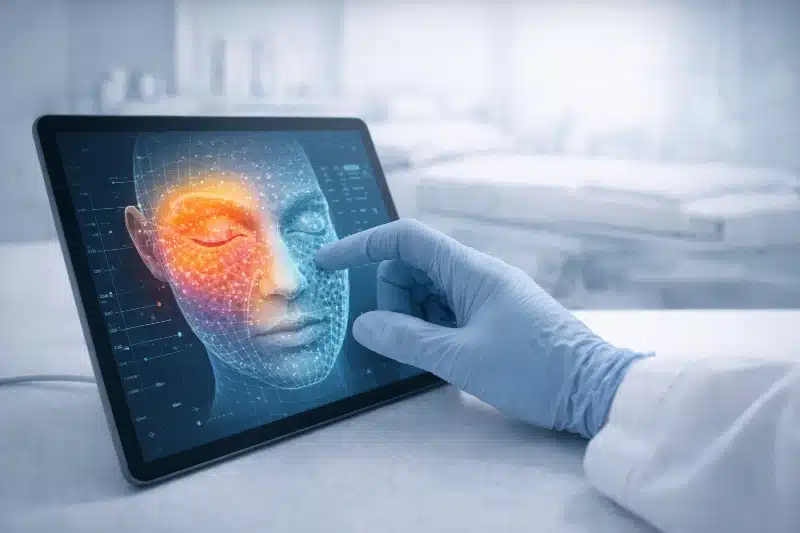
What AI skin analysis actually does
Lighting modes and why they matter
Most AI systems rely on controlled lighting conditions to isolate different surface and subsurface features. Standard lighting shows overall appearance, while cross-polarized lighting reduces surface shine and makes subsurface patterns easier to see. Some systems include UV or fluorescence-style imaging that highlights features not obvious under normal light.
Consistent capture matters because lighting strongly influences what the algorithm sees. Variation in results due to environmental and postural factors is emphasized in scientific discussions of full-face imaging systems, and that same need for consistency is also a recurring theme in standardization-focused reviews of AI methods. Reliable clinics follow the same capture protocol at every visit to reduce this variability.
Environmental and day-of-visit effects
Skin appearance shifts with hydration, oil production, recent exfoliation, and topical products. Makeup, tinted sunscreen, and self-tanner alter color and surface reflectance, which affects AI scoring. Even temperature and humidity can subtly influence redness and texture readings. These factors explain why short-term fluctuations should be interpreted cautiously.
Review the scan before choosing intensity
When imaging shows mixed redness, texture, and tone patterns, a conservative skin barrier health approach may fit better than immediately choosing stronger exfoliation or brightening steps.
Different imaging modes used in AI skin analysis emphasize certain facial appearance features more than others. This chart summarizes what each mode highlights and typical limitations to keep in mind when interpreting results.
| Imaging Mode | Primary Features Highlighted | Typical Use Case | Common Limitations |
|---|---|---|---|
| Standard Color | Overall tone and visible pigmentation | Baseline appearance evaluation | Affected by surface shine and lighting |
| Cross-Polarized | Subsurface patterns, pigment/vascular contrast | Assessing redness and deeper tone patterns | More sensitive to capture setup consistency |
| UV/Fluorescence-Style | Spots not visible under normal light | Detecting subsurface irregularities | Can be influenced by prior product residues |
| Side/Angle Lighting | Surface texture and fine lines | Evaluating texture and relief patterns | Shadows can exaggerate features |
| Composite/Algorithm Output | Aggregated feature scores | Trend tracking over time | Dependent on consistent input conditions |
The four appearance areas AI tracks best
Tone and pigment patterns
Tone tracking focuses on distribution rather than a single color value. Algorithms identify areas where pigment appears denser or uneven compared with surrounding skin. Research comparing AI outputs with validated imaging systems shows strong alignment for pigment mapping under controlled conditions. Changes in tone patterns usually occur gradually, making AI useful for long-term trend monitoring.
Redness and vascular appearance
Redness metrics act as appearance proxies rather than direct measures of inflammation or blood flow. Comparative studies show moderate to strong correlations between AI-based redness scoring and established clinical instruments. This makes redness tracking helpful for monitoring sensitivity-prone skin and evaluating whether routines calm or aggravate visible flushing.
Pore visibility
AI pore analysis evaluates visibility and distribution, not permanent pore size. Updated tools have demonstrated improved agreement with dermatologist assessments across diverse skin tones. These systems work best for tracking relative change, such as whether pores appear less noticeable after texture or oil-balance improvements.
Texture and surface irregularity
Texture metrics assess raised and depressed surface areas that contribute to roughness. Independent precision studies show that texture scores remain relatively stable when imaging conditions stay consistent. Short-term improvements often reflect hydration or barrier support, while deeper textural change develops more slowly.
Accuracy, repeatability, and limits
AI skin analysis performs best when used for comparison across time under the same conditions. Independent evaluations of established imaging systems report that overall differences across repeated measurements can stay relatively low under controlled conditions, supporting their use for tracking trends. Absolute scores tend to be more stable than percentile rankings, which can fluctuate even when true appearance changes little.
Interpretation still matters. Variability increases for certain features, especially redness, and small differences may reflect noise rather than meaningful change. Evidence syntheses emphasize the importance of standardized protocols and careful interpretation in aesthetic applications of AI, which aligns with the caution highlighted in peer-reviewed standardization and validation discussions.
Personalization in real-world facial planning
When tone patterns guide decisions
Uneven tone often reflects cumulative sun exposure, pigment clustering, or barrier disruption. AI maps help prioritize gentler, barrier-supportive approaches before aggressive treatments. Gradual pacing reduces irritation that could worsen visible unevenness.
When redness leads the plan
Redness-dominant patterns benefit from conservative sequencing and close monitoring. AI tracking shows whether calming strategies reduce visible flushing or if adjustments are needed. This feedback supports personalization without escalating intensity too quickly.
When pores and texture take priority
Texture and pore visibility frequently overlap. AI reports help distinguish surface roughness from oil-related shine, guiding more targeted adjustments. Improvements often appear first in texture, with pore visibility changing as a secondary effect.
Mixed patterns, which are most common
Most faces show overlapping concerns. AI summaries help clinicians balance competing priorities, such as improving texture without aggravating redness. The technology supports sequencing rather than simultaneous over-treatment.
Diversity, fairness, and responsible use
Evidence shows that some AI tools perform differently across skin tones, which makes calibration and clinician oversight essential. Updated algorithms demonstrate improved performance across diverse phototypes, but results still require context. Patients with deeper skin tones benefit when providers understand these limitations and interpret outputs cautiously.
Research in dermatology imaging emphasizes that machine learning systems can detect subtle visual differences in skin images, while also underscoring the importance of representative data and validation; this broader context is reviewed in AI in dermatology. Patients should feel comfortable asking how tools are calibrated and reviewed.
Privacy also matters. Systems typically store images, scores, and timestamps. Patients should understand how long data is kept and who can access it, and clinics should obtain clear consent.
What patients experience during a visit
The imaging process usually takes only a few minutes. Patients position their face in a standardized setup, images are captured, and results appear immediately. The most valuable part follows: a discussion that connects visual data to a realistic care plan.
At Fountain of Youth in Fort Myers, staff stays current on developments in AI skin analysis to ensure that imaging supports thoughtful personalization rather than replacing professional judgment.
3 Practical Tips
- Arrive with a clean face and skip tinted products when possible so images reflect your natural skin.
- Try to schedule follow-up scans at similar times of day and under similar conditions.
- Focus on trends across multiple visits, not single-scan “wins” or “losses.”
When AI is not enough
Persistent irritation, sudden pigment changes, or unexplained redness should prompt medical evaluation rather than cosmetic tracking alone. AI tools support appearance monitoring but cannot rule out underlying conditions. Responsible care recognizes when to pause and seek further assessment.
When AI-guided facial planning may fit
AI skin analysis may fit when a patient wants a more concrete starting point before choosing a facial. It can also help when concerns feel vague, change with weather or products, or involve several visible patterns at once. The best use comes from matching the scan with a provider’s evaluation and a realistic care sequence.
- Consider it when tone, redness, pores, or texture concerns need clearer prioritization.
- Use it cautiously when recent exfoliation, irritation, makeup, or tinted products could affect readings.
- Expect the scan to support treatment planning, not diagnose medical skin conditions.
Patients comparing facial choices may also review what medical-grade skincare means before deciding how home care should support in-office treatment.
Frequently Asked Questions
Can AI skin analysis diagnose skin conditions?
AI skin analysis evaluates visible patterns but does not diagnose disease. The systems focus on appearance metrics like tone and texture rather than medical criteria. A qualified clinician must assess symptoms or concerns that suggest a medical condition.
If my score changes after one facial, is that meaningful?
Single-visit changes often reflect hydration or surface effects rather than lasting improvement. Meaningful interpretation comes from consistent trends across multiple visits. Short-term fluctuations should be viewed cautiously.
Does makeup or sunscreen affect results?
Tinted products and heavy sunscreens can alter color and reflectance. These changes influence AI scoring and reduce comparability. Clean, product-free skin produces the most reliable images.
Is AI skin analysis accurate for all skin tones?
Performance has improved across diverse skin tones, but differences still exist. Clinician oversight helps interpret results fairly and safely. Patients should feel comfortable asking how tools are calibrated and reviewed.
Next steps after reviewing your skin patterns
A scan may point toward a gentler hydrating facial when comfort and barrier support matter most, or a more tone-focused brightening facial when uneven appearance becomes the main concern.
Questions? We are here to help! Call 239-355-3294.
Medical review: Reviewed by Dr. Keith Lafferty MD, Fort Myers on February 5, 2026. Fact-checked against government and academic sources; see in-text citations. This page follows our Medical Review & Sourcing Policy and undergoes updates at least every six months.