
Biotin Shots Sound Simple. The Evidence Is More Nuanced.
- Biotin deficiency can cause hair loss, rash, and brittle nails, but true deficiency is uncommon in people eating a normal mixed diet.
- Biotin is heavily marketed for hair, skin, and nails, yet good evidence for visible benefits in people who are not deficient remains weak.
- Injections are not automatically better absorbed than oral biotin: NIH reports that free oral biotin is absorbed very efficiently.
- High-dose biotin can interfere with important blood tests, including some thyroid and heart-attack tests, so disclosure before lab work matters.
Fountain of Youth SWFL offers biotin as one option within its vitamin injection program. The useful question is not “Are shots stronger?” It is whether biotin makes sense for your goal, what evidence supports that goal, and what you need to know before the injection.
What Does Biotin Actually Do?
Biotin is vitamin B7, a water-soluble B vitamin that helps several enzymes process fats, carbohydrates, and amino acids. Your body needs it. That part is not controversial.
What often gets lost in advertising is the difference between needing biotin and taking extra biotin. A nutrient can be essential without providing extra benefits when you already have enough.
NIH notes that biotin deficiency is rare, and severe deficiency has not been reported in healthy people eating a normal mixed diet. Adults have an adequate intake target of 30 micrograms per day, and many common foods contribute biotin.
Does Biotin Really Help Hair and Nails?
This is the reason many people click on a page like this. You notice more hair in the shower, your nails keep splitting, or your hair simply feels thinner than it used to. Biotin is one of the first supplements that appears in search results.
The evidence is much less dramatic than the marketing. NIH says claims for hair, skin, and nail improvement are supported mainly by a few small studies and case reports. A 2024 review looking specifically at higher-quality hair-growth studies found only three studies that met its criteria. The best placebo-controlled study did not find a significant hair-growth advantage for biotin.
That does not mean biotin never helps. People with an actual deficiency or certain uncommon disorders can improve when the deficiency is corrected. It means a healthy person with normal biotin status should not be promised thicker hair simply because the dose is high or delivered by injection.
If hair shedding is the main concern, the more useful conversation may involve iron status, thyroid function, recent weight loss, medications, hormonal changes, nutrition, stress, scalp conditions, or other causes. Biotin is only one possible piece of that puzzle.
Oral vs. Injectable Biotin: What Absorption Really Looks Like
A common reason people consider injections is the assumption that oral biotin is poorly absorbed and that an IM shot delivers dramatically more usable biotin. Current evidence does not support that comparison.
The NIH Office of Dietary Supplements reports that the absorption rate of free oral biotin is 100%, even at pharmacologic oral doses up to 20 mg per day. Oral biotin therefore should not be dismissed as an unreliable route for most people simply because it passes through the digestive system.
| Question | Oral Biotin | IM Biotin | What Matters Most |
|---|---|---|---|
| Absorption | Free oral biotin is absorbed very efficiently according to NIH | Bypasses the gastrointestinal route | Injection should not be sold as automatically superior absorption |
| Convenience | Taken at home | Requires an office injection | The better route depends partly on the reason for treatment and patient preference |
| Hair and nail evidence | Limited benefit shown outside deficiency or selected conditions | No strong evidence that injection changes that limitation | Correcting a real need matters more than choosing the most intensive route |
| Lab-test interference | Possible at high doses | Still relevant because the risk comes from circulating biotin | Tell your clinician and laboratory what you are taking |
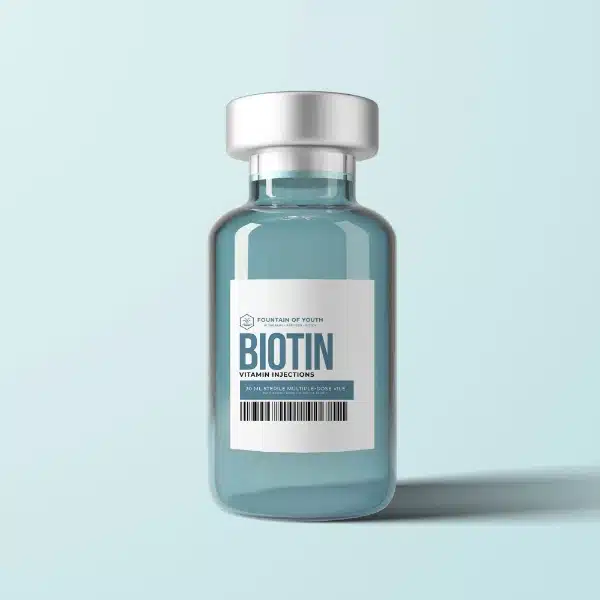
Biotin injections are one option on Fountain of Youth SWFL’s vitamin injection menu.
Who Might Need a Closer Biotin Review?
Most people do not need high-dose biotin simply because they have fatigue, hair shedding, dull skin, or brittle nails. Those symptoms have many possible causes.
A closer review makes more sense when there is a genuine risk factor for low biotin status or another reason to question nutritional adequacy. NIH identifies several groups that deserve particular attention:
- People with biotinidase deficiency. This is a rare inherited disorder detected through newborn screening in the United States. It is generally treated with lifelong oral biotin, which is another reason this page should not imply that injections are the standard treatment for deficiency.
- People with chronic alcohol exposure. Chronic alcohol exposure can interfere with biotin absorption.
- People who are pregnant or breastfeeding. Marginal biotin deficiency can occur during pregnancy, although NIH says the clinical significance is still not fully understood. High-dose injections should not be treated as routine pregnancy wellness care.
- People taking certain anticonvulsants. Long-term use of medications including carbamazepine, phenytoin, primidone, and phenobarbital has been associated with lower biotin levels.
If your concern is hair loss or possible nutrient depletion, micronutrient testing and a broader medical review may be more useful than assuming biotin is the missing nutrient.
The Safety Issue Most People Never Hear About: Blood Tests
Biotin is generally considered low in direct toxicity, but high doses can create a different kind of risk: they can make some laboratory tests look falsely high or falsely low.
That matters because the affected tests can include thyroid testing, vitamin D assays, hormone testing, and some troponin tests used when doctors are evaluating a possible heart attack. FDA has continued to warn about this problem because a misleading result can lead to a missed diagnosis or unnecessary treatment.
NIH notes that even a single 10 mg dose has interfered with thyroid testing within 24 hours. The exact amount of time you should stop biotin before bloodwork is not one universal number. It depends on the dose, timing, kidney function, and the specific laboratory assay.
One Simple Rule Before Bloodwork
Tell the clinician ordering the test and the laboratory that you use biotin, including injections, hair-and-nail supplements, B-complex products, or multivitamins that contain it. Do not rely on a blanket “stop for 48 hours” or “stop for 72 hours” rule unless your provider or laboratory gives that instruction for the specific test.
What a Biotin Injection Visit at Fountain of Youth Looks Like
For patients who choose an injection after clinical review, the appointment itself is straightforward. Fountain of Youth SWFL lists vitamin injections at $25–$35 per injection. New patients complete medical history and consent forms, and the team reviews allergies and treatment fit before the injection is given.
Most injection visits take only a few minutes after intake. A trained member of the clinical team administers the injection in the Fort Myers office, and most patients return to normal activities right away. Temporary soreness, redness, or tenderness at the injection site can occur.
The clinic is located at 13720 Cypress Terrace Circle, Suite 303, Fort Myers, with free parking and ground-floor access. Patients can book a therapy visit or call 239-355-3294 to ask about the current biotin formulation, price, and whether an injection fits their goals.
How Often Should Biotin Injections Be Given?
There is no evidence-based universal schedule such as “every three days for two weeks” or “monthly for maintenance” that should be prescribed by a general information page.
Frequency depends on the product being used, the dose, the reason for treatment, other supplements, lab timing, medical history, and the provider’s plan. Fountain of Youth’s general vitamin-injection program notes that some injections can be used weekly, but that does not mean weekly biotin is necessary or appropriate for every patient.
The practical question is whether repeat dosing is doing something useful enough to justify continuing it. If there is no clear reason for treatment and no meaningful benefit, simply repeating injections because they are available is not a strong medical rationale.
What About Pregnancy, Medications, and Other Supplements?
Pregnancy
The adequate intake for biotin during pregnancy is 30 micrograms per day. Marginal deficiency can occur during pregnancy, but high-dose biotin injections should only be considered through an appropriate medical discussion rather than treated as routine prenatal support.
Anticonvulsant medications
Some long-term anticonvulsant therapies are associated with lower biotin status. That does not mean patients should increase their own dose. Medication changes and supplementation decisions should be discussed with the treating clinician.
Other supplements
Biotin often appears in multivitamins, B-complex products, prenatal vitamins, and hair-and-nail supplements. It is easy to take several products without realizing how much total biotin they contain. Bring or photograph your supplement labels if the total dose is unclear.
Three Practical Tips Before You Book
- Do not assume hair loss means biotin deficiency. Ask whether another cause needs evaluation first.
- Check everything you already take. Biotin may be hidden in multivitamins, B-complex products, and beauty supplements.
- Plan around bloodwork. Tell your provider and laboratory about biotin before scheduled tests and before emergency testing whenever possible.
Frequently Asked Questions
Will biotin injections make my hair grow faster?
There is no strong evidence that high-dose biotin improves hair growth in healthy people who already have adequate biotin. It can help when a true deficiency or certain uncommon conditions are contributing to the problem.
Are injections better than oral biotin?
Not automatically. NIH reports that free oral biotin is absorbed very efficiently, even at high oral doses. An injection bypasses the digestive tract, but that does not prove better hair, skin, nail, or energy results.
Can biotin injections boost energy?
Biotin participates in normal energy metabolism, but that does not mean extra biotin creates an energy boost in someone who is already sufficient. Ongoing fatigue deserves a broader look at sleep, iron status, thyroid function, medications, nutrition, blood sugar, stress, and other possible causes.
Can biotin interfere with thyroid tests?
Yes. High circulating biotin can interfere with some laboratory assays and create misleading thyroid results. It can affect other tests as well, including some cardiac and hormone tests.
How long should I stop biotin before lab work?
There is no single safe interval for every dose and every test. Ask the ordering clinician or laboratory because the answer depends on the biotin dose, the assay being used, timing, and individual factors.
Are biotin injections safe during pregnancy?
Pregnancy changes biotin needs and marginal deficiency can occur, but high-dose injections are not routine prenatal treatment. Discuss the total dose from prenatal vitamins, food, supplements, and any proposed injection with the clinician managing the pregnancy.
How much do biotin injections cost at Fountain of Youth?
Fountain of Youth currently lists vitamin injections at $25–$35 per injection. Ask the clinic to confirm current pricing and whether package pricing applies to the specific injection you are considering.
Related Fountain of Youth Resources
If you are comparing biotin with other nutrient options, use these pages to understand what each service is intended to address rather than stacking injections automatically.
Key Evidence
- NIH Office of Dietary Supplements: Biotin – Current information on oral absorption, deficiency, adequate intake, pregnancy, anticonvulsants, hair and nail evidence, and laboratory interference.
- 2024 review of biotin for hair loss – Higher-quality evidence does not support routine biotin use for hair growth in healthy individuals.
- Biotinidase deficiency – Reviews the inherited disorder and lifelong biotin treatment.
Biotin Is Useful. More Biotin Is Not Automatically More Useful.
Biotin has a real biological role, and deficiency can cause real problems. The mistake is turning that truth into a promise that high-dose injections will improve anyone’s hair, skin, nails, energy, or metabolism.
For a regular patient, the best decision is usually the simplest one: understand why biotin is being suggested, compare it with oral options, make sure another cause of your symptoms is not being missed, and remember the lab-test issue before your next blood draw.
Medical review: Reviewed by Dr. Keith Lafferty MD, Fort Myers on September 1, 2026. Fact-checked against government and academic sources; see in-text citations. This page follows our Medical Review & Sourcing Policy.