
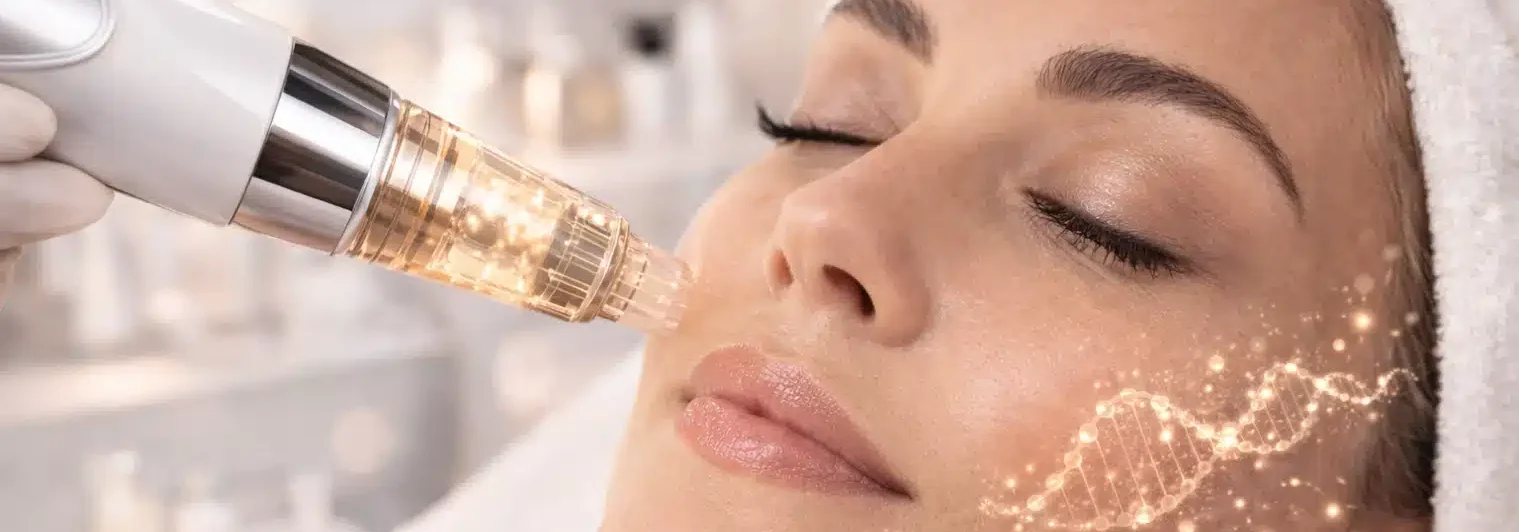
Before adding PDRN to a microneedling plan
- The clearest evidence supports fine-line and texture goals more than pigment correction.
- Product type, delivery method, treatment depth, and device choice all affect expectations.
- A careful consultation should separate wrinkle support, pigment risk, and recovery planning.
Skin renewal should match the evidence
For patients weighing repair-focused add-ons, a personalized microneedling plan can clarify whether texture, fine lines, visible redness, or pigment risk should guide the treatment approach.
Physician-reviewed content • Evidence-aware care • Personalized treatment planning
Helpful reading before comparing regenerative skin treatments
The strongest decision usually starts with the exact concern, expected downtime, and whether the evidence applies to the device and product being discussed.
What readers should know before focusing on the trend
PDRN-supported microneedling attracts attention because it sits between two ideas patients already recognize: controlled skin injury from microneedling and a repair-focused add-on meant to support healing. The strongest current signal does not show a universal fix for every cosmetic concern. Current evidence points most clearly toward wrinkle improvement, shows a weaker and more mixed picture for pigment, and supports a plausible but still incomplete case for faster recovery.
That distinction matters in real life. A reader bothered by fine crinkling near the eyes may approach this treatment very differently from someone dealing with stubborn melasma on the cheeks or someone who mainly fears lingering redness after a procedure. Those goals should stay separate, because current evidence does not support the same level of confidence for wrinkles, pigment correction, and recovery.
Where the evidence looks strongest right now
Wrinkles and surface texture
The clearest human study for this topic involved noninsulated radiofrequency microneedling performed over the full face, with one side randomly assigned to receive topical polynucleotides and the other side saline. Twenty-nine participants completed the protocol, and Antera 3D analysis showed faster improvement on the treatment side at the two-month follow-up. By six months, most participants reported a 25% to 75% improvement in periorbital wrinkles, and no serious adverse events such as infection, pigmentary change, persistent erythema, or scarring were observed.
For patients, that result supports a practical takeaway rather than a sweeping promise. The study suggests that a polynucleotide add-on may improve early wrinkle response when paired with radiofrequency microneedling, especially around delicate eye-area lines. It does not prove that every form of microneedling plus every PDRN-style product will create the same benefit across the full face, all age groups, or every skin concern. The wrinkle study also followed a registered protocol with three treatment sessions spaced two weeks apart.
Pigment and uneven tone
Pigment claims need tighter limits. A 2016 study found reduced melanin-related activity in laboratory models and reported noticeable improvement in a very small clinical observation involving six women with facial hyperpigmentation after three sessions of intradermal PDRN. That finding is interesting, but it remains early evidence and does not carry the same weight as a larger controlled facial trial.
The stronger direct study for pigment looked at melasma, a condition that often frustrates patients because it recurs and reacts to heat, irritation, hormones, and sunlight. In that randomized split-face trial, both sides improved after microneedling radiofrequency, yet the side treated with polynucleotides did not outperform the control side in melanin index, modified melasma severity scores, or erythema outcomes. For readers whose main goal is pigment correction, that makes “better for discoloration” too strong a claim based on current evidence.
Recovery and downtime
Recovery claims sit in the middle ground between promise and proof. A rat study using fractional ablative CO2 laser wounds found faster healing in the PDRN-treated group, along with thicker granulation tissue and more VEGF-positive cells and CD31-positive microvessels. Those findings support a biologic reason to study post-procedure recovery, even though laser resurfacing in animals is not the same thing as cosmetic microneedling in people.
A separate randomized controlled trial after thyroidectomy adds a human wound-healing signal. Patients who received early postoperative PDRN injections had lower vascularity scores, lower erythema measures, fewer subjective symptoms, and lower scar height at three months, with no specific side effects tied to the injections. That does not prove shorter downtime after routine facial needling, but it supports the narrower idea that PDRN may help calm wound-related redness and scar activity after controlled tissue injury.
The table below shows what current evidence has actually studied, rather than what broad marketing language may imply. That distinction helps readers separate direct human facial data from indirect wound-healing or review-level evidence before deciding what this treatment may realistically do.
| Research focus | Setting studied | How PDRN or polynucleotides were used | What researchers measured | What this means for readers |
|---|---|---|---|---|
| Periorbital wrinkle improvement | Human split-face trial using full-face radiofrequency microneedling | Topical polynucleotides applied to one side after treatment, saline to the other side | Objective wrinkle analysis, physician grading, patient satisfaction, pain, and safety | This is the strongest direct evidence for a wrinkle-related benefit, especially for fine lines near the eyes. |
| Melasma and facial pigment | Human split-face randomized study in patients with melasma | Microneedling radiofrequency with polynucleotides on one side and control treatment on the other side | Melanin index, modified melasma severity score, erythema index, and skin roughness | Both sides improved, but the polynucleotide side did not show clear superiority for melasma control. |
| Pigment biology in early research | Laboratory work plus a very small clinical observation | Intradermal PDRN and laboratory testing of melanogenesis-related pathways | Melanin content, tyrosinase activity, MITF, TRP-1, and visible hyperpigmentation change | This supports scientific interest in pigment effects, but it does not carry the same weight as larger controlled facial trials. |
| Post-procedure healing speed | Animal wound-healing model after fractional ablative laser injury | Injected PDRN after controlled skin injury | Wound closure timing, granulation tissue, and markers tied to angiogenesis | The recovery story has biologic support, although this evidence is indirect for cosmetic microneedling in people. |
| Scar redness and healing quality | Human randomized postoperative scar study after thyroid surgery | Early PDRN injections around the healing scar | Vascularity, erythema, scar height, patient symptoms, and adverse events | This gives human support for wound-healing and redness-related benefits, even though it is not a facial microneedling study. |
| Overall confidence in the field | Systematic review of clinical studies on polynucleotides in aesthetic medicine | Review of available studies across wrinkles, hydration, texture, elasticity, and adjunctive uses | Study quality, total patient count, outcomes reported, and evidence consistency | The field looks promising, but readers should treat it as emerging evidence rather than settled best practice. |
| What has not been proven yet | Across the current evidence base | No single standardized protocol covers every device type, delivery method, or cosmetic concern | Consistency of outcomes across broader patient groups, longer follow-up, and protocol standardization | Patients should be cautious when a clinic presents one broad claim for wrinkles, pigment, and recovery all at once. |
Not every “repair” add-on fits every skin goal
A medically grounded medical aesthetics consultation can separate fine-line support from pigment-sensitive care, post-treatment redness concerns, and realistic session planning.
How this pairing is thought to work
Microneedling creates controlled micro-injuries in the skin, and radiofrequency microneedling adds thermal energy to that injury pattern. In the wrinkle trial, the authors explicitly noted that radiofrequency microneedling can serve as a transdermal drug-delivery modality, which helps explain why a topical adjunct may matter after treatment. That point is useful for patients who wonder why the product goes on after the device rather than acting as a stand-alone cream at home.
PDRN and related polynucleotide products also carry a wound-repair rationale in the literature. The laser-healing study described enhanced angiogenesis and fibroblast growth, while the pigmentation paper found changes in melanin content, tyrosinase activity, MITF, and TRP-1 in laboratory models. Those mechanisms help explain why clinics talk about repair, collagen support, and calmer healing, although the clinical reality still depends on the indication, the protocol, and the quality of evidence behind each claim.
How to judge the evidence before booking
A careful reader can sort most claims in this category by asking three simple questions. The first asks how direct the evidence is, which means whether the study actually involved facial microneedling patients rather than animal wounds, laboratory models, or a different procedure. The second asks how controlled the comparison was, because split-face and randomized designs usually give a cleaner signal than loose before-and-after observations. The third asks how transferable the result is, since a finding about periorbital wrinkles with radiofrequency microneedling and topical polynucleotides does not automatically apply to standard microneedling, injections, or pigment-prone cheeks.
That framework keeps expectations closer to the data. The wrinkle study scores well on directness and control, which is why wrinkle improvement currently looks like the strongest use case. Pigment research looks weaker because the most relevant controlled melasma study did not show clear superiority for the polynucleotide side, and recovery research looks only partly transferable because surgical scars and animal laser wounds are not identical to cosmetic facial downtime. When a clinic claim sounds broad, that three-part filter usually shows whether the evidence underneath it is broad or narrow.

PDRN-Supported Microneedling
What treatment goals make the most sense
The best-fit reader usually wants help with early lines, crepey texture, or general surface quality rather than a dramatic fix for deep folds or long-standing pigment. That framing matches the strongest direct evidence, which sits around periorbital wrinkles and short-term improvement with a topical polynucleotide adjunct after radiofrequency microneedling. Patients looking for a single treatment that handles wrinkles, brown patches, redness, and recovery equally well may leave disappointed, because the research does not support that kind of all-in-one certainty.
A realistic scenario helps. Someone with fine eye-area lines and mild texture change before an event season may see this category as a reasonable discussion point with a qualified clinician. Someone with melasma that flares after heat or irritation should approach the same treatment more cautiously, because the best direct trial did not show that the polynucleotide side beat radiofrequency microneedling alone for melasma control.
Where clinics often overstate this category
The most common overstatement is treating PDRN, polynucleotides, radiofrequency microneedling, and standard microneedling as if they were one interchangeable concept. They are not the same treatment, and the outcome signal can shift when the device, delivery route, treatment depth, heat profile, and target concern all change. A patient should be cautious when a website uses a wrinkle study to support a pigment claim or uses a scar-healing study to imply guaranteed next-day facial recovery.
Another common problem appears when early biologic rationale gets presented as if it were settled clinical proof. Mechanisms like angiogenesis support, fibroblast activity, and pigment-pathway effects help explain scientific interest, but mechanisms alone do not prove visible cosmetic benefit in every patient group. That is why the safest reading of the current literature still places wrinkles first, recovery second, and pigment a distant third in overall confidence.
What a treatment course may feel like from the patient side
Current studies do not support a one-session miracle narrative. The wrinkle and melasma trials both used three treatment sessions spaced two weeks apart, then followed patients for months rather than days. That matters for expectation-setting, because skin quality changes tend to unfold gradually and the useful question is often whether the improvement curve looks better over time, not whether the face looks transformed the next morning.
Short-term reactions still matter to patients, even when trials focus on objective scores. In the wrinkle study, the average pain score was 2.2 out of 10 and serious adverse events were not observed, which offers some reassurance about tolerability in that protocol. A cautious reader should still remember that study populations were limited, and the systematic review found only nine studies of low to moderate quality across 219 patients overall.
The broader review adds useful context to the more encouraging individual studies. Its authors reported promising findings for wrinkles, texture, and elasticity, but they also noted limited consensus on optimal use and the need for more rigorous, high-quality trials. Patients can reasonably view this as a developing treatment category rather than a settled standard with one clearly established protocol.
What a careful consultation should clarify
Before agreeing to treatment, a patient should know exactly which device is being used, whether the plan involves standard microneedling or radiofrequency microneedling, and whether the product is applied topically or delivered by injection. Those details matter because the published evidence does not treat every combination as equivalent. A consultation should also identify the primary goal in plain language, such as eye-area wrinkles, textural refinement, melasma control, or shorter visible redness after a procedure.
Success measures also deserve a direct answer. A strong consultation explains how progress will be judged, when photos will be compared, how many sessions are expected, and what would count as a reasonable result rather than an idealized one. That kind of specificity usually reflects a more evidence-based approach than a generic promise about glow, collagen, or faster healing.
3 Practical Tips
Match the treatment to the concern
Readers who care most about fine wrinkles and textural change have the most evidence-based reason to ask about this treatment. Readers focused mainly on melasma or patchy discoloration should ask whether the plan truly fits pigment biology, because current controlled evidence does not show that the polynucleotide add-on clearly improves melasma outcomes beyond microneedling radiofrequency alone.
Ask which version is being used
The literature often discusses PDRN and polynucleotides together, yet the protocols vary by delivery route, timing, and procedure pairing. A patient should know whether the plan involves standard microneedling or radiofrequency microneedling, whether the product goes on topically after treatment or by injection, and what exact concern the clinician expects it to address. Clear answers reduce confusion and make before-and-after expectations more realistic.
Judge results over weeks, not hours
Many people check the mirror too early and assume the treatment failed if redness, dryness, or roughness appear before smoother skin does. The available trials tracked outcomes across months, not a single afternoon, and the scar data also measured results at three months. Photos taken in the same lighting over several weeks usually tell a more honest story than hourly mirror checks on day one.
Questions that often come up before booking
Patients often want to know whether this field is hype or substance. The fairest answer is that both forces are present: early clinical and mechanistic evidence gives the topic legitimacy, but the total body of evidence remains limited and uneven. That is exactly why wrinkles, pigment, and recovery should be judged as separate questions rather than blended into one oversized promise.
Fountain of Youth in Fort Myers, Florida, stays current on developments related to PDRN-supported microneedling so patients can discuss newer treatment categories with evidence strength, limitations, and personal skin goals in mind.
Questions? We are here to help! Call 239-355-3294.
When this conversation may be worth having
PDRN-supported microneedling makes the most sense when a patient’s goals match the evidence, the skin can tolerate controlled injury, and the plan accounts for pigment risk rather than ignoring it.
- Fine lines, early crepiness, or mild texture changes matter more than dramatic lifting.
- Downtime concerns include redness and healing quality, not a promise of instant recovery.
- Pigment-prone skin needs a conservative plan with clear pre-care and aftercare expectations.
A precise consultation should identify the primary concern before any regenerative add-on enters the plan.
FAQ
Does this treatment look better for wrinkles than for discoloration?
Current evidence says yes, with an important qualifier. The best direct human study found added early benefit for periorbital wrinkles when topical polynucleotides followed radiofrequency microneedling. Pigment data remains weaker, and the melasma trial did not show that the polynucleotide-treated side performed better than the control side.
Can it really make recovery faster?
The answer is possible, but not proven across every microneedling setting. Animal laser-wound data and a human scar-prevention trial both support a wound-healing effect, especially around redness, vascularity, and tissue repair. Direct proof for routine cosmetic microneedling downtime is still limited, so patients should treat faster recovery as a plausible benefit rather than a guarantee.
Is this a smart choice for melasma-prone skin?
That depends on the treatment goal and the patient’s trigger pattern. The most relevant controlled trial found improvement with microneedling radiofrequency overall, but it did not find that polynucleotides added superior melasma control over the comparison side. Someone with easily triggered pigment should ask very direct questions about heat, irritation, recurrence risk, and how success will be measured.
What should a careful patient remember before deciding?
The key point is to match the plan to the strongest evidence rather than the broadest promise. Wrinkles and surface texture have the best support so far, recovery has supportive but indirect evidence, and pigment correction remains the least convincing area for this pairing. That kind of goal-specific thinking usually leads to better questions and fewer disappointments.
Next reading for safer treatment expectations
Skin treatments usually work best when the device, aftercare, and supporting products match the patient’s actual concern rather than a broad promise about glow or repair.
Medical review: Reviewed by Dr. Keith Lafferty MD, Fort Myers on April 29, 2026. Fact-checked against government and academic sources; see in-text citations. This page follows our Medical Review & Sourcing Policy and undergoes updates at least every six months.
