

Before deciding on temple filler
- Temple hollowing can make the upper face look sharper, narrower, or more tired without obvious cheek changes.
- The newer randomized data supports measurable improvement with a specific hyaluronic acid filler, not every filler or every treatment plan.
- Natural-looking correction depends on anatomy, injector judgment, product choice, and conservative volume planning.
Restore balance without overfilling
Temple hollowing should be evaluated as part of the whole face, which is why a careful injectables consultation can help identify whether filler, another aesthetic option, or no treatment makes the most sense.
Physician-reviewed content • Evidence-aware care • Personalized treatment planning
The right question is not just whether filler works
Temple treatment works best when the hollow truly drives the concern and the correction stays subtle. Readers comparing options should understand product type, treatment area, recovery, and how the upper face relates to the cheeks, brow, and overall facial frame.
Why the temple area has become a bigger conversation
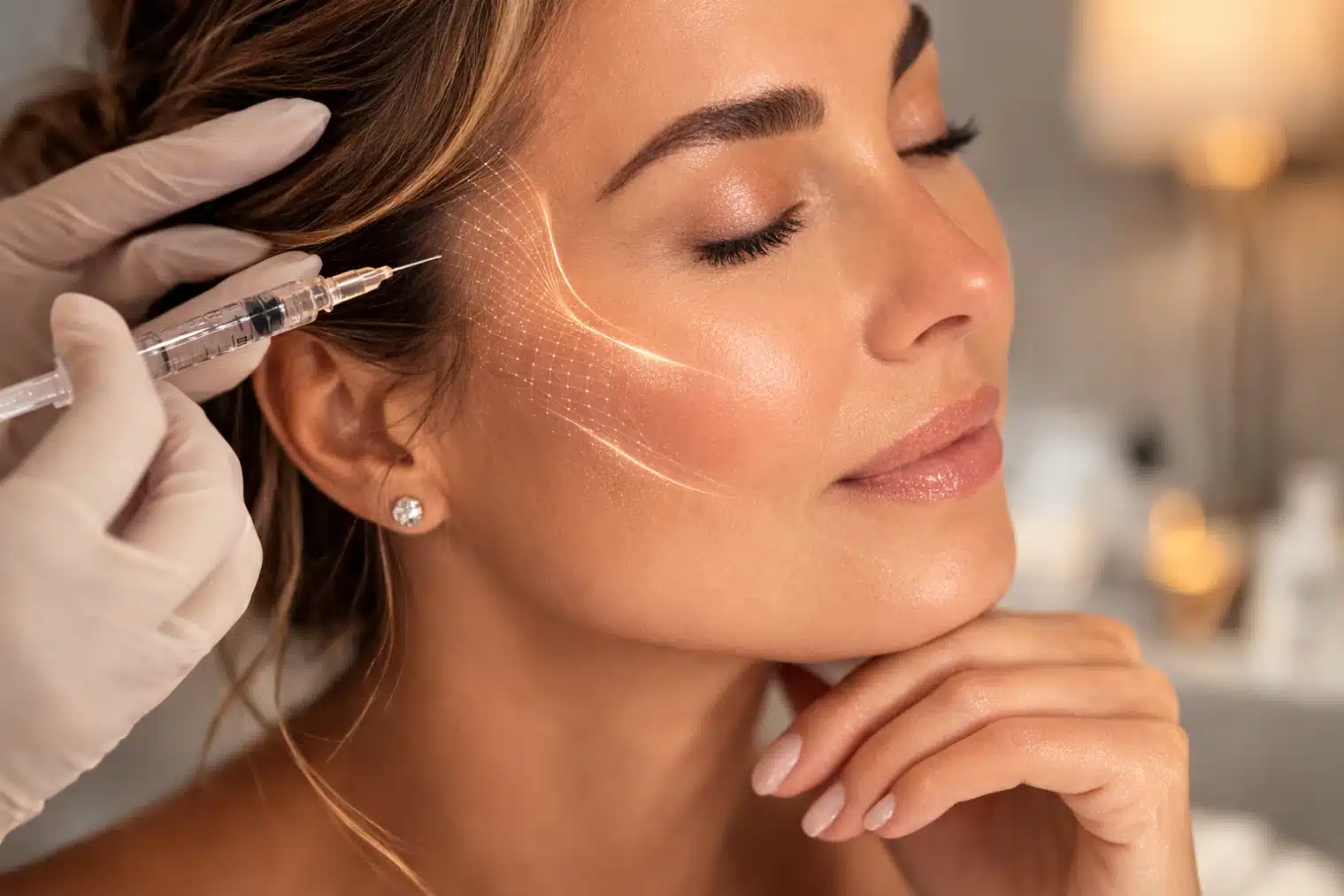
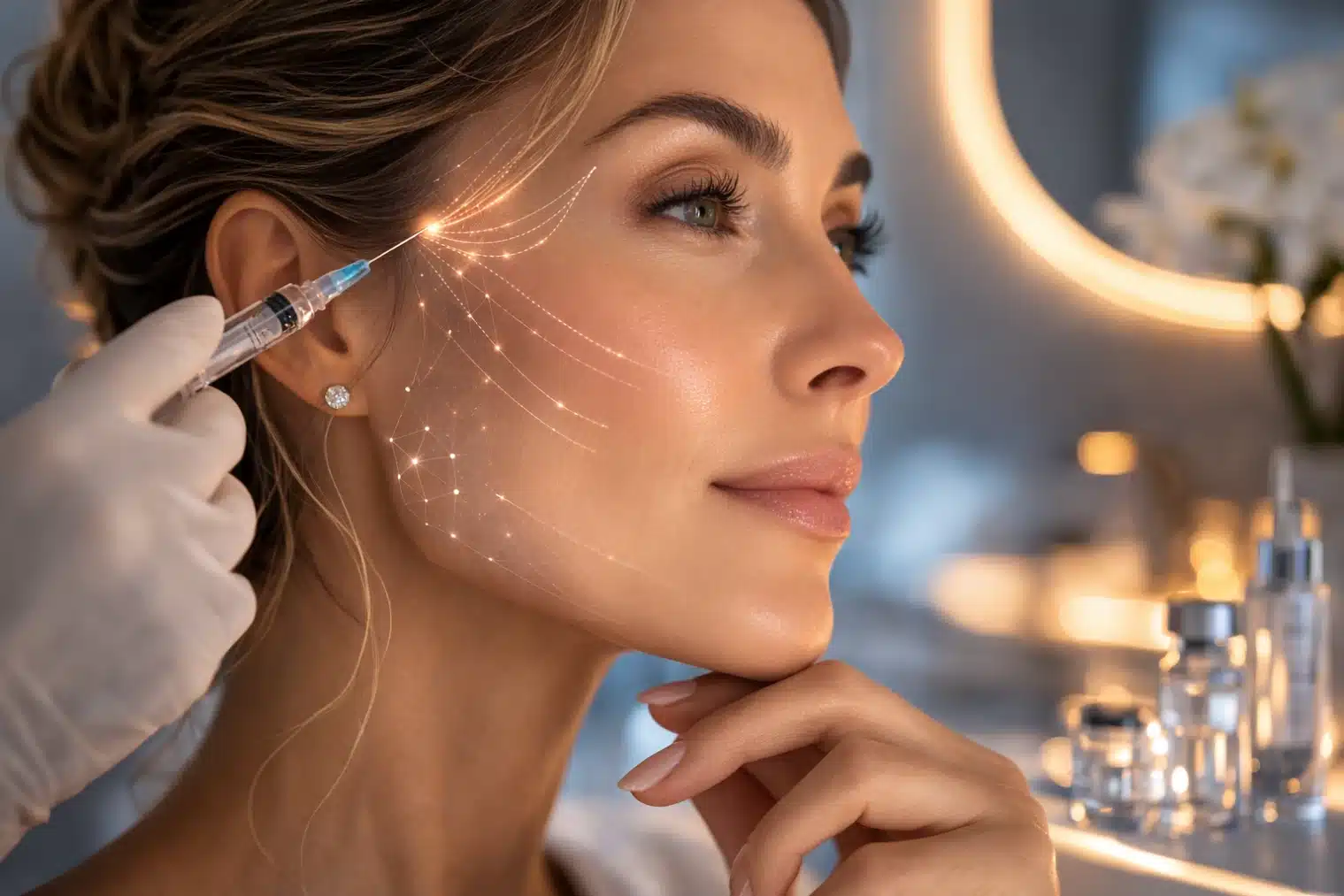
Many people notice temple hollowing only after something feels off in photos. The face can start to look narrower, sharper, or more tired, even when the cheeks and jawline still look fairly balanced. That change often comes from volume loss near the sides of the forehead, where a hollow can deepen with age or stand out more in naturally lean faces.
Temple filler has existed in aesthetic practice for years, but the conversation around it used to lean heavily on injector experience and before-and-after images. That left many readers with a basic question: does this treatment actually have stronger evidence behind it, or is it just another cosmetic trend? The topic matters more now because a randomized controlled study finally gives people better information about what treatment can and cannot do.
That shift does not make temple filler casual or risk-free. It does, though, give interested readers something more solid than anecdotes, social media clips, and sales language. Anyone who has wondered whether this area can be treated in a believable way now has a better starting point for making sense of the option.
What temple hollowing actually changes in the face
Why the temples influence facial balance
The temples frame the upper face, so volume loss there rarely stays isolated. A deeper hollow can make the forehead-to-cheek transition look less smooth, and the outer eye area may seem more severe even when the skin itself looks fine. Many people describe the overall effect as gaunt, angular, or older, even when they cannot immediately name the feature causing it.
A common real-world scenario goes like this: someone feels that their face has become harsher over time, yet cheek filler or skin treatments do not seem like the full answer. Another person may lose weight, then notice that the upper face suddenly looks narrower and more tired. In both cases, the temples can play a bigger role than most people expect.
Natural anatomy versus age-related volume loss
Not every temple hollow needs correction. Some people simply have a naturally lean facial structure, and that look may suit the rest of their features well. Treatment becomes a more meaningful discussion when the hollow stands out as a change, creates imbalance, or bothers the person enough that they keep noticing it in mirrors, video calls, or photographs.
The difference between a normal facial trait and a treatment target often comes down to context. Older photos, recent weight changes, and the way the upper face relates to the cheeks and brow can all help clarify whether the hollow reflects aging, natural anatomy, or a mix of both. That distinction matters because good aesthetic decisions usually start with identifying the real source of the concern rather than chasing a feature that may not need correction.
What temple hollowing actually changes in the face
What the new study actually adds
Why randomized data matters here
The strongest new evidence in this conversation comes from a multicenter, evaluator-blinded, randomized controlled trial of VYC-20L, known as Juvéderm Voluma XC, for temple hollowing. Adults with minimal, moderate, or severe temple hollows entered the study, and researchers compared treatment with a no-treatment control group. That design matters because it tests visible improvement more carefully than casual observation alone.
In everyday terms, randomized means people did not simply choose treatment and call it a success afterward. Investigators measured change with a validated temple scale, while patient satisfaction and appearance ratings added another layer of real-world relevance. That does not answer every question about every filler, yet it gives this area a level of evidence it did not have before.
What the results showed
At month three, 80.4% of treated participants achieved at least a one-grade improvement in both temples on the Allergan Temple Hollowing Scale, compared with 13.5% of untreated controls. Investigator ratings and participant ratings also showed strong improvement, which suggests the change was not limited to a technical scale that ordinary people would never notice. The published follow-up reported that benefit remained visible through month thirteen, although results naturally varied from person to person.
Patient-reported outcomes strengthened the picture. Satisfaction with temple appearance and overall facial appearance improved meaningfully, which matters because the goal in this area usually centers on looking softer and more balanced rather than looking filled. A treatment can look successful on paper, but patient-facing evidence becomes more useful when people actually feel better about how their face looks.
How this study measured more than a simple before-and-after
The newer temple filler data becomes more useful when readers can see exactly what the study evaluated and why those details matter. This table adds context that helps separate stronger evidence from the kind of cosmetic claims that often rely only on photos or opinions.
| Study detail | What it means in plain English | Why it adds value for readers |
|---|---|---|
| Randomized treatment versus no-treatment control | Researchers compared treated participants with people who did not receive treatment during the controlled phase. | This makes the results more credible than a simple collection of before-and-after photos. |
| Evaluator-blinded design | The main evaluator rated improvement without relying on open enthusiasm from the treated group. | That reduces the chance that visible improvement gets overstated by expectation alone. |
| Validated temple scale used for the main endpoint | The trial did not rely only on casual impressions; it used the Allergan Temple Hollowing Scale to judge change. | Readers can see that improvement was measured in a structured way rather than described loosely. |
| Both temples had to improve for the primary response | A participant counted as a responder only if both sides improved by at least one grade. | This sets a stricter bar than claiming success from a one-sided or minor change. |
| Month 3 was the key checkpoint | The main effectiveness result was assessed at month three, when 80.4% of treated participants responded versus 13.5% of controls. | This helps readers focus on the most important comparison instead of scattered short-term impressions. |
| Follow-up continued through month 13 | Researchers kept tracking participants well beyond the early treatment period. | That gives readers a better sense of durability than a study ending after the initial cosmetic wow phase. |
| Investigator and participant ratings both mattered | The study looked at clinical ratings and also asked participants how improved they felt they looked. | That matters because temple filler should look better to real people, not only score well on a chart. |
| FACE-Q satisfaction tools were included | Researchers measured satisfaction with temple appearance and overall facial appearance, not just hollow depth. | This adds a quality-of-life angle that better matches what readers actually care about. |
| Safety tracking included treatment-related adverse events | The publication reported short-term treatment-related issues such as headache, jaw pain, and injection-site symptoms, while noting no serious treatment-related adverse events or treatment-related vascular occlusion events in the study. | Readers get a more honest picture when a study reports both improvement and side effects in the same dataset. |
| The evidence applies to the studied product, not automatically to every filler | The randomized data supports VYC-20L in this use, rather than proving that all hyaluronic acid fillers perform the same way in the temple. | This keeps the article grounded and helps readers avoid overgeneralizing one study into a universal rule. |
Use the data as a starting point, not a guarantee
The randomized trial strengthens the conversation around temple hollowing, but product selection and facial assessment still matter. A Juvéderm consultation can help connect the evidence to anatomy, goals, and a conservative correction plan.
What these findings mean for someone considering treatment
What the study supports
The study supports a straightforward point: hyaluronic acid filler can improve temple hollowing in a measurable, visible way when the right product is used in the right setting. It also suggests that the result can last well beyond the first few weeks, which helps separate a true correction from short-lived post-treatment swelling. Readers who wanted better evidence now have it.
The findings also support a more realistic expectation about the kind of change people usually want. Temple treatment tends to work best when it restores smoothness and balance rather than calling attention to itself. Most people who consider this area do not want a dramatic transformation; they want the face to look less hollow, less severe, and less tired.
What the study does not prove
One trial does not prove that every hyaluronic acid filler performs the same way in the temples. It also does not prove that every injector will produce equally natural results, or that every face needs treatment in this area. Readers should take the evidence as encouraging and specific, not as a blanket guarantee.
The study also does not erase the importance of judgment. Some people may have only a mild hollow that does not really need correction, while others may benefit more from addressing a different facial area first. A good consultation should sort out whether the temple truly drives the concern rather than pushing filler simply because a treatment exists.
Why the temple area has become a bigger conversation
What a natural-looking result usually involves
Subtle change tends to work best
The most appealing temple correction often looks almost invisible to other people. Friends may notice that the face seems less sharp or more rested without being able to say exactly why. That kind of outcome usually suits this area better than aggressive volume, because the temple affects the frame of the face rather than serving as a focal point like the lips.
People often worry that temple filler will create a puffed or unnatural upper face. The more realistic goal involves softening a hollow and improving the transition from forehead to cheekbone, not building obvious fullness where none existed before. Restraint matters here, and a result that blends with the rest of the face usually ages better than a correction that tries to do too much at once.
Why the whole face still matters
Temple hollowing rarely exists in a vacuum. Someone may also have cheek volume loss, weight-related facial changes, or a naturally narrow bone structure that shapes how any correction will read. The best decision often comes from looking at the face as a whole, then deciding whether the temple deserves treatment now, later, or not at all.
This is also where expectations can become more realistic. A person who wants a fresher look for work meetings, family photos, or everyday confidence may feel pleased by a modest correction. Someone expecting the temples alone to completely reverse facial aging will likely expect too much from one treatment area.
Safety deserves a calm, honest conversation
Why this area requires more care
The temple remains an anatomically sensitive area, which is why better data should not be confused with a casual green light. The trial reported no serious treatment-related adverse events and no treatment-related vascular occlusion events, yet that reassuring result should be read alongside the fact that injector skill and careful planning matter enormously. Product quality helps, while injector judgment matters just as much in real life.
Short-term reactions can still happen. The published data described treatment-related events such as jaw pain, headache, injection-site pain, discomfort, mass, temporomandibular joint symptoms, and trismus, with reported events characterized as mild and resolved without lasting problems. Readers should treat that as useful context, not as a promise that every recovery will feel easy.
Questions worth asking before booking
A thoughtful consultation should answer basic but important questions. Which product is being used, why that product fits the temple, how much change seems realistic, and what short-term effects might happen all deserve clear answers. People should also feel comfortable asking how often the injector treats temples specifically, because general filler experience does not always mean strong experience in this exact area.
A careful discussion should also cover whether temple treatment is the best first step at all. Some faces need broader structural planning, while others may look better with a lighter correction than the patient expected. That kind of restraint usually supports a more natural result and reduces the risk of treating a feature that is not really the main problem.
Questions? We are here to help! Call 239-355-3294.
At Fountain of Youth in Fort Myers, Florida, staff stays current on developments like the newer randomized data on temple filler so readers can have a more informed conversation about what is evidence-based, what remains individualized, and what may or may not fit their goals.
What treatment and recovery may feel like in real life
What people often notice right away
Treatment day can create an immediate visual shift, although the first mirror check does not show the final answer. Swelling, tenderness, and early asymmetry can blur the real result for several days. A person who judges the treatment too quickly may either panic unnecessarily or feel overconfident before things settle.
A common situation involves someone leaving the appointment unsure whether the temples look perfect, underdone, or slightly uneven. That uncertainty does not automatically mean anything went wrong. Early tissue response can distort the look enough that patience becomes part of the process.
How to think about the first week
Readers usually benefit from a simple recovery mindset: watch the area, follow aftercare instructions, and give the result time to settle before deciding how much they like it. Normal short-term changes can include tenderness and visible fluctuation, while urgent concerns should go back to the treating office rather than to message boards or guesswork. That approach keeps the focus on actual symptoms instead of online horror stories.
Results in practice also do not last on a clock. The study followed improvement through thirteen months, but individual longevity can differ with anatomy, metabolism, treatment amount, and aesthetic goals. Someone considering temple filler should view maintenance as a possibility rather than assuming one session will solve the issue forever.
3 Practical Tips
Use old photos as a reality check
Photos from a few years ago can help people decide whether temple hollowing reflects a real change or simply a feature they never noticed before. That comparison often makes the decision clearer than staring at a magnified mirror every day. It can also help frame a consultation around restoration rather than chasing a trend.
Ask about temple-specific experience
Anyone can say they offer filler, but temple treatment deserves more specific questions. A person should ask how often the injector treats this area, how they decide whether someone is a candidate, and how they approach natural-looking correction. Those answers reveal much more than a generic promise of expertise.
Judge the result after it settles
People often make their harshest assessment too early. A better approach involves waiting until swelling calms and the tissues settle before deciding whether the change feels balanced, subtle, and worth maintaining. That small pause can prevent a lot of unnecessary worry.
Who may need a temple-focused assessment
Temple filler is usually most relevant when the upper face looks newly hollow, narrow, or severe and that change affects overall facial balance. The decision should come from anatomy and proportion rather than a generalized interest in filler.
- The face looks sharper or more tired in photos, especially around the upper cheek and outer eye transition.
- Recent weight loss, aging, or naturally lean features make the temple hollow more noticeable than before.
- Cheek treatment alone does not seem to address the imbalance in the upper face.
A restrained assessment can clarify whether temple correction belongs in the plan or whether another area should come first.
FAQ
Does temple filler look natural when it is done well?
It usually can, because the goal centers on softening a hollow rather than creating obvious fullness. The best result tends to make the upper face look smoother and less severe without drawing attention to the treatment itself. A natural outcome still depends heavily on product choice, restraint, and injector judgment.
Is temple filler only for older people?
No, because temple hollowing can come from natural anatomy as well as age-related change. Some younger adults notice this area after weight loss or simply because their facial structure is lean. Treatment makes the most sense when the hollow truly bothers the person and fits the rest of the face.
Does the new study mean temple filler is now proven?
The randomized trial gives this topic stronger support than it had before, especially for the specific product studied. That is a meaningful step forward, yet it does not mean every filler performs the same way or that every treatment setting will match the study. Readers should see the evidence as stronger and more credible, not absolute.
How long do results usually last?
The published study reported sustained improvement through month thirteen, which suggests temple correction can last well beyond the early treatment period. Real-life duration still varies, so no one should expect an identical timeline in every case. A maintenance plan may make sense for people who like the result and want to preserve it.
Compare facial balancing options carefully
Temple hollowing may be one part of facial aging or natural anatomy, not the whole story. A thoughtful aesthetic plan may compare filler, skin treatments, neuromodulators, or a lighter-touch approach before deciding what belongs first.
Medical review: Reviewed by Dr. Keith Lafferty MD, Fort Myers on May 13, 2026. Fact-checked against government and academic sources; see in-text citations. This page follows our Medical Review & Sourcing Policy and undergoes updates at least every six months.
