How This Injection Works at a Cellular Level
Intramuscular (IM) B-complex injections deliver key B-group vitamins directly into muscle tissue, where blood vessels steadily absorb them. This process bypasses the digestive system, offering higher and more consistent nutrient availability for patients with absorption issues or increased metabolic demand. Unlike oral supplements, which depend on stomach acidity and gut health, IM shots achieve predictable serum levels without gastrointestinal interference.
After injection, the solution forms a “depot” in the muscle that releases nutrients gradually into circulation. This slow diffusion creates a sustained vitamin effect that supports steady metabolic activity over time. The recommended dose is 100 mg IV/IM per day for 3–5 days in acute thiamine deficiency, demonstrating the importance of this delivery route in medical contexts. For patients dealing with fatigue, stress, or nutrient depletion, that distinction can be meaningful.
Unlike IV drips that flood the bloodstream immediately, IM delivery allows for a smoother, lower-peak rise in plasma concentration. This delivery curve may reduce side effects while extending the duration of action. The method aligns with efficient nutrient support in office settings, requiring only a small injection volume and no IV setup.
The Powerhouse Inside: What’s in a B-Complex Injection?
Core Vitamins and Their Clinical Functions
A typical B-complex injection includes a curated mix of water-soluble B-group vitamins: B1 (thiamine), B2 (riboflavin), B3 (niacinamide), B5 (dexpanthenol), and B6 (pyridoxine). These nutrients form essential coenzymes that drive cellular metabolism, nervous system stability, and red blood cell production.
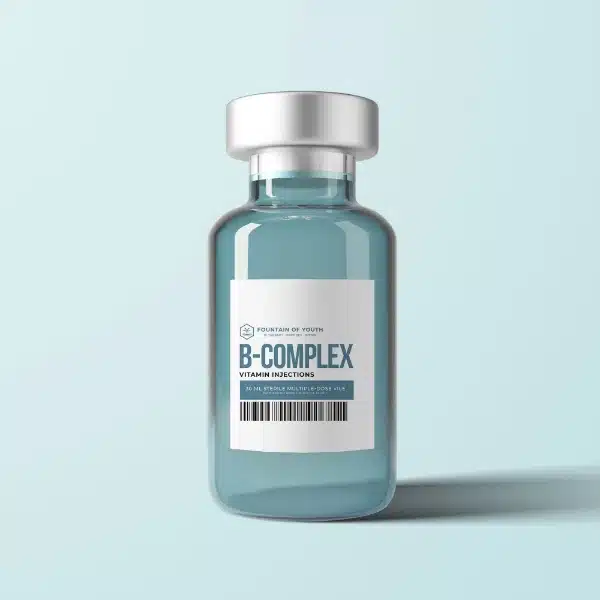
The Powerhouse Inside: What’s in a B-Complex Injection?
Thiamine helps convert glucose into energy and supports nerve impulse transmission. Riboflavin aids in oxidative energy processes and helps maintain skin, eye, and mucosal health. Niacinamide contributes to the synthesis of NAD and NADP—molecules central to over 400 enzymatic functions. Pantothenic acid acts as the backbone for Coenzyme A, linking it to fat metabolism and adrenal hormone synthesis. Pyridoxine plays a key role in neurotransmitter production and hemoglobin formation, with downstream effects on cognitive function and mood regulation.
Each vitamin performs a non-redundant task, and deficiencies can lead to distinct clinical conditions. For instance, thiamine is a key micronutrient that plays a critical role in energy metabolism and nerve function, according to the CDC.
Regulatory and Compound Formulas in Use
Clinical formulations used in wellness and hospital settings often follow a consistent blueprint. A widely referenced preparation—B-Complex 100 Injection—includes thiamine (100 mg), niacinamide (100 mg), riboflavin (2 mg), B5 (2 mg), and B6 (2 mg) per mL. Empower Pharmacy and other reputable compounding sources follow nearly identical ratios, tailored for IM use.
Vitamin B12 is intentionally excluded from these blends because its clinical profile and dosing needs differ significantly. Most clinics, including Fountain of Youth SWFL, offer B12 as a separate intramuscular option, allowing for more targeted treatment plans.
While exact contents may vary, we ensure our compound matches prescription-only, high-grade standards suitable for IM delivery. This lets our staff deliver precisely formulated injections based on patient history and goals.
Clinical Uses in Medical and Wellness Settings
Traditional Indications in Mainstream Medicine
Historically, B-complex injections served as frontline treatment for deficiency caused by malabsorption, alcoholism, or metabolic stress. Hospital patients with burns, chronic illness, or gastrointestinal dysfunction often receive IM or IV B-complex to support tissue repair and systemic recovery. Label guidelines for pharmaceutical versions highlight these roles clearly.
In these contexts, clinicians prioritize parenteral administration because oral absorption fails to meet the body’s elevated demand. IM shots fill the gap with rapid uptake and bypass of gut-related absorption issues.
Investigational and Supportive Uses
Outside of deficiency states, researchers have explored B-complex injections for their impact on neurologic and pain-related outcomes. A peer-reviewed trial found that a B1-B6-B12 IM combination improved nerve pain and sensory function in patients with trigeminal neuralgia. Other small studies noted symptom relief in plantar neuropathy and diabetic neuropathy when B-complex shots were used as adjunctive therapy.
These outcomes typically apply to patients with documented nerve damage and do not generalize to healthy individuals. Still, the supportive role of B-vitamins in nerve regeneration, myelin repair, and neurotransmitter balance remains well established. The neurotropic B vitamins B1, B6, and B12 are essential for proper functioning of the nervous system.
At Fountain of Youth, we interpret this data as a reasoned foundation for supporting nerve health—not as a treatment claim for medical conditions. Our clinicians assess each case and consider whether IM B-complex can serve as a wellness-supportive option, especially when chronic stress or nutrient imbalance is present.
Limits of Evidence in Wellness Use
In people without documented deficiency, clinical results tend to vary more widely. Some patients report sharper mental clarity, improved mood, or better energy within days of injection. Others experience subtler changes over a longer timeframe.
Controlled trials for wellness populations remain limited, and no ethical clinic should guarantee universal outcomes. The likely explanation for varied responses lies in individual differences in stress, sleep, diet, gut health, and existing nutrient levels.
We position IM B-complex as a targeted tool to support physiological function in those who may benefit from higher bioavailability, not as a one-size-fits-all solution.
Why IM Over Oral? The Absorption Advantage
Pharmacokinetics of Intramuscular Delivery
IM injections enter richly vascularized muscle tissue, where nutrient absorption occurs gradually over several hours. This delivery method avoids gastrointestinal breakdown, hepatic first-pass metabolism, and interactions with food or medications that can block uptake.
Compared to oral intake, this route offers improved consistency and bioavailability, especially for patients with gut issues or systemic inflammation. In the case of B12, deficiency is often treated with injections because this method bypasses absorption barriers.
For B1, B2, and B6, similar advantages apply when higher systemic levels are needed without overwhelming the GI tract or causing unwanted digestive symptoms.
IM vs. IV: Two Different Routes, Two Different Goals
IM and IV nutrient therapies differ fundamentally in design and application. IV drips deliver high-dose nutrients directly into circulation, creating a rapid plasma spike. These infusions often require longer appointments and involve larger fluid volumes.
In contrast, B-complex injections at Fountain of Youth involve a quick office visit, small-volume delivery, and no IV lines. The nutrients absorb steadily from the muscle over time, providing a slow-release effect that better suits long-term support rather than emergency correction.
We keep our messaging clear: this service is not IV therapy in miniature. It’s a distinctly different tool with its own merits and indications.
Safety, Risk Management, and Patient Candidacy
Common Side Effects and Rare Complications
Most patients tolerate IM B-complex shots well. Some report mild injection-site soreness, redness, or a sensation of heaviness in the limb. These effects typically resolve within 24 hours and require no treatment.
In rare cases, systemic reactions such as itching, rash, or lightheadedness may occur. More serious allergic reactions, including anaphylaxis triggered by thiamine, are exceedingly rare but have been documented. The B-Complex 100 Injection label warns about this risk and advises careful monitoring in sensitive individuals.
IM injections also carry procedural risks like bruising, hematoma, or—if performed incorrectly—nerve irritation. That’s why only trained professionals should administer these shots using approved site and depth protocols.
Vitamin-Specific Toxicity Concerns
Vitamin B6, when consumed at extremely high doses over long periods, may lead to reversible sensory neuropathy. This risk appears mostly in cases of chronic, unsupervised oral megadosing. Peripheral neuropathy has been reported at doses of vitamin B6 of less than 50 mg daily, according to the Australian TGA.
Standard clinical doses, including those found in compounded IM injections, sit well below those thresholds. Still, our team reviews each patient’s total vitamin intake—including oral supplements—before starting an injection plan. We may recommend periodic lab testing for patients receiving frequent treatments to ensure optimal and safe levels are maintained.
Screening and Clinical Oversight Protocol
Not everyone qualifies for IM vitamin therapy. Patients with clotting disorders, active skin infections near the injection site, or advanced muscle wasting may require alternative approaches.
Our intake process includes a full medical history review, medication reconciliation, and optional lab tests to assess baseline B-vitamin status. We design each protocol around that data, aligning patient safety with effective care.
Questions? We are here to help! Give us a call at 239-355-3294 to speak with a member of our medical team.
3 Practical Tips Before and After Your Injection
- Hydration supports optimal absorption, so drink water and eat a light snack before your appointment. This helps stabilize blood sugar and reduces lightheadedness after the injection.
- After receiving the shot, gently move or stretch the injection limb to disperse the fluid and minimize soreness. This small effort often prevents delayed muscle tension and keeps circulation flowing.
- Keep the injection area clean and dry for the rest of the day. Apply a cool compress if any redness or discomfort arises. Contact us immediately if you notice hives, trouble breathing, or persistent swelling.
How Injections Are Administered in Real-World Clinics
At Fountain of Youth SWFL, intramuscular B-complex shots are administered by licensed professionals following strict safety protocols. We use a single-use syringe and needle sized for optimal depth and absorption. Common sites include the upper arm (deltoid) and gluteal region, based on patient comfort and muscle mass.
Each shot takes less than a minute to administer. The volume typically ranges from 0.5 to 2 mL, depending on the formula and individual needs. Our staff monitors the site immediately afterward and provides post-care guidance before the patient leaves.
Patients often report a quick and efficient experience. Most return to normal activity within minutes and need no downtime. We welcome feedback and always adapt techniques based on comfort and clinical outcomes.
When Results Are Most Noticeable
Some patients feel subtle energy shifts within 24 hours, while others notice gradual improvements over one to two weeks. Because IM B-complex injections act through nutrient replenishment rather than pharmacologic stimulation, the response curve depends heavily on individual biology.
Patients with borderline deficiency or high stress loads tend to notice more pronounced changes early on. Those with balanced nutrient levels may feel steadier mental clarity or mood enhancement rather than a dramatic energy “kick.”
We encourage patients to track how they feel across sleep, focus, mood, and endurance domains. A series of two or three injections often offers more insight than a single dose.
While most people associate B-complex shots with energy support, the vitamins also play critical roles in metabolic, cognitive, and circulatory pathways. The table below shows clinical markers and lifestyle situations where IM B-complex injections may offer additional value beyond basic supplementation.
| Clinical Context |
Relevant B Vitamins |
Why IM Delivery Helps |
Suggested Screening |
| Frequent fatigue with normal iron levels |
B1, B2, B3 |
Supports mitochondrial ATP production via coenzyme activation |
Serum B1/B2, CBC, metabolic panel |
| Peripheral tingling or numbness |
B1, B6 |
Delivers direct nerve support in demyelinating or healing states |
Vitamin B6 level, EMG if persistent |
| Post-illness or surgical recovery |
B3, B5, B6 |
Helps replenish cofactors for tissue repair and adrenal function |
CRP, albumin, B-complex panel |
| Low-calorie or restrictive diets |
B1, B2, B3, B6 |
Improves micronutrient levels when intake or absorption is limited |
Dietary recall, B-vitamin labs |
FAQs About IM B-Complex Injections
What’s the difference between a B-complex shot and a B12 shot?
B-complex shots contain multiple B-group vitamins, usually B1, B2, B3, B5, and B6. B12 injections contain only cobalamin, a distinct vitamin with separate functions. We offer both options, each with different use cases.
How often should I get a B-complex injection?
Frequency depends on your goals and lab values. Some patients opt for weekly shots during high-stress periods, while others benefit from monthly maintenance. We individualize every schedule after medical review.
Can I take oral B-vitamins and still benefit from an injection?
Yes, especially if your digestion or absorption is compromised. IM shots offer a direct delivery path that bypasses GI issues. We review your supplement regimen to avoid overdosing.
Do these injections really help with energy?
Many patients report improved stamina and focus after their injection series. The effect depends on your baseline status and overall health. Results tend to be strongest in individuals with deficiency or increased demand.
Who This Is Right For—and Who It Isn’t
Intramuscular B-complex injections serve patients who need targeted support for energy metabolism, nerve health, or red blood cell synthesis. Busy professionals, athletes, postpartum women, or individuals recovering from illness often find value in this modality.
People managing stress, sleep issues, or poor diet may also benefit—especially when oral supplements don’t seem to help. That said, this isn’t a casual pick-me-up or substitute for a balanced lifestyle.
We guide every patient through informed decision-making and medical screening. Our staff stays current with research on nutrient metabolism and injectable formulation standards to ensure each protocol meets the highest level of care.
Let us know if you’re ready to explore what B-complex injections can do for your energy, focus, and resilience.
B-Complex injections are often used as a foundation for energy, stress resilience, and cognitive focus throughout the week. Patients who want immune reinforcement on top of that baseline frequently add Vitamin C or Tri-Immune Boost injections for focused antioxidant and infection-fighting support. Glutathione pairs well with B-Complex in plans that emphasize detoxification, oxidative stress control, and skin clarity. When long-term cellular health and performance are priorities, NAD+, Amino Blend, and Mineral Blend can be layered into the same schedule to back up mitochondrial function, muscle recovery, and electrolyte balance. For structural and aesthetic goals, Vitamin D3 and Biotin injections can be added under provider guidance to support bone density along with healthy hair and nails.
Medical review: Reviewed by Dr. Keith Lafferty MD, Fort Myers on December 4, 2025. Fact-checked against government and academic sources; see in-text citations. This page follows our Medical Review & Sourcing Policy and undergoes updates at least every six months.