
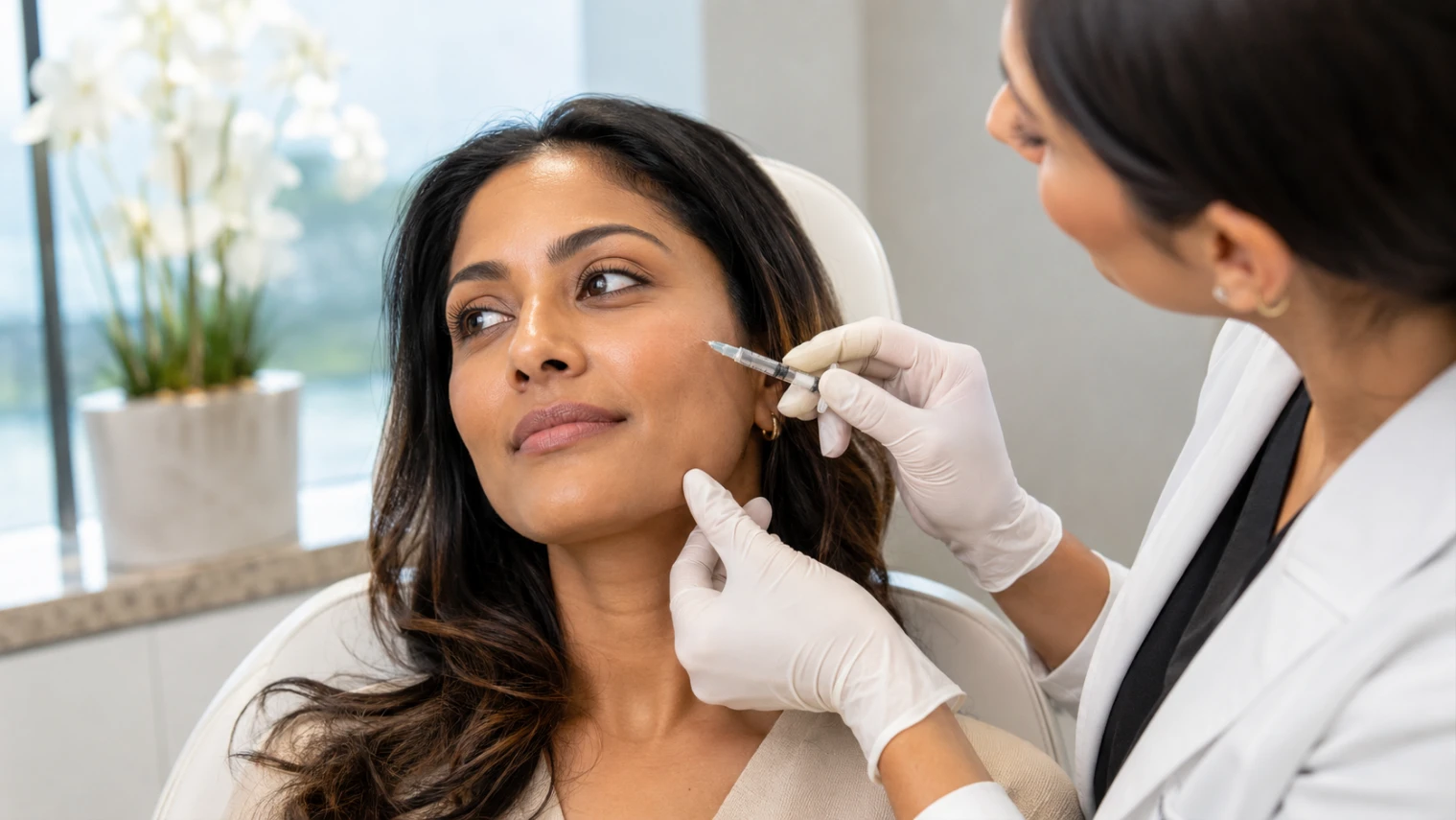
Subtle filler planning starts before the syringe
- Natural-looking filler depends on anatomy, expression, placement, product choice, and conservative volume.
- Cold-crosslinked HA fillers may expand treatment discussions, but they do not replace careful facial assessment.
- Smile-line correction should account for cheek support, prior filler, tissue quality, and the patient’s fear of looking overdone.
Want smoother folds without a heavier look?
A measured injectables consultation can help determine whether HA filler, neuromodulator treatment, skin-quality support, or no added volume fits the concern you see in motion.
Physician-reviewed content • Evidence-aware care • Personalized treatment planning
A balanced result may need more than one option
Patients comparing HA fillers often benefit from understanding how product families and treatment areas differ. Related planning may include Juvederm filler options or Restylane treatment when those platforms better match the area, tissue, and desired subtlety.
Many people still like the idea of softening lines, but they no longer want dramatic filler changes. Patients across Lee County often ask about smoother smile lines, better facial balance, and less tired-looking skin without a swollen or stiff result. For local patients, that concern feels especially practical when they want to look like themselves at work, in photos, and during everyday social plans. The newer conversation around cold-crosslinked HA fillers fits that concern, although the product itself cannot replace careful assessment.
The phrase “filler fatigue” usually describes frustration, not a medical diagnosis. Someone may feel tired of seeing overfilled cheeks online, worried after a friend looked puffy, or unsure whether another syringe will make the face look heavier. At Fountain of Youth in Fort Myers, Florida, staff stays current on injectables developments, including newer HA filler platforms and changing treatment-area discussions. That matters most when patients want a measured plan instead of a brand-name decision. It also keeps the conversation anchored in fit, not fashion.
Why More Patients Are Asking for Softer, More Natural Filler Results
A normal filler question rarely starts with chemistry. Most people want to know whether treatment will smooth a fold without changing their expression. A patient may notice nose-to-mouth lines in car-window reflections, group photos, or bright outdoor light after time on the water. The same person may also worry that filler will create the “done” look they wanted to avoid. That tension makes newer HA filler platforms interesting, but it also makes restraint more important than novelty.
Patients who already tried filler may ask different questions than first-time patients. They may remember a result that looked good for a few months, then seemed heavier as facial aging, weight changes, or product layering changed the overall balance. Seasonal residents may also bring treatment history from another state, which can make future planning less straightforward. A good injectables discussion should sort out what bothers the patient now, what changed over time, and what result would still feel believable in motion.
What Usually Causes the Overfilled Look
The overfilled look usually comes from a planning problem, not one single material. Too much volume in one visit can soften lines but flatten natural facial character. Repeated small treatments can also build into a heavier look if nobody reassesses the face as a whole. Product selection matters, yet placement depth, injection amount, tissue quality, and facial movement often matter just as much.
Smile lines create a good example. A deep nasolabial fold may reflect local skin folding, cheek support changes, or both. Treating only the fold can help in some cases, but chasing the crease too aggressively can make the midface or lower face look less natural. Patients who want subtle filler correction often need a conversation about balance, not just a decision about which syringe to use. The best-fit plan may involve less filler than the patient expected, staged treatment, or a different aesthetic priority.
Concerned about looking puffy or overdone?
A conservative injectables plan can review prior filler, facial movement, fold depth, and tissue support before deciding whether added volume belongs in the treatment strategy.
Where Cold-Crosslinked HA Fillers Enter the Conversation
Hyaluronic acid fillers use HA, a water-binding substance, to add soft-tissue support and smooth selected folds or wrinkles. Crosslinking helps the HA gel hold together longer after injection. The newer Evolysse Smooth and Evolysse Form products use a cold-crosslinking process called Cold-X Technology. The published study on this platform describes traditional HA filler crosslinking as a process that often uses alkaline and heated conditions, while the newer method uses cold conditions intended to preserve longer HA chains.
That manufacturing difference gives patients a useful question to ask, but it should not become the whole treatment decision. A gel can have properties that affect flexibility, tissue behavior, and support, yet no filler automatically creates a natural result. A skilled injector still has to match the product to the area, expression pattern, fold depth, and patient goal. Timing and follow-up can change the plan as much as the filler choice. For someone worried about stiffness or overcorrection, the value lies in pairing the right material with a conservative plan.
What “cold-crosslinked” means without the chemistry lecture
A simple way to think about crosslinking is structure. HA gel needs enough structure to last and support tissue, but it also needs to sit naturally in a moving face. Cold-crosslinking aims to create that structure while preserving long HA chains during manufacturing. Patients do not need to memorize the chemistry, but they should understand that newer filler design focuses on how the gel behaves after placement.
What This New HA Filler Is Actually Approved to Treat
The U.S. Food and Drug Administration granted FDA approval to Evolysse Smooth and Evolysse Form in 2025. The approved use covers dermal and subdermal injection to correct moderate to severe dynamic facial wrinkles and folds, such as nasolabial folds, in adults 22 and older. Nasolabial folds are the smile lines that run from the sides of the nose toward the corners of the mouth. That approval gives the platform a real place in the filler conversation, especially for patients focused on smile-line correction. The indication matters because patients often arrive with broader questions about facial balance.
This approval does not automatically apply to every facial area patients ask about. Lips, cheeks, under-eyes, temples, jawline contouring, and full-face rejuvenation each raise separate anatomy and product-selection questions. Patients may see social posts or headlines that make a new filler sound broadly useful, but the treatment area still matters. A responsible consultation should separate what the FDA approved from what a provider may discuss based on available products, training, anatomy, and patient goals.
What the 2025 Study Found About Nasolabial Folds
A peer-reviewed 2025 study followed 140 patients with moderate-to-severe nasolabial folds. The study used a split-face design, meaning each patient received a cold-crosslinked filler in one nasolabial fold and Restylane-L in the other. This design helps compare results within the same person, which reduces differences from age, skin quality, expression strength, and lifestyle. Patients had follow-up through 12 months, with optional retreatment at that point.
The study reported that both Evolysse products met the primary endpoint for noninferiority compared with Restylane-L. It also reported statistically superior improvement on certain wrinkle severity measurements at specific time points. Live evaluator assessments favored Evolysse Form through 12 months and Evolysse Smooth at 6 and 9 months. These findings explain why the platform now appears in patient conversations about smile-line filler. The study still centers on nasolabial folds, not every cosmetic concern people associate with filler.
What the study does not say
The study did not measure “filler fatigue” as a clinical endpoint. It also did not prove that a patient can avoid puffiness, heaviness, or unnatural movement simply by choosing one newer product. A careful plan remains necessary because filler outcomes depend on anatomy, technique, product amount, and prior treatment history.
Choosing Between Familiar HA Fillers and Newer Options
Many patients recognize names such as Juvederm and Restylane before they understand how HA fillers differ. Brand familiarity can help someone start the conversation, but it should not decide the treatment plan. HA fillers can vary in firmness, flexibility, lift, water attraction, and how they suit different tissue layers. A product that works well for one fold, face, or treatment goal may not fit another patient’s anatomy.
The better question is not “Which filler is newest?” but “Which filler fits this area and this face?” A patient with pronounced smile lines may need a product that supports the fold without adding too much visible bulk. Someone with prior filler may need assessment for existing volume before adding anything new. Another patient may need skin-quality work, neuromodulator treatment, or no filler at all for the concern they describe. These distinctions protect the natural look far more than brand loyalty.
Safety and Fit Still Come Before Trend Timing
Dermal fillers can cause expected temporary effects such as swelling, bruising, tenderness, redness, itching, and small lumps. FDA safety information on dermal filler risks also describes less common but serious risks, including infection, nodules, migration, tissue injury, vision problems, and vascular complications. The 2025 Evolysse study reported no treatment-related serious adverse events, and treatment-related events that occurred after initial treatment were mild or moderate and resolved. Patients should still treat any injectable filler as a medical aesthetic procedure, not a casual beauty appointment.
A safety-focused visit should cover medical history, allergies, medications, prior filler, past reactions, recent infections, and upcoming dental or medical procedures. Event timing also matters for Lee County residents and visitors who schedule treatments around weddings, travel, seasonal stays, and outdoor plans. A patient with a major photo event next weekend may need a different timeline than someone planning gradual maintenance. For some patients, postponing treatment may offer the cleanest path to a better result. The right answer may involve waiting, treating less, or staging treatment over more than one visit.
What a Lee County Consultation Should Clarify Before Treatment
A useful injectables consultation should start with the concern the patient sees most often. Some people notice folds at rest, while others only see shadowing when they smile or speak. The provider should look at facial movement, cheek support, skin thickness, asymmetry, and whether past filler may still affect the area. This step helps prevent a patient from treating the wrong problem with the right product.
Local lifestyle can shape expectations. People in Cape Coral, Estero, Bonita Springs, and nearby communities may plan filler around boating, social events, business schedules, or visits from family. Sun exposure does not create filler fatigue, but it can affect skin texture, pigment, and the way lines show in harsh light. The consultation should connect the patient’s daily life with practical timing, possible downtime, and a result that does not look surprising in normal settings. That practical context can change how much correction makes sense at one visit.
Questions? We are here to help! Call 239-355-3294.
Why patients may hear more about this filler platform in 2026
Reports in 2025 described Evolysse Sculpt as a pipeline product submitted for FDA review for mid-face volume restoration. That does not mean Evolysse Smooth and Evolysse Form have the same approved uses. Patients may hear more about the broader platform in 2026, especially around facial volume discussions. Current treatment decisions should still focus on available products, approved indications, individual anatomy, and the specific area being treated.
Who benefits from a conservative filler review?
Patients who fear an overfilled result often need a more detailed assessment, not a bigger treatment plan. The right visit should clarify what filler can improve and where restraint protects facial character.
- Smile lines look deeper, but the face already has enough cheek or midface fullness.
- Prior filler still affects the treated area, even if the original appointment happened months ago.
- The patient wants soft correction for photos, work, or social plans without obvious facial change.
Those details can guide whether HA filler, a staged plan, or a different option such as neuromodulator treatment better supports the patient’s goal.
Questions Patients Ask Before Trying a New HA Filler
Is cold-crosslinked filler safer than older HA fillers?
No current patient should treat “newer” as a synonym for safer. The 2025 study supports safety and effectiveness for the studied nasolabial fold use, and it reported no treatment-related serious adverse events. General HA filler risks still apply, so screening and injection technique remain central.
Will this type of filler stop me from looking puffy or overfilled?
No filler can guarantee that outcome by itself. Puffiness or an overfilled appearance can come from too much volume, poor sequencing, product choice, swelling patterns, or older filler already present. A conservative plan often does more for natural-looking results than choosing a new platform alone.
Is Evolysse approved for cheeks, lips, or under-eyes?
Evolysse Smooth and Evolysse Form have FDA approval for moderate to severe dynamic facial wrinkles and folds, such as nasolabial folds, in adults 22 and older. That approval does not automatically cover cheeks, lips, under-eyes, or every facial contouring request. Patients should ask what indication, product choice, and treatment area apply to their specific concern.
How should I choose between Juvederm, Restylane, and newer HA fillers?
A consultation should guide that choice rather than a brand preference. The right option depends on the treated area, tissue quality, facial movement, prior filler, desired subtlety, and comfort with possible risks. Patients usually make better decisions when they describe the look they want, the look they fear, and any prior treatment history.
Compare the options before adding volume
Patients usually get better guidance when the consultation compares treatment area, tissue behavior, product properties, and prior filler history. That conversation can prevent overcorrection and keep the result aligned with normal facial movement.
Juvederm filler treatment and Restylane filler treatment may each play a role depending on anatomy, goals, and the specific concern being treated.
Medical review: Reviewed by Dr. Keith Lafferty MD, Fort Myers on July 20, 2026. Fact-checked against government and academic sources; see in-text citations. This page follows our Medical Review & Sourcing Policy and undergoes updates at least every six months.
