
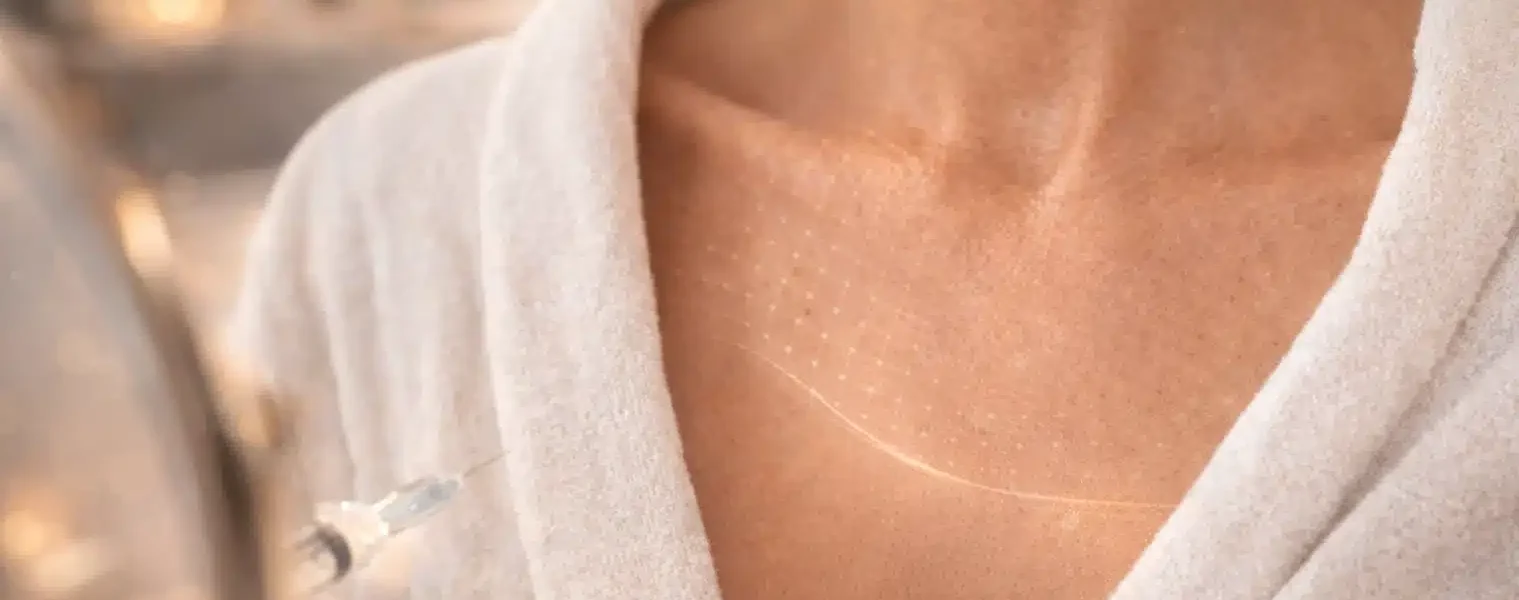
Chest Wrinkles Need a Different Aesthetic Plan
- The décolletage often shows sun exposure, side-sleeping lines, and collagen loss before patients expect it.
- Injectable chest treatments may improve texture and line softness, but they should not be framed like cheek or lip filler.
- The best plan depends on whether the main concern is fine creping, etched vertical lines, pigmentation, or broader skin quality.
Not Every Chest Line Needs the Same Treatment
Fountain of Youth SWFL approaches décolletage concerns through careful skin assessment, realistic treatment planning, and medically responsible use of aesthetic injectables when they fit the visible pattern of aging.
Physician-reviewed content • Evidence-aware care • Personalized treatment planning
Useful Skin-Quality Context Before Booking
Chest rejuvenation may involve more than one modality, especially when texture, collagen loss, and sun damage overlap. Related FOY pages on medical aesthetics and microneedling can help readers understand how non-facial skin concerns are evaluated.
Why This Area Ages So Fast
Chest wrinkles have moved from a quiet cosmetic concern to a more visible topic, mostly because many people notice them in photos, lower necklines, and bright overhead lighting. The face often gets the most attention, yet the upper chest can show sun damage, thinning skin, and etched lines earlier than expected. The décolletage sits in a tough spot because skin there gets repeated sun exposure, it folds with side sleeping and daily movement, and it tends to lose smoothness as collagen support declines over time. Those changes can show up as fine crisscross lines, deeper vertical cleavage lines, or a crepey surface that looks worse in certain light.
Many readers arrive at this topic after trying chest creams, sunscreen, or home devices and still feeling unhappy with what they see. A common real-life scenario looks like this: the face appears fairly refreshed after skincare or facial treatment, but the chest still gives away years of sun exposure. That mismatch helps explain why chest rejuvenation now gets more attention as its own conversation rather than an afterthought.
What “Injectable Chest Wrinkle Correction” Really Means
This topic does not point to one single product or one standard treatment plan. In the current literature, chest injectables usually fall into a few broad groups, including collagen-stimulating injectables, certain hyaluronic acid approaches, and much less commonly, botulinum toxin in selected situations. The goal also varies: some treatments aim to improve skin quality and texture, while others try to soften visible lines.
That distinction matters because many people hear the word “injectable” and picture classic facial filler. The chest does not behave like the cheeks or lips, and the published research does not support promising a face-style transformation in this area. A realistic treatment discussion should focus on softening, smoothing, and improving overall skin appearance rather than chasing a perfectly line-free chest.
A useful way to think about this category is to separate three questions before focusing on any product name. The first question is whether the main concern is fine texture, etched lines, or more global photodamage. The second is whether the likely goal is gradual skin-quality improvement or a faster visible change. The third is whether the chest concern stands alone or sits inside a broader rejuvenation plan that may also need resurfacing, pigment management, or stricter UV protection.
What the Best Current Evidence Supports
The strongest current region-specific evidence in this area involves diluted calcium hydroxylapatite, often shortened to CaHA. In a 2024 prospective, multicenter, evaluator-blinded, randomized study, researchers reported that 73.5% of treated patients achieved at least a 1-point improvement on a validated décolleté wrinkle scale sixteen weeks after the last treatment. The study also reported a favorable safety profile, which makes this one of the most useful pieces of evidence for people trying to separate real data from trend-driven marketing.
Poly-L-lactic acid, or PLLA, also has supportive published evidence for the chest. A 2018 PubMed-indexed study concluded that PLLA was safe and effective for improving rhytids and skin quality in photodamaged décolletage skin. That does not make it a universal answer, but it does show that collagen-stimulating approaches in this area are not just a social-media idea.
Some readers also hear about “skin booster” style treatments and assume any smoothing injectable can automatically transfer from the face to the chest. Current FDA information does not support that assumption. For example, SKINVIVE by Juvéderm is approved in the United States to improve facial skin smoothness of the cheeks in adults over 21, not the chest, and the FDA notes that approved dermal fillers are reviewed for specific areas of the face and hands rather than broad cosmetic use everywhere.
Older literature also explored botulinum toxin for décolleté wrinkles. A small 2002 study reported that botulinum toxin A could be an effective and safe temporary option in that setting, but that evidence base is much thinner than the recent CaHA study and the later PLLA data. For most readers, that means chest injectables should be viewed as an emerging treatment area with promising options, not as a settled one-size-fits-all category.
Evidence Helps, but Skin Pattern Still Leads
When chest aging includes crepey texture, photodamage, and visible folding, treatment planning may need to consider resurfacing-style support such as BioRePeel alongside a careful injectable discussion.
What Results Usually Look Like in Real Life
The best-supported expectation is improvement, not erasure. People may notice softer lines, smoother texture, and skin that looks less creased or less weathered, especially when the concern centers on fine wrinkling or overall skin quality. Someone hoping to eliminate every etched line from years of sun exposure will likely expect too much from injectables alone. Results may also build gradually rather than showing up overnight, which often fits the real goal better because many people do not want the upper chest to look treated so much as less tired.
A practical example helps here. One person may mainly dislike fine lines that show when she wears a V-neck top, while another may feel that the whole area looks crepey and rough in daylight even when no single wrinkle stands out. The same injectable will not necessarily serve both concerns equally well, which is why a responsible consultation should define whether the target is texture, line depth, or broader skin quality.
That is also why satisfaction often depends less on the label on the syringe and more on whether the treatment plan matches the visible pattern of aging. Fine textural change, vertically etched cleavage lines, diffuse photodamage, and visible laxity do not behave the same way. A grounded plan usually starts by naming which feature matters most to the patient instead of treating every chest concern as one generic wrinkle problem.
Who May Be the Best Fit for This Kind of Treatment
The most reasonable fit tends to be someone with mild to moderate chest wrinkling, realistic expectations, and an interest in improvement rather than perfection. This category can make sense for patients who feel the chest looks older than the face and want a measured way to soften that mismatch. It can also appeal to people who notice fine texture changes and weathering before they see severe laxity.
The fit becomes weaker when the dominant issue is heavy sun damage, pronounced pigmentation, marked looseness, or the expectation that one session should undo years of cumulative change. In those cases, the injectable may still play a role, but it may not be the most important part of the plan. The article’s evidence supports a cautious, tailored approach rather than a universal recommendation.
What This Treatment Cannot Reliably Do
Injectables do not solve every chest-aging problem. The current evidence does not support treating them like a complete replacement for resurfacing, pigmentation care, or other approaches when the main issue is heavy sun damage, marked laxity, or a complex mix of discoloration and wrinkling. Reviews of non-facial rejuvenation make it clear that chest care often involves multiple treatment paths rather than one universal fix.
The area also remains less established than familiar facial zones. The FDA’s position on fillers underscores that approvals are tied to specific anatomic locations, and published reviews still describe the chest as part of an expanding non-facial rejuvenation field rather than a fully standardized injectable category. A careful reader should treat big claims with caution, especially when they promise dramatic correction from a single session.
Why the Décolletage Often Needs a Different Treatment Mindset
The chest can be harder to treat than many people expect, even when the lines look mild at first glance. This quick comparison helps explain why realistic planning matters so much in this area and why results often depend on more than the injectable alone.
| Treatment Factor | Why It Matters in the Chest Area | What It Can Mean for Results | Helpful Question to Ask |
|---|---|---|---|
| Thin skin | The décolletage has less forgiving skin than fuller facial areas, so texture and fine wrinkling may show easily. | Improvement may look subtle and natural rather than dramatic. | Is this plan meant to soften lines, improve texture, or both? |
| Long-term sun exposure | Years of UV damage can affect skin quality, wrinkle depth, and overall smoothness. | An injectable may help part of the problem without correcting the whole look of sun-damaged skin. | What part of my chest aging is this treatment actually expected to improve? |
| Side sleeping and repeated skin folding | Repeated compression can deepen vertical cleavage lines over time. | Some lines may soften, but daily habits can still influence how the area looks. | Are my lines mostly from skin texture, deeper folds, or both? |
| Crepey texture versus etched lines | Not every chest concern behaves the same way, even when people describe all of it as wrinkles. | A treatment that helps overall texture may not erase deeper lines. | Which part of my concern is most likely to respond first? |
| Gradual collagen-focused improvement | The best-supported studies in this area involve treatments discussed more in terms of skin quality and remodeling than instant filling. | Readers may need patience because visible change can build over time. | Should I expect an immediate change, or a slower improvement pattern? |
| Off-label treatment context | Some injectable uses discussed for the chest are not FDA-approved specifically for that area. | A growing treatment area can still be less standardized than familiar facial zones. | Is this use specifically approved for the chest, or is it an off-label approach? |
| Visible recovery area | Bruising, redness, or tenderness may feel more noticeable on the chest because clothing and necklines do not always hide the area well. | Downtime may matter more for social plans, events, or travel. | What kind of visible recovery should I plan for after treatment? |
| Expectation mismatch with facial filler | Many people assume chest injectables will behave like cheek or lip filler, but the literature does not support that comparison. | The best outcome may be smoother-looking skin, not a fully wrinkle-free chest. | What does a realistic good result look like for this area? |
Questions? We are here to help! Call 239-355-3294.
How to Think About Safety and Treatment Fit
Safety starts with understanding that “promising” does not mean “risk-free.” Even when studies report a favorable safety profile, injections can still involve redness, swelling, bruising, tenderness, and other complications that matter more on chest skin because the area is thin and visible. People who bruise easily, spend a lot of time in the sun, or expect zero downtime should talk through those points clearly before treatment.
Fit matters just as much as safety. A reader with mild to moderate lines and realistic expectations may feel pleased by gradual smoothing, while someone looking for a dramatic reset may do better with a broader plan that addresses surface damage and texture more directly. That gap between “good candidate” and “wrong tool for the job” often explains why one person loves a result and another feels underwhelmed. At Fountain of Youth in Fort Myers, Florida, staff stays current on developments in aesthetic injectables and related skin-quality treatments so patients can ask grounded questions about what this evolving category may and may not realistically do.
One practical safeguard is to ask the provider to define success in plain language before treatment starts. That means naming the main target, the likely pace of change, the possibility of visible recovery, and the chance that the chest may still need complementary care. Clear framing does not make a result less exciting. It makes the result easier to judge honestly.
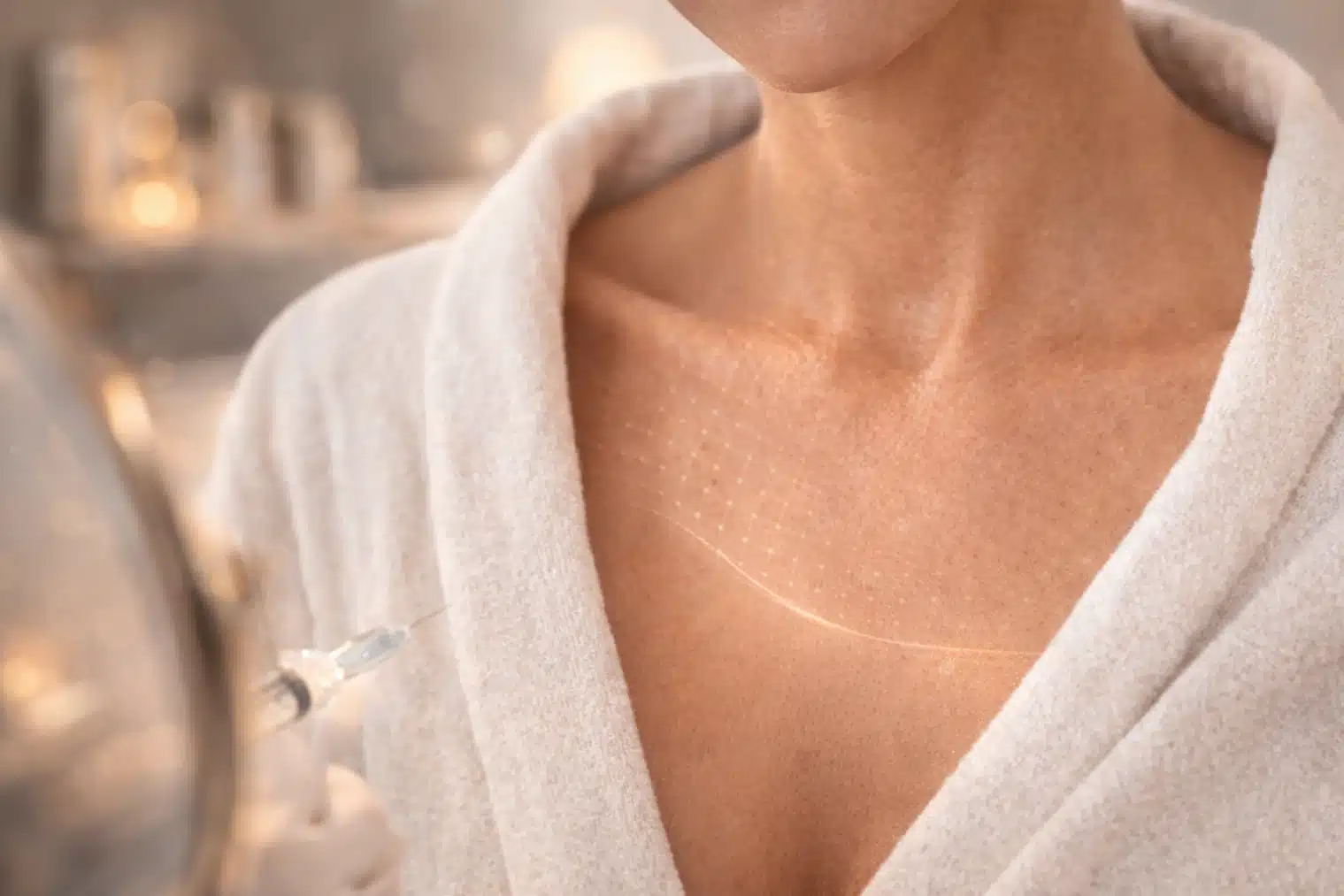
Décolletage Often Needs a Different Treatment Mindset
A Simple Way to Judge Whether the Plan Makes Sense
Patients often do better when they review the plan through three lenses: target, timeline, and tradeoffs. The target is the exact feature the treatment is supposed to improve first, such as fine wrinkling or overall texture. The timeline is whether the expected change should appear gradually over weeks rather than immediately. The tradeoffs include visible recovery, off-label context, and the possibility that one treatment may improve part of the chest’s appearance without correcting everything at once.
That framework helps strip away vague promises. It also reduces the chance of comparing a chest treatment to a cheek-filler result, which the published literature does not support. When those three lenses stay clear, patients can have a much more useful consultation and a much fairer expectation of what success looks like.
3 Practical Tips
- Take clear before photos in the same lighting, angle, and posture before deciding whether any chest treatment helped. The décolletage can look very different under bathroom lights, outdoor sun, and soft indoor light, so casual mirror checks often create confusion. Consistent photos give people a fairer way to judge whether lines softened or the texture simply looked different on a better day.
- Ask what the treatment is meant to improve before focusing on the product name. Some people want smoother skin, others want softer vertical lines, and others mainly want the chest to match a well-maintained face. That simple question can prevent disappointment because it shifts the conversation from hype to outcome.
- Treat sun protection as part of the plan rather than an optional extra. The available studies support injectables as one part of chest rejuvenation, but they do not suggest that treatment can outrun daily UV exposure. Readers who ignore sun protection often end up trying to fix new damage while paying to improve old damage.
A Better Fit Starts With the Right Question
The most useful consultation does not start with a product name. It starts by identifying whether the chest concern comes mostly from fine wrinkling, deeper folding, crepey texture, visible sun damage, or a mixed pattern.
- The chest looks older than the face after years of sun exposure, even when facial skin appears well maintained.
- Vertical lines show most in certain necklines, side-sleeping positions, or bright overhead lighting.
- The main concern is subtle texture and creping rather than heavy laxity or extensive pigmentation.
A measured plan should define the target, recovery expectations, and whether complementary skin care may improve the final result.
FAQ
Do injectables actually help chest wrinkles?
Current published evidence says they can help some people, especially when the concern involves fine wrinkling and skin quality rather than severe laxity. The best direct study so far found meaningful improvement with diluted CaHA, and published PLLA data also support benefit in photodamaged décolletage skin. That said, the field still needs more high-quality studies, so “help” is a better word than “guarantee.”
Is this already a standard injectable category like cheeks or lips?
Not in the same way. Reviews show that chest rejuvenation has become a recognized non-facial treatment area, but FDA approvals for fillers remain tied to specific anatomic locations, and currently approved uses focus on areas such as the face and hands rather than the chest. The category is real and growing, yet it still sits in an emerging stage rather than a fully standardized one.
Will the chest look puffy or overfilled afterward?
That should not be the goal when treatment is planned responsibly. The better-supported approaches in this topic focus more on skin quality and softening lines than on adding obvious bulk. Readers should still ask what kind of visual change to expect, because the chest is not an area where a “more filler equals better result” mindset makes sense.
How long does it take to notice a change?
The best answer depends on the product and the treatment plan, but current evidence suggests that change may build over time rather than appear instantly. The 2024 CaHA study assessed outcomes sixteen weeks after the last treatment, which reflects a slower improvement pattern than many people expect from facial filler conversations. Patience matters more in this area because texture and skin quality often improve gradually.
Related FOY Reading for Skin Texture and Chest Aging
Chest wrinkles often overlap with broader skin-quality concerns, so the next step may involve prevention, barrier support, and non-facial rejuvenation planning. These FOY resources offer additional context on medical-grade skincare and red light therapy.
Medical review: Reviewed by Dr. Keith Lafferty MD, Fort Myers on May 7, 2026. Fact-checked against government and academic sources; see in-text citations. This page follows our Medical Review & Sourcing Policy and undergoes updates at least every six months.
