

Beyond Hot Flashes: The Surprising Role of Bazedoxifene-CE in Muscle Preservation After Menopause
Muscle changes after menopause deserve a broader plan than symptom relief alone
- Hot flash control and bone support matter, but lean-mass decline often calls for a more complete hormone conversation.
- Women noticing weakness, slower recovery, or changing body composition may need labs, timing review, and a clearer treatment fit.
- The strongest path usually combines hormone strategy with resistance training, protein intake, and follow-up tracking.
Review postmenopausal muscle concerns through a hormone-informed lens
If muscle loss, fatigue, and body-composition changes are becoming harder to ignore, our Women’s Hormone Replacement Therapy service can help you assess whether symptom relief, metabolic support, and long-term hormone planning are aligned.
Helpful next reads for the bigger menopause picture
These pages can help connect muscle preservation questions with the broader issues that often shape midlife hormone decisions.
Why Muscle Health Matters After Menopause
Muscle loss during menopause often goes unnoticed until fatigue, balance issues, or weakness set in. While weight may remain constant, lean tissue quietly shrinks, changing body composition in ways that diet alone can’t reverse. Hormone fluctuations, especially declining estrogen, accelerate these shifts and reduce muscle repair efficiency—a common issue addressed by women’s hormone replacement therapy. More women are asking whether hormone replacement therapy (HRT) can help defend against this decline. At Fountain of Youth SWFL, our team closely monitors emerging therapies like Duavee to offer clarity and evidence-based guidance.
Understanding Duavee: A Unique Tissue-Selective Hormone Therapy
Duavee pairs conjugated estrogens with bazedoxifene, a selective estrogen receptor modulator (SERM), creating a compound with highly specific tissue actions. Unlike standard estrogen therapies that can overstimulate breast and uterine tissues, Duavee uses bazedoxifene to block those risks while allowing estrogenic support where it’s needed most. The FDA approved this therapy for two clear uses: relief of hot flashes and prevention of postmenopausal osteoporosis, but unlike testosterone replacement, its muscle effects are less understood. This targeted approach appeals to women seeking symptom relief without full systemic hormone exposure. The unique blend creates potential for secondary benefits that extend beyond bones and vasomotor symptoms.
Muscle Loss in Midlife Women: The Silent Factor Behind Fatigue and Frailty
By the time women reach their mid-50s, they may have already lost 10–15% of their muscle mass. This silent erosion contributes to fatigue, reduced coordination, and increased injury risk. Unlike visible weight gain, muscle decline hides beneath the surface and isn’t easily measured without body composition testing. Estrogen plays a key role in muscle repair and protein synthesis, making its loss a prime contributor to sarcopenia. Clinicians increasingly recommend hormone evaluations for women reporting early physical decline, especially when paired with sedentary lifestyles. If weight gain accompanies muscle loss, a medical weight loss program may help target fat without sacrificing lean tissue.
What Research Says: Does Duavee Impact Muscle Composition?
Despite its widespread use, Duavee hasn’t been directly studied for muscle preservation. Clinical trials have focused on bone density improvements and menopausal symptom relief, leaving muscle-related outcomes unexplored. In a 2025 pilot study, researchers tracked mood outcomes rather than lean tissue changes, offering no new insight into muscle effects. Preclinical animal studies suggest bazedoxifene may exert mild influence on certain muscle groups but fall short of promoting growth (Sciencedirect). Until targeted human trials exist, Duavee’s potential impact on muscle remains largely speculative. That’s why we stay alert to any clinical updates that may shift current understanding.
Estrogen’s Influence on Skeletal Muscle: What We Know So Far
Muscle cells respond to estrogen through specific receptors that support repair, glucose handling, and energy metabolism. Studies involving estradiol-based HRT have shown promising effects on muscle function, particularly in the early years post-menopause (JAMA Network). Improvements in strength and reduced fat infiltration point to a protective mechanism rooted in hormonal balance. These findings highlight estrogen’s potential as a modulator of muscle integrity. However, Duavee’s specific formulation hasn’t been included in these trials, meaning benefits seen with other HRT types can’t automatically be assumed here.
Why Bazedoxifene Might Not Deliver Muscle Benefits Alone
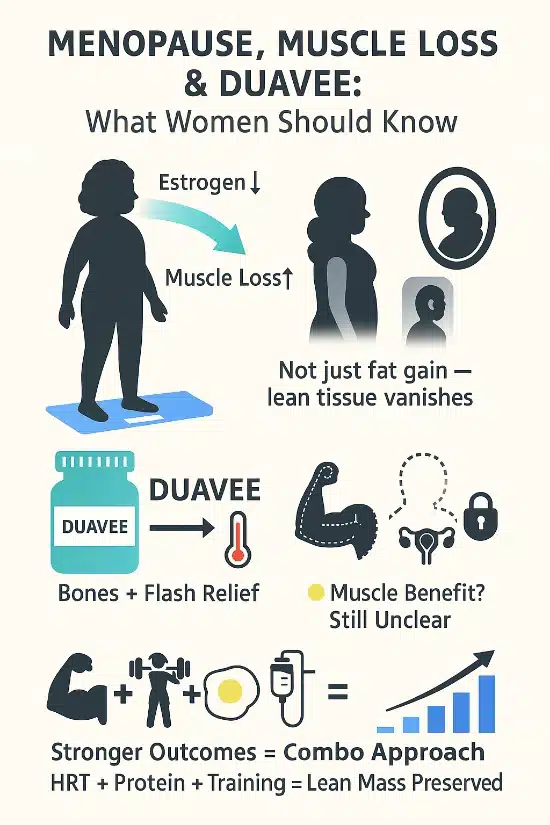
Estrogen loss during menopause accelerates muscle decline. Duavee supports bones and hot flash relief, but lean mass requires more—training, protein, and synergy.
Bazedoxifene acts as an estrogen blocker in some tissues, which may limit its usefulness in supporting skeletal muscle. While helpful in reducing cancer risk, this selective blocking could also mute the anabolic potential needed for true muscle growth. SERMs generally provide structural preservation rather than stimulating new tissue formation. In Duavee’s case, that might translate to stability, not improvement. Without additional interventions like exercise or nutritional support, its muscle-related influence could be minimal (Taylor & Francis).
Potential Synergies: Can Duavee Work Alongside Exercise or Other Interventions?
Resistance training offers a proven path to maintaining muscle mass during menopause and could complement the protective aspects of Duavee. Hormonal support may enhance recovery, enabling women to train more consistently and with better results. Pairing this therapy with post-exercise protein intake or strategic supplementation might amplify the benefits. Some researchers are beginning to explore multi-factor approaches that combine hormone therapy with fitness, vitamin injections, and nutrition. If you’re wondering whether this could work for you, call 239-355-3294 to speak with a member of our team.
When therapy, training, and recovery need to work together
If you are trying to protect lean mass while managing menopausal symptoms, a tailored conversation through our Women’s Hormone Replacement Therapy service can help clarify whether a medication like Duavee belongs inside a wider muscle-support strategy.
Future Research Directions: What We Need to Know Before Making Claims
Upcoming studies are expected to include muscle-specific outcomes like grip strength and DEXA-scanned lean mass. Trial designs are also shifting toward measuring physical function, such as walking speed and endurance, alongside hormonal markers. Researchers are exploring whether timing plays a role—such as whether starting Duavee within five years of menopause delivers better physical results. Funding is now moving toward these types of targeted outcomes, creating space for a clearer understanding of Duavee’s full impact. At Fountain of Youth SWFL, we track these trials closely to help patients make informed decisions (Frontiers in Endocrinology).
Below is a snapshot of ongoing and recent clinical trials examining Duavee (bazedoxifene + conjugated estrogens), highlighting their design focus, population, and endpoints. This overview helps you see at-a-glance where research is headed regarding muscle, metabolism, and other outcomes.
| Study Name / Identifier | Population | Endpoint(s) | Status / Timeline |
|---|---|---|---|
| NCT02237079 (ClinicalTrials.gov) | Postmenopausal women (TSEC users) | Lean mass & fat composition (via DXA) | Active / recruiting |
| SMART-2 Trial (Phase III) | Women with moderate-severe hot flashes | Vasomotor symptoms & BMD | Completed |
| Phase IIB UCSF (NCT04821141) | Peri- and postmenopausal women | Breast biomarkers & imaging | Completed / reporting soon |
| High-throughput SERM Screen (2025 Study) | Muscular dystrophy model (preclinical) | Muscle-related molecular effects | Published 2025 |
Who should bring this topic into a menopause visit?
This discussion becomes more relevant when muscle changes are showing up in everyday life rather than only on paper.
- Women in postmenopause who feel weaker, recover more slowly, or notice a steady decline in lean tone despite stable weight.
- Women already considering hormone therapy who want to understand what Duavee may help with, and what it likely will not do alone.
- Women pairing menopause care with strength training, protein targets, or body-composition monitoring and wanting a more coordinated plan.
A useful next step is deciding whether the goal is symptom control, muscle support, or both.
When the next step is medication review, lab discussion, or hormone-planning follow-up, TeleHealth can offer a practical way to continue the conversation.
FAQ: Duavee and Muscle Mass Preservation
Is there any clinical trial specifically testing Duavee for muscle mass retention?
No trials currently measure muscle retention as a primary endpoint in Duavee users. However, future studies may include this focus as clinical interest grows.
Can Duavee be safely combined with protein or creatine supplements?
Yes, most patients can safely take protein or creatine while on Duavee. It’s best to check with your provider to personalize your approach.
Are there differences in muscle-related outcomes between Duavee and bioidentical HRT?
Research on direct comparisons is limited. Each therapy works differently, so outcomes depend on formulation, timing, and lifestyle.
Does taking Duavee increase energy or reduce fatigue in aging women?
Some women feel more energetic once menopausal symptoms ease, but energy levels depend on sleep, diet, and physical activity too.
Explore the decisions around longer-term hormone support
If this article raised bigger questions about timing, personalization, or how menopause care changes over time, these two pages are a strong place to continue.
5 Practical Tips for Supporting Muscle Health During Hormone Therapy
- Start a strength-focused routine using free weights or resistance bands twice per week.
- Choose complete protein sources like lean meats, dairy, or tofu to fuel muscle repair.
- Schedule periodic DEXA scans or body composition tests to track changes you may not feel immediately.
- Stay consistent with training even if early progress feels slow—results build over time.
- For those incorporating strength workouts, performance IV therapy may support energy and muscle recovery when used under professional guidance.
For extra support, give us a call at 239-355-3294 and ask how our team can tailor your program.
Reframing Expectations: Duavee’s Strengths and Where It Falls Short
Duavee excels in supporting bone health and reducing hot flashes without overstimulating risky tissues. When it comes to muscle mass, its benefits remain uncertain and require more focused research. That doesn’t mean it lacks value—it simply plays a role best understood as part of a broader strategy. At Fountain of Youth SWFL, we help patients pair therapy with movement, nutrition, and tracking to create measurable, sustainable results. Knowing what a therapy can and can’t do is key to making empowered, personalized decisions (MDPI).
Medical review: Reviewed by Dr. Keith Lafferty MD, Fort Myers on August 12, 2025. Fact-checked against government and academic sources; see in-text citations. This page follows our Medical Review & Sourcing Policy and undergoes updates at least every six months.
