

When bone health, metabolism, and menopause start intersecting
- See how emerging senolytic ideas compare with established menopause care.
- Understand where biomarkers, bone risk, and inflammatory burden may change the conversation.
- Sort out a practical next step when symptoms, long-range aging concerns, and metabolic changes overlap.
Bring the bigger menopause picture into focus
For women weighing emerging longevity therapies alongside established care, our Women’s Hormone Replacement Therapy service helps frame symptoms, labs, bone-risk factors, and whether a broader treatment plan makes more sense than chasing a single headline therapy.
A few useful places to keep reading
Some women need a clearer view of how hormones connect with weight, insulin patterns, and day-to-day function. These pages on HRT and metabolic therapy and personalized HRT plans can make that decision path easier to read.
The Rise of Senolytics in Women’s Health
Menopause shifts bone turnover and metabolic regulation toward fragility and weight gain. Growing evidence from aging studies blames accumulating senescent “zombie” cells for inflammatory damage. A National Institute on Aging study highlighted senolytics’ subtle yet promising skeletal impact. Researchers explore drugs that remove these dysfunctional cells as an innovative alternative to hormone replacement. The paradigm targets upstream cellular aging rather than supplementing estrogen alone. Women increasingly ask clinics for proactive strategies that go beyond calcium and exercise.
Understanding Dasatinib + Quercetin: What Makes This Pair Unique
Scientists paired dasatinib, a tyrosine-kinase inhibitor, with quercetin, a flavonoid antioxidant, after observing complementary senolytic activity. Dasatinib disrupts survival signals inside senescent cells, while quercetin impairs anti-apoptotic pathways those cells over-express. Combining both agents enhances clearance while limiting dasatinib’s dose and related side effects. Intermittent three-day bursts rather than daily dosing minimize drug exposure yet maintain efficacy. Early safety studies in elderly volunteers reported mild fatigue and transient nausea, supporting continued advancement. The duo remains the most clinically studied senolytic regimen to date.
The Phase 2 Clinical Trial: Design, Demographics, and Delivery
Investigators enrolled sixty post-menopausal women aged sixty-two to eighty-eight in a double-blind trial. Participants took dasatinib two milligrams per kilogram plus one-gram quercetin daily for three consecutive days each month. The ClinicalTrials.gov record lists endpoints tracking bone markers and wrist density. Researchers chose intermittent dosing to test whether short pulses could trigger lasting skeletal benefits. Peer reviewers in Nature Medicine praised the design and clinical relevance.
Who Benefits Most: The Role of Senescent Cell Burden
Trial tolerance looked strong, yet improvements clustered in women with high p16INK4a expression. Responders posted thirty-four percent P1NP jumps and eleven percent CTx drops within two weeks. Wrist bone-mineral density rose 2.7 percent after twenty weeks. A Mayo Clinic analysis emphasized this burden-dependent benefit pattern. Biomarker work in Aging Cell supports using blood p16 assays to guide candidate selection.
Beyond the Bones: Metabolic Health and Inflammatory Markers
Laboratory data revealed declining IL-6 and TNF-α levels within the high-responder group. Improved inflammatory tone correlated with modest fasting-glucose reductions and better insulin sensitivity scores. Animal research supports the shifts, showing improved glucose tolerance after dasatinib plus quercetin in ovariectomized rats. Researchers hypothesize that clearing senescent adipocytes reduces cytokine spillover and systemic lipotoxicity. High-risk patients might pair D+Q with structured metabolic health support.
A promising mechanism still needs real-world context
When menopause has also brought central weight gain, insulin concerns, or stubborn inflammation into the picture, our Medical Weight Loss program can ground that discussion in labs, body composition, and realistic follow-up rather than theory alone.

Integrating Senolytics into Post-Menopausal Protocols
Integrating Senolytics into Post-Menopausal Protocols
Providers now ask whether D+Q should replace or augment established osteoporosis therapies. Fountain of Youth SWFL teams combine senolytic bursts with nutrition coaching and rejuvenation therapies for holistic care. They schedule dosing cycles around bone-density scans and inflammatory lab panels for dynamic monitoring.
Some women continue low-dose estrogen for vasomotor relief while receiving monthly D+Q pulses. Education also emphasizes adherence to calcium, vitamin D intake, and resistance training for comprehensive bone preservation.
Safety and Monitoring Considerations
Investigators reported no serious adverse events across Phase 2 participants. Clinicians measure liver enzymes, platelet counts, and blood pressure before each dosing cycle to maintain vigilance. Our team at Fountain of Youth SWFL offers in-house phlebotomy and same-day telehealth reviews to streamline these checks. Women discuss any fatigue or nausea promptly, allowing dose adjustments or supportive care. Some women also boost energy levels with nutrient IV drips during recovery periods. Providers encourage hydration and light activity during dosing days to ease tolerability. Long-term registries will track fracture rates and cardiovascular markers as senolytic usage expands.
Senolytics vs. Traditional Osteoporosis Therapies
Bisphosphonates inhibit bone-resorbing osteoclasts, while SERMs mimic estrogen at skeletal receptors. Senolytics operate upstream, removing cells that drive imbalanced remodeling and systemic inflammation. Bisphosphonates improve spine and hip density but may stunt microdamage repair over time. Senolytics spark new bone formation without hampering turnover, offering a fresh mechanism for resistant cases. However, hormone therapy still remains the gold standard for vasomotor symptom control.
Comparing Core Therapies in Post-Menopausal Care
This chart outlines the primary differences in how senolytics, hormone therapy, and bisphosphonates support post-menopausal health. It highlights mechanisms, use patterns, and ideal candidates for each.
| Therapy Type | Primary Mechanism | Use Frequency | Best for Patients Who… |
|---|---|---|---|
| Senolytic Therapy (D+Q) | Clears senescent cells that drive inflammation and aging | Intermittent (monthly or every few months) | Have high senescence burden and don’t tolerate hormones |
| Hormone Therapy (HRT) | Replaces declining estrogen and progesterone levels | Daily, often long-term | Have vasomotor symptoms and low fracture risk |
| Bisphosphonates | Inhibits bone resorption by blocking osteoclasts | Weekly, monthly, or yearly (depending on formulation) | Are at high risk for fractures or bone loss progression |
| SERMs (e.g. raloxifene) | Mimics estrogen in bone but blocks it in other tissues | Daily oral tablet | Want bone protection but need to avoid systemic estrogen |
A Look Ahead: The Phase 3 Roadmap
Researchers secured funding for a three-hundred patient fracture-outcome study slated to begin early 2026. The protocol extends follow-up to thirty-six months, capturing vertebral and non-vertebral fracture incidents. Secondary endpoints include vasomotor scores, insulin sensitivity, and quality-of-life surveys. Investigators will stratify participants by senescent burden to validate biomarker-driven precision therapy. Success could fast-track regulatory review and position senolytics as a mainstream option within five years. Stakeholders across endocrinology and geriatrics eagerly await enrollment milestones.
This becomes a more relevant conversation when…
Not every reader of a senolytics article needs to act on it. The topic becomes more useful when menopause-related changes are no longer abstract and the next decision needs a clinical frame.
- You are post-menopausal and concerns about osteopenia, bone loss, or long-term resilience are starting to shape care decisions.
- Hot flashes, sleep disruption, body-composition changes, or slower recovery now seem connected rather than separate issues.
- You are interested in senolytics because of new research, but want a physician-reviewed discussion of biomarkers, medication history, monitoring, and what remains investigational.
A careful review helps separate broad interest in longevity medicine from a next step that actually fits your health picture.
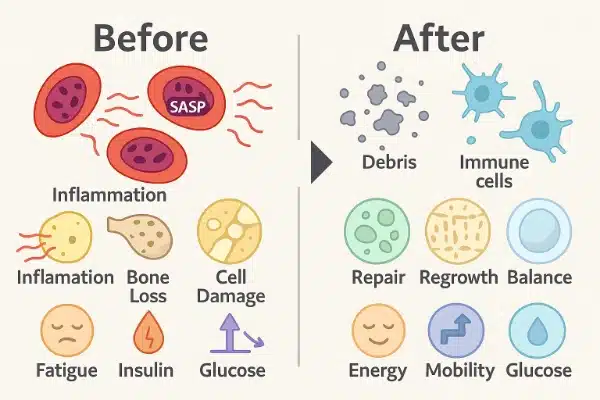
This infographic shows how clearing senescent cells through senolytic therapy may reduce inflammation and support energy, glucose balance, and bone regrowth.
FAQ: What Women Should Know About Senolytic Therapy
How does senolytic therapy differ from hormone therapy for menopause?
Hormone therapy supplements declining estrogen to relieve symptoms, while senolytics remove harmful senescent cells. These distinct mechanisms can work together in personalized care plans.
Is dasatinib + quercetin something I can ask my doctor about now?
Doctors may discuss access through clinical trials or compassionate-use programs. Formal approval will depend on forthcoming Phase 3 fracture data.
What biomarkers determine if I might benefit from this therapy?
High p16INK4a expression or elevated SASP cytokines suggest stronger potential response. Specialized labs offer these assays for targeted patient selection.
Are there lifestyle changes that can support cellular rejuvenation naturally?
Regular resistance exercise, nutrient-dense diets, and consistent sleep routines reduce oxidative stress and senescent-cell accumulation. These habits enhance pharmaceutical strategies.
Related paths to explore next
Some readers need stronger recovery and resilience support, while others need a clearer testing conversation before deciding what belongs in their plan. You can explore Rejuvenation and Healing or Micronutrient Testing to see which direction fits more naturally.
3 Practical Tips for Post-Menopausal Women Considering Senolytics
- Request a senescent-cell biomarker panel before starting therapy to gauge potential benefit accurately.
- Plan intermittent dosing cycles in coordination with bone-density assessments to track early skeletal changes.
- Maintain weight-bearing exercise and balanced nutrition to strengthen bones while senolytics address cellular aging.
Why Senolytic Therapy Deserves a Seat at the Table
Clearing senescent cells shifts menopause care toward true rejuvenation rather than replacement. Dasatinib plus quercetin already shows selective benefits in women with high senescence markers. Future fracture-outcome data may elevate senolytics to frontline status for bone and metabolic health. Patients deserve options that honor individual biology, and senolytics embody that personalized philosophy. As science advances, informed women and proactive clinicians will drive this promising field forward.
Medical review: Reviewed by Dr. Keith Lafferty MD, Fort Myers on July 26, 2025. Fact-checked against government and academic sources; see in-text citations. This page follows our Medical Review & Sourcing Policy and undergoes updates at least every six months.
