
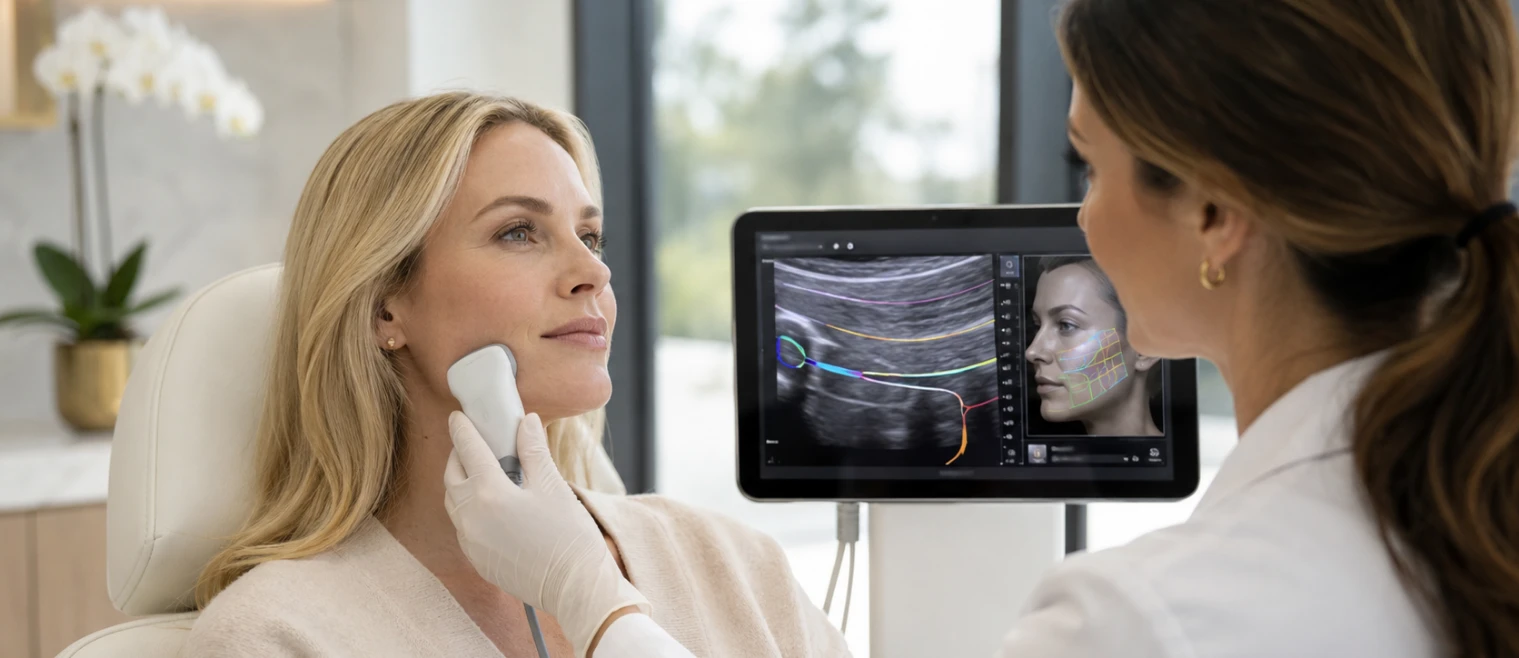
A patient who has had injectables before may not always know what still sits beneath the skin. The face may look fuller in one area, flatter in another, or different after aging and weight change. Old treatment records may no longer exist, and memory rarely captures product names, injection depth, or exact placement. Ultrasound-guided filler mapping has entered the conversation because it can sometimes help trained clinicians see information that the mirror cannot show.
At Fountain of Youth in Fort Myers, Florida, staff stays current on developments in injectable safety, including the growing discussion around ultrasound-guided filler assessment. That does not mean every patient needs imaging before treatment. It means patients with older injectable product, unclear contour changes, or revision concerns now have a better question to ask before anyone adds more volume.
Before Adding More Volume, Clarify the Starting Point
- Prior filler, facial weight loss, swelling, and tissue laxity can create similar surface changes.
- Older treatment records, product names, and placement depth may affect the safest next step.
- A careful injectable visit should decide whether volume, dissolving, waiting, or reassessment fits best.
Plan Injectables Around What Is Already There
When old product or unclear contour changes affect the decision, a measured injectable treatment consultation can help separate what looks depleted from what may already contain filler.
Physician-reviewed content • Evidence-aware care • Personalized treatment planning
Product History Still Matters
Patients who previously chose Juvéderm filler or Restylane treatment may need a different conversation when records are missing, facial balance has changed, or revision questions enter the plan.
Why More Injectable Patients Are Asking What Is Still Under the Skin
Many patients do not walk into an injectable consultation with a technical question. They ask why the under-eye area looks puffy, why the cheek looks different after weight loss, or why a lip border changed after years of small touch-ups. Those concerns matter because visible shape does not always reveal the cause. A face can look hollow from volume loss, heavy from old product, uneven from swelling, or simply different because tissue support changed over time. A careful plan starts by separating those possibilities before choosing a syringe.
Lee County patients also compare many aesthetic options across injectables, skin treatments, and medical weight-loss support. That broader mix can make facial changes harder to interpret. A patient who lost facial fullness may assume filler alone will restore balance, but added volume can look wrong if previous product already affects the area. The better first step asks what is present now.
What Ultrasound-Guided Filler Mapping Means in Plain English
Filler mapping means using ultrasound to look below the skin before deciding how, where, or whether to inject. High-frequency ultrasound can show facial layers, and Doppler ultrasound can help identify blood-flow patterns. A 2026 review of aesthetic ultrasound described ultrasound as useful before, during, and after injectable procedures, including vascular mapping, filler placement assessment, complication diagnosis, and treatment planning. The scan does not create a perfect facial roadmap, but it may reduce uncertainty when prior filler or anatomy matters. The provider still needs strong anatomy knowledge, conservative technique, and sound medical judgment.
Why a regular mirror check cannot answer every filler question
A mirror shows shape, shadow, movement, and balance. It does not show whether fullness comes from old filler, normal tissue, swelling, or another issue. Ultrasound may help connect the visible concern with what sits beneath the skin. That distinction matters most when the patient wants more volume in an area that may already contain product.
Old Filler, Migration Worries, and the “Do I Need More?” Problem
Patients often interpret new facial changes as a need for more volume. In some cases, the better question is whether previous product still contributes to the current contour. Migration remains a reported filler concern, but it does not explain every fullness change. A thoughtful revision visit should not rely only on surface appearance when the history feels unclear.
A real-world example might involve a patient who had cheek treatment years ago and now notices heaviness near the lower eyelid. Another patient may see a lip border look less crisp after repeated small touch-ups. Someone else may feel a firm area but cannot remember whether anyone injected that exact spot. A 2024 ultrasound-based study reported that filler placed near the lateral cheek could redistribute toward the temple in layer-dependent patterns, which shows why location and depth can matter.
Revision Questions Need More Than a Surface Check
When older cheek, lip, or under-eye filler complicates the next decision, a conservative medical aesthetics visit can help connect the visible concern with treatment history, facial anatomy, and timing.
Weight Loss Can Change the Filler Conversation
After meaningful weight loss, some patients notice facial changes that feel sudden even when the process developed gradually. The temples, cheeks, or lower face may look less supported, while another area may still look full from previous treatment. That shift can make older filler more noticeable, even when the filler did not suddenly move. Weight loss alone does not prove filler migration. It can change the visual balance around prior aesthetic work.
This situation creates a common consultation trap. A patient may ask for more volume because one area looks depleted. The provider may need to consider whether another area still carries previous product, whether skin laxity plays a role, or whether another approach fits better. Ultrasound may help answer part of that puzzle when visible assessment and treatment history do not line up.
The Safety Layer: Why Blood Vessels Matter
The most serious injectable safety conversations often involve blood vessels. The FDA warns that unintended injection into a blood vessel can block blood flow and may cause serious complications, including tissue injury, vision problems, blindness, or stroke, and it also lists migration among rare reported risks with dermal fillers. These events remain uncommon, but the severity makes planning important. Doppler ultrasound can help locate blood-flow patterns, especially when a provider wants more anatomical information before treating a sensitive area. Facial vessels also vary between patients, so a textbook diagram cannot describe every person’s exact vessel path.
That safety discussion gives patients a practical takeaway. Ultrasound works best as part of a broader safety mindset, not as a standalone promise. The injector still needs to know when not to treat. A scan can add information, but judgment decides what happens next.
Ultrasound adds visibility, not a guarantee
Ultrasound can add useful information, especially when older product, uncertain anatomy, or a higher-risk area changes the decision. It cannot make the procedure risk-free. A responsible consultation should explain whether imaging would actually change the plan that day.
When Lee County Patients Should Reasonably Ask About Ultrasound
A patient does not need to turn every injectable visit into an imaging appointment. The question becomes more reasonable when the patient had prior treatment from another provider, does not know the product name, lacks records, or worries that product may have shifted. It also makes sense to ask when lumps, swelling, asymmetry, or revision planning affect the next step. Higher-risk areas deserve careful planning, and some patients feel more confident when the provider can explain whether imaging adds value. A patient who has lost significant facial volume may also need reassessment before adding more volume.
The best question is simple: would ultrasound change where, how, or whether treatment happens today?
Questions? We are here to help! Call 239-355-3294.
What Ultrasound May Help With After a Filler Problem
Ultrasound can also matter after treatment when symptoms suggest a complication or when the patient notices a new concern. In 2025, RSNA reported ultrasound findings from 100 suspected filler-related vascular complication cases from May 2022 through April 2025. The report noted absent flow to perforator vessels in 42% of cases and absent flow in major arteries in 35% of cases. Those findings show why a clinician may use imaging to locate a problem more precisely instead of guessing from the surface.
Patients should not try to diagnose a vascular problem at home. Unusual pain, skin color change, vision symptoms, or rapidly worsening swelling need urgent professional evaluation. Photos and online comparisons cannot replace a medical assessment when symptoms move quickly.
When a Mapping Conversation Makes Sense
Not every filler visit needs imaging, but some consultations deserve a slower review before another syringe enters the plan. The decision usually depends on prior treatment history, current symptoms, facial balance, and whether added information would change the approach.
- Previous filler came from another provider, and product name, placement, or timing remains unclear.
- Fullness, puffiness, firmness, or asymmetry appears in an area that received older treatment.
- Recent weight loss changed facial proportions, making old volume harder to judge from the surface.
The safest next step may involve observation, treatment, revision discussion, or no same-day injection at all.
FAQ: Ultrasound-Guided Filler Mapping in Lee County
Does ultrasound make dermal filler completely safe?
No. Ultrasound may add useful visibility in selected cases, but it cannot remove every treatment risk. Product choice, injection technique, anatomy knowledge, dose, patient history, and emergency readiness still matter. A careful provider should explain what ultrasound can and cannot change before treatment.
Can ultrasound show whether old filler is still there?
Ultrasound can often help identify certain product deposits, especially when the clinician uses appropriate equipment and understands facial ultrasound anatomy. Results can vary by product type, depth, timing, and tissue conditions. The scan matters most when old product could change the next treatment decision. A patient with unknown filler history may benefit from that extra information before adding volume.
Should I ask for ultrasound before every filler appointment?
Not necessarily. A straightforward treatment with clear history and low complexity may not need imaging. The question becomes more useful when previous product, asymmetry, migration concern, revision planning, or a sensitive treatment area enters the discussion. A good consultation should explain whether ultrasound would change the plan rather than treating it as a routine extra.
Can ultrasound help if I think my filler moved?
It may help clarify whether product appears outside the expected area. Migration remains a reported issue, but a visible change can also come from aging, swelling, weight change, or tissue laxity. Photos alone cannot reliably prove what caused the change. Clinical evaluation gives the patient a safer path than guessing based on appearance.
Related Aesthetic Planning Paths
Filler mapping questions often overlap with broader facial planning, especially when expression lines, skin quality, and volume changes all influence the final result. These related pages may help patients frame the right consultation question before treatment.
What a Careful Injectable Consultation Should Cover
A careful injectable consultation should start with the concern, not the product. The provider should ask what changed, when the patient noticed it, what previous treatments occurred, and whether records or old photos exist. The plan should address whether adding filler makes sense, whether waiting fits better, or whether dissolving requires discussion when hyaluronic acid product creates a concern. Patients should also hear which warning signs matter after treatment. That conversation helps the patient understand the reasoning before any procedure begins.
What to bring if you are worried about old product
Old records can make a major difference, even when they look minor. Product names, treatment dates, treated areas, before-and-after photos, and any dissolving history help narrow the decision. Patients should also mention recent weight changes, swelling episodes, delayed reactions, allergies, medications, and prior complications. A consultation becomes more useful when the provider does not have to reconstruct the full history from memory.
Patients in Lee County who feel unsure about previous product, facial volume changes, or revision planning can ask whether imaging, observation, dissolving, filler, or another aesthetic option fits the situation. The right answer may differ from one area of the face to another. A conservative plan may treat one concern, delay another, and avoid adding volume where old filler already affects the contour. Ultrasound-guided mapping gives certain patients one more way to reduce guesswork before choosing the next step.
Medical review: Reviewed by Dr. Keith Lafferty MD, Fort Myers on June 20, 2026. Fact-checked against government and academic sources; see in-text citations. This page follows our Medical Review & Sourcing Policy and undergoes updates at least every six months.
